


Page 945 - Hematology_ Basic Principles and Practice ( PDFDrive )
P. 945
828    Part VII  Hematologic Malignancies


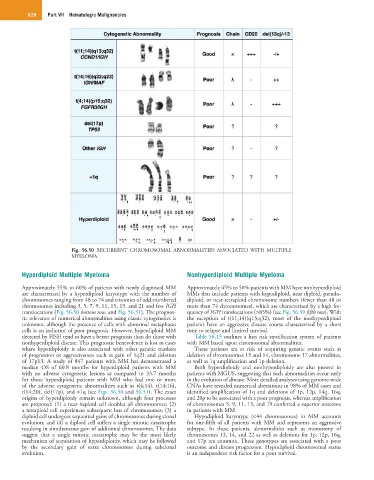
                        Fig.  56.50  RECURRENT  CHROMOSOMAL  ABNORMALITIES  ASSOCIATED WITH  MULTIPLE
                        MYELOMA.

        Hyperdiploid Multiple Myeloma                         Nonhyperdiploid Multiple Myeloma

        Approximately 55% to 60% of patients with newly diagnosed MM   Approximately 45% to 50% patients with MM have nonhyperdiploid
        are characterized by a hyperdiploid karyotype with the number of   MMs that include patients with hypodiploid, near diploid, pseudo-
        chromosomes ranging from 48 to 74 and trisomies of odd-numbered   diploid, or near-tetraploid chromosome numbers (fewer than 48 or
        chromosomes including 3, 5, 7, 9, 11, 15, 19, and 21 and few IGH   more than 74 chromosomes), which are characterized by a high fre-
        translocations (Fig. 56.50 bottom row, and Fig. 56.51). The prognos-  quency of IGH translocations (>85%) (see Fig. 56.50 fifth row). With
        tic relevance of numerical abnormalities using classic cytogenetics is   the  exception  of  t(11;14)(q13;q32),  most  of  the  nonhyperdiploid
        unknown, although the presence of cells with abnormal metaphases   patients  have  an  aggressive  disease  course  characterized  by  a  short
        cells is an indicator of poor prognosis. However, hyperdiploid MM   time to relapse and limited survival.
        detected by FISH tend to have a better prognosis than do those with   Table 56.15 outlines a lists risk stratification system of patients
        nonhyperdiploid disease. This prognostic benevolence is lost in cases   with MM based upon chromosomal abnormalities.
        where  hyperdiploidy  is  also  associated  with  other  genetic  markers   These  patients  are  at  risk  of  acquiring  genetic  events  such  as
        of progression or aggressiveness such as gain of 1q21 and deletion   deletion of chromosomes 13 and 14, chromosome 17 abnormalities,
        of  17p13.  A  study  of  847  patients  with  MM  has  demonstrated  a   as well as 1q amplification and 1p deletion.
        median  OS  of  60.8  months  for  hyperdiploid  patients  with  MM   Both  hyperdiploidy  and  nonhyperdiploidy  are  also  present  in
        with  no  adverse  cytogenetic  lesions  as  compared  to  33.7  months   patients with MGUS, suggesting that such abnormalities occur early
        for  those  hyperdiploid  patients  with  MM  who  had  one  or  more   in the evolution of disease. More detailed analyses using genome-wide
        of  the  adverse  cytogenetic  abnormalities  such  as  t(4;14),  t(14;16),   CNAs have revealed numerical aberrations in 98% of MM cases and
        t(14;20), del(17p), and +1q (see Figs. 56.50 and 56.51). The exact   identified amplification of 1q and deletions of 1p, 12p, 14q, 16q,
        origins of hyperdiploidy remain unknown, although four processes   and 20p to be associated with a poor prognosis, whereas amplification
        are proposed: (1) a near-haploid cell doubles all chromosomes; (2)   of chromosomes 5, 9, 11, 15, and 19 conferred a superior outcome
        a tetraploid cell experiences subsequent loss of chromosomes; (3) a   in patients with MM.
        diploid cell undergoes sequential gains of chromosomes during clonal   Hypodiploid  karyotype  (<44  chromosomes)  in  MM  accounts
        evolution; and (4) a diploid cell suffers a single mitotic catastrophe   for one-fifth of all patients with MM and represents an aggressive
        resulting in simultaneous gain of additional chromosomes. The data   subtype.  In  these  patients,  abnormalities  such  as  monosomy  of
        suggest  that  a  single  mitotic  catastrophe  may  be  the  most  likely   chromosomes 13, 14, and 22 as well as deletions for 1p, 12p, 16q,
        mechanism of acquisition of hyperdiploidy, which may be followed   and 17p are common. These genotypes are associated with a poor
        by  the  secondary  gain  of  extra  chromosomes  during  subclonal     outcome and disease progression. Hypodiploid chromosomal status
        evolution.                                            is an independent risk factor for a poor survival.

