


Page 944 - Hematology_ Basic Principles and Practice ( PDFDrive )
P. 944
Chapter 56  Conventional and Molecular Cytogenomic Basis of Hematologic Malignancies  827


            mutations followed by clonal evolution proceeding with TP53 and   MULTIPLE MYELOMA
            BIRC3 genomic lesions. The second evolutionary pathways involves
            del(13q) and proceeds towards acquisition of SF3B1 mutations and   MM is a malignancy of terminally differentiated B cells (see Chapter
            BIRC3  abnormalities.  These  molecular  events  confirmed  earlier   86). MM plasma cells have a very low proliferation rate, a character-
            cytogenetic observations, that trisomy 12 coexists with 13q rearrange-  istic that has limited the field of cytogenetic studies. Conventional
            ments in rare patients. Recent integration of cytogenetic and muta-  karyotyping reveals chromosomal abnormalities in 25% to 30% of
            tion studies in 637 patients with newly diagnosed CLL consistently   newly diagnosed patients, especially in cases with an exceptionally
            showed  that  patients  with  TP53  or  BIRC3  lesions  had  a  worse   high plasma cell proliferative rate. Karyotypes obtained from these
            prognosis,  followed  by  patients  with  mutations  in  SFRB1  and   cells usually are complex and exhibit more than 20 aberrations in
            NOTCH1 and del(11q). The presence of a minor subclone composed   approximately 10% of cases.
            of as little as 2% of the tumor cells within a population in early CLL   When  reassessed  by  FISH,  CGH,  and  multicolor  karyotyping
            predated its emergence as a dominant subclone at relapse and the   using a large panel of centromere-specific and translocation-specific
            development of a chemoresistant phenotype.            probes, interphase plasma cell nuclei have been shown to be charac-
                                                                  terized by chromosomal aneuploidy in almost all patients with MM
                                                                  or  monoclonal  gammopathy  of  unknown  significance  (MGUS).
            Richter Syndrome                                      Array CGH indicates that 100% of patients with newly diagnosed
                                                                  MM have copy number alterations and frequent homozygous dele-
            Approximately 15% of patients with CLL transform eventually to   tions of genes including TRAF3, BIRC1/BIRC2, RB1 and CDKN2C.
            Richter  syndrome  (RS),  a  highly  aggressive  phase  of  CLL,  which   Even during CR, after therapy, 12% to 71% of plasma cells still have
            morphologically  mimics  diffuse  large  B-cell  lymphoma  (DLBCL)   numerical gain or loss of chromosomes 3, 7, 8, 9, 11, 13, 15, 21,
            and  frequently  has  a  dismal  outcome.  RS  is  characterized  by  a   and X.
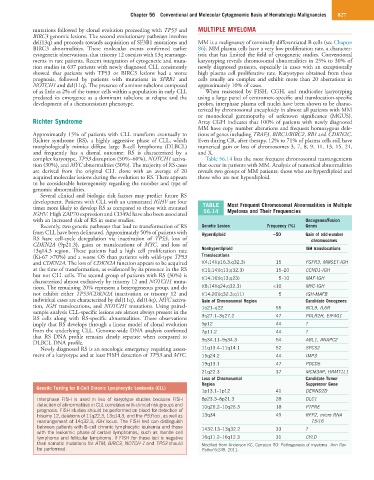
            complex karyotype, TP53 disruption (50%–60%), NOTCH1 activa-  Table 56.14 lists the most frequent chromosomal rearrangements
            tion (30%), and MYC abnormalities (30%). The majority of RS cases   that occur in patients with MM. Analysis of numerical abnormalities
            are  derived  from  the  original  CLL  clone  with  an  average  of  20   reveals two groups of MM patients: those who are hyperdiploid and
            acquired molecular lesions during the evolution to RS. There appears   those who are not hyperdiploid.
            to be considerable heterogeneity regarding the number and type of
            genomic abnormalities.
              Several clinical and biologic risk factors may predict future RS
            development. Patients with CLL with an unmutated IGHV are four   TABLE   Most Frequent Chromosomal Abnormalities in Multiple
            times more likely to develop RS as compared to those with mutated   56.14  Myeloma and Their Frequencies
            IGHV. High ZAP70 expression and CD49d have also been associated
            with an increased risk of RS in some studies.                                            Oncogenes/Fusion
              Recently, two genetic pathways that lead to transformation of RS   Genetic Lesion  Frequency (%)  Genes
            from CLL have been delineated. Approximately 50% of patients with   Hyperdiploid  ~50    Gain of odd-number
            RS  have  cell-cycle  deregulation  via  inactivation  of  TP53,  loss  of                 chromosomes
            CDKN2A  (9p21.3),  gains  or  translocations  of  MYC,  and  loss  of
            13q14.3  region.  These  patients  had  a  high  cell  proliferation  rate   Nonhyperdiploid  IGH translocations
            (Ki-67 >70%) and a worse OS than patients with wild-type TP53   Translocations
            and CDKN2A. The loss of CDKN2A function appears to be acquired   t(4;14)(p16.3;q32.3)  15  FGFR3, MMSET-IGH
            at the time of transformation, as evidenced by its presence in the RS   t(11;14)(q13;q32.3)  15–20  CCND1-IGH
            but not CLL cells. The second group of patients with RS (30%) is   t(14;16)(q13;q23)  5–10  MAF-IGH
            characterized almost exclusively by trisomy 12 and NOTCH1 muta-
            tions. The remaining 20% represent a heterogeneous group, and do   t(8;14)(q24;q32.3)  <10  MYC-IGH
            not  exhibit  either  TP53/CDKN2A  inactivation  or  trisomy  12  and   t(14;20)(q32.3;q11)  5  IGH-MAFB
            individual cases are characterized by del(11q), del(14q), MYC activa-  Gain of Chromosomal Region  Candidate Oncogenes
            tion,  IGH  translocations,  and  NOTCH1  mutations.  Using  paired-  1q21–q22  55       BCL9, IL6R
            sample analysis CLL-specific lesions are almost always present in the
            RS  cells  along  with  RS-specific  abnormalities.  These  observations   3q27.1–3q27.2  47  POLR2H, EIF4G1
            imply that RS develops through a linear model of clonal evolution   5p12       44        ?
            from the underlying CLL. Genome-wide DNA analysis confirmed   7p11.2           44        ?
            that  RS  DNA  profile  remains  clearly  separate  when  compared  to
            DLBCL DNA profile.                                     9q34.11–9q34.3          54        ABL1, ANAPC2
              Newly diagnosed RS is an oncologic emergency requiring assess-  11q13.4–11q14.1  52    SPCS2
            ment of a karyotype and at least FISH detection of TP53 and MYC.  15q24.2      44        IMP3
                                                                   19q13.1                 47        PDCD5
                                                                   21q22.3                 37        MCM3AP, HRMT1L1
                                                                   Loss of Chromosomal               Candidate Tumor
                                                                   Region                            Suppressor Gene
             Genetic Testing for B-Cell Chronic Lymphocytic Leukemia (CLL)
                                                                   1p13.1–1p12             41        DENND2D
             Interphase  FISH  is  used  in  lieu  of  karyotype  studies  because  FISH   8p23.3–8p21.3  28  DLC1
             detection of abnormalities in CLL correlates with clinical risk groups and   10q26,2–10q26.3  18  PTPRE
             prognosis. FISH studies should be performed on blood for detection of
             trisomy 12, deletions of 11q22.3, 13q14.3, and the P53 loci, as well as   13q34  49     RFP2, micro RNA
             rearrangement of 14q32.3, IGH locus. The FISH test can distinguish                        15/16
             between patients with B-cell chronic lymphocytic leukemia and those   1432.13–13q32.2  33  ?
             with the leukemic phase of certain lymphomas, such as mantle cell
             lymphoma and follicular lymphoma. If FISH for these loci is negative   16q11.2–16q12.3  31  CYLD
             then somatic mutations for ATM, BIRC3, NOTCH 1 and TP53 should   Modified from Anderson KC, Carrasco RD: Pathogenesis of myeloma. Ann Rev
             be performed.                                         Pathol 6:249, 2011.

