


Page 946 - Hematology_ Basic Principles and Practice ( PDFDrive )
P. 946
Chapter 56  Conventional and Molecular Cytogenomic Basis of Hematologic Malignancies  829


                               1               2                 3             4               5


                             6         7          8         9       10             11             12


                             13            14            15            16           17           18


                               19             20             21          22           X           Y
                          A


                               1               2                 3              4              5


                             6          7          8        9        10            11            12


                             13           14             15            16           17           18


                              19             20            21          22           X            Y
                          B
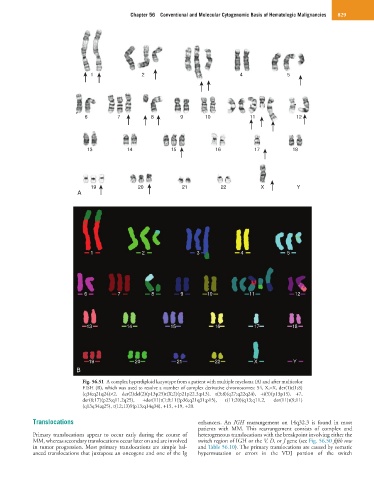
                            Fig. 56.51  A complex hyperdiploid karyotype from a patient with multiple myeloma (A) and after multicolor
                            FISH (B), which was used to resolve a number of complex derivative chromosomes: 54, X,−X, der(1)t(1;8)
                            (q34;q21q24)×2,  der(2)del(2)(p13p25)t(X;2)(p21p22.3;p13),  t(3;8)(q27;q22q24),  +i(5)(p13p15),  +7,
                            der(8;17)(p23;q11.2q25),   +der(11)t(1;9;11(?p36;q21q31;p15),   t(11;20)(q13;q11.2,   der(11)t(9;11)
                            (q13q34;q25), t(12;13)9(p13;q14q34), +15, +19, +20.

            Translocations                                        enhancers.  An  IGH  rearrangement  on  14q32.3  is  found  in  most
                                                                  patients  with  MM.  This  rearrangement  consists  of  complex  and
            Primary  translocations  appear  to  occur  early  during  the  course  of   heterogeneous translocations with the breakpoint involving either the
            MM, whereas secondary translocations occur later on and are involved   switch region of IGH or the V, D, or J gene (see Fig. 56.50 fifth row
            in tumor progression. Most primary translocations are simple bal-  and Table 56.10). The primary translocations are caused by somatic
            anced translocations that juxtapose an oncogene and one of the Ig   hypermutation  or  errors  in  the  VDJ  portion  of  the  switch

