


Page 947 - Hematology_ Basic Principles and Practice ( PDFDrive )
P. 947
830    Part VII  Hematologic Malignancies


        recombination  region.  The  translocations  include  a  promiscuous   by  FISH.  Two  genes  on  chromosome  4p16.3  and  the  IGH  switch
        array of at least 20 nonrandom chromosomal partners. The charac-  region on 14q32.3 are involved. The fibroblast growth factor receptor
        terization of these translocations has led to the identification of critical   3 gene (FGFR3) is detected on der(14), where it is overexpressed along
        dysregulated oncogenes (e.g., BCL2, cyclin D). In each translocation,   with a fusion of the MM set domain (MMSET) gene, which is located
        a potent enhancer is juxtaposed to dysregulated oncogenes. The five   on 4p16.3. This is the first example of a translocation that simultane-
        most frequent IGH translocations are t(4;14)(p16.3;q32.3), t(6;14)  ously deregulates two genes with oncogenic potential: the FGFR3 gene
        (p21;q32.3), t(11;14)(q13;q32.3), t(14;16)(q32.3;q23), and t(14;20)  detected on der(14) and the MMSET gene detected on der(4). FGFR3 is
        (q32.3;q12) (see Table 56.12 and Fig. 56.50).         50–100 kb telomeric to MMSET. Loss of FGFR3 on der(14) is detected
           A  recurrent  CCND1-IGH  rearrangement  is  characterized  by   in approximately 20% of cases. A significant number of these patients
        overexpression  of  cyclin  D1.  In  contrast  to  MCL,  breakpoints  on   have del(13q) within the same clone and are hypodiploid.
        11q13 with MM are not clustered but are scattered over a relatively   Translocation (14;16)(q32.3;q23) can only be detected with (see
        large genomic region. Virtually all MM and MGUS cells have cyclin   Fig. 56.50 second row) FISH studies. The incidence of t(14;16) has
        D  dysregulation,  suggesting  that  this  abnormality  is  an  early  and   been estimated to be approximately 5% of cases. This translocation
        unifying pathogenetic event (see Fig. 56.50, first row). In contrast to   results in the relocation of the MAF proto-oncogene from its position
        other abnormalities involving the IGH locus, t(11;14) MM cells tend   on 16q23 to chromosome 14, band q32.3, and it is overexpressed.
        to be diploid. There appears to be an association of t(11;14) with an   Rare variants t(14;20)(q32;q11)/IGH-MAFB and t(8;20) are included
        oligosecretory or light chain form of MM with CD20 expression,   within this group because they share a similar gene expression signa-
        and a lymphoplasmacytic morphology. This chromosomal rearrange-  ture and clinical outcome. Survival of patients with t(14;16) is sig-
        ment  is  the  most  common  genetic  lesion  in  MM  (15%–20%  of   nificantly shorter as compared with patients without t(14;16).
        patients with MM) but it has been also observed in MGUS, primary   A large number of secondary chromosomal aberrations are found
        plasma  cell  leukemia,  and  light  chain  amyloidosis. Two  groups  of   during  disease  progression.  Disease  progression  is  accompanied  by
        patients  with  t(11;14)  are  recognized:  one  with  a  rather  indolent   four main abnormalities including translocations of MYC, the loss or
        course and the other associated with a more aggressive course.  deletion of chromosome 13, deletions of short arms and amplification
           Approximately  15%  of  patients  have  a  recurrent  t(4;14)(p16.3;   of long arms of chromosome 1, and the deletion of short arms of
        q32.3) abnormality associated with aggressive disease (see Fig. 56.50   chromosome 17. Translocations and/or amplification of MYC (8q24)
        third row). This cytogenetic abnormality is associated with IgAλ form   may involve up to 45% of patients with an advanced MM, and then
        of MM with immature plasma cell morphology, and a poor response   cytogenetic  study  frequently  involves  very  complex  nonreciprocal
        to therapy. This abnormality is cytogenetically cryptic and is detected   rearrangements, duplications, and amplifications. More recent data
                                                              based on the CGH- or SNP-array technologies has revealed homo-
                                                              zygous deletions such as BIRC2/3 on chromosome 11, deletions of
          TABLE   Risk Stratification of Myeloma              TRAF3 on chromosome 14, and deletions of CYLD on chromosome
          56.15                                               16. Another recurrent double deletion that has been observed in a
          A.  Standard Risk                                   limited number of the patients occurs on chromosome 1, targeting
            Trisomies (hyperdiploidy)                         the tumor suppressor CDKN2C gene at 1q21 chromosomal site.
            t(11;14)                                             Deletion  of  either  band  q14  or  q14.3  (RB1,  DNA  marker
            t(6;14)                                           D13S319) on chromosome 13 is detected in 10% to 20% of patients
          B.  Intermediate Risk                               using conventional cytogenetics and in 50% using interphase FISH.
            t(4;14)                                           Microarray CGH data of the critical region on chromosome 13 is
          C.  High Risk                                       consistent  with  previous  findings  (Fig.  56.52).  Loss  of  the  entire
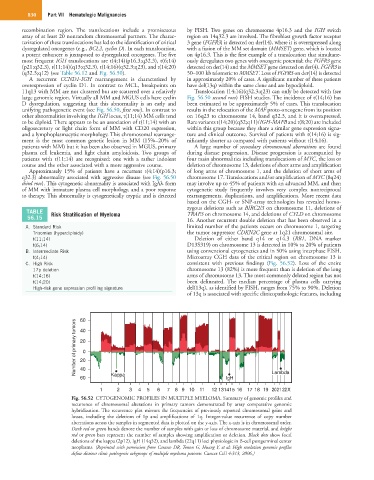
            17p deletion                                      chromosome 13 (82%) is more frequent than is deletion of the long
            t(14;16)                                          arms of chromosome 13. The most commonly deleted region has not
            t(14;20)                                          been  delineated.  The  median  percentage  of  plasma  cells  carrying
            High-risk gene expression profiling signature     del(13q), as identified by FISH, ranges from 75% to 90%. Deletion
                                                              of 13q is associated with specific clinicopathologic features, including


                           60
                          Number of primary tumors  40 0

                           20


                           20
                           40
                           60        Kappa                                 IgH            Lambda

                                  1    2   3  4  5  6   7  8 9 10  11  12 131415 16  17 18 19 2021 22X
                        Fig. 56.52  CYTOGENOMIC PROFILES IN MULTIPLE MYELOMA. Summary of genomic profiles and
                        recurrence  of  chromosomal  alterations  in  primary  tumors  demonstrated  by  array  comparative  genomic
                        hybridization. The  recurrence  plot  mirrors  the  frequencies  of  previously  reported  chromosomal  gains  and
                        losses,  including  the  deletions  of  1p  and  amplifications  of  1q.  Integer-value  recurrence  of  copy  number
                        aberrations across the samples in segmented data is plotted on the y-axis. The x-axis is in chromosomal order.
                        Dark red or green bands denote the number of samples with gain or loss of chromosome material, and bright
                        red or green bars represent the number of samples showing amplification or deletion. Black dots show focal
                        deletions of the kappa (2p12), IgH (14q32), and lambda (22q11) loci physiologic in B-cell postgerminal center
                        neoplasms. (Reprinted with permission from Carasco DR, Tonon G, Huang Y, et al: High resolution genomic profiles
                        define distinct clinic pathogenic subgroups of multiple myeloma patients. Cancer Cell 4:313, 2006.)

