


Page 953 - Hematology_ Basic Principles and Practice ( PDFDrive )
P. 953
836    Part VII  Hematologic Malignancies


                             1                2                3               4              5


                         6           7           8          9          10         11          12


                         13            14             15           16            17           18


                         19            20            21            22            X             Y
                       A


                               1                 2              3              4             5


                          6           7          8          9        10        11           12


                           13           14            15           16           17           18


                           19            20           21           22           X            Y
                      B
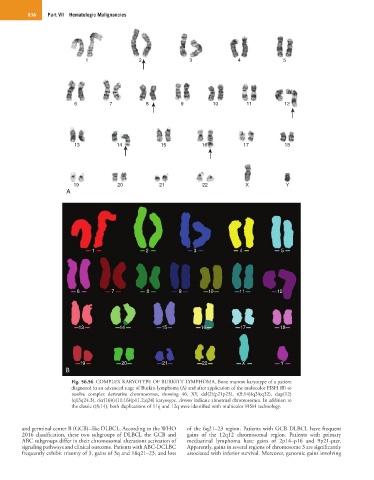
                        Fig. 56.56  COMPLEX KARYOTYPE OF BURKITT LYMPHOMA. Bone marrow karyotype of a patient
                        diagnosed in an advanced stage of Burkitt lymphoma (A) and after application of the multicolor FISH (B) to
                        resolve  complex  derivative  chromosomes,  showing  46,  XY,  del(2)(p21p23),  t(8;14)(q24;q32),  dup(12)
                        (q13q24.3), der(16)(t(11;16)(p11.2;q24) karyotype. Arrows indicate abnormal chromosomes. In addition to
                        the classic t(8;14), both duplications of 11q and 12q were identified with multicolor FISH technology.


        and germinal center B (GCB)–like DLBCL. According to the WHO   of the 6q21–23 region. Patients with GCB DLBCL have frequent
        2016 classification, these two subgroups of DLBCL the GCB and   gains  of  the  12q12  chromosomal  region.  Patients  with  primary
        ABC subgroups differ in their chromosomal alterations activation of   mediastinal  lymphoma  have  gains  of  2p14–p16  and  9p21-pter.
        signaling pathways and clinical outcome. Patients with ABC-DCLBC   Apparently, gains in several regions of chromosome 3 are significantly
        frequently exhibit trisomy of 3, gains of 3q and 18q21–23, and loss   associated with inferior survival. Moreover, genomic gains involving

