


Page 955 - Hematology_ Basic Principles and Practice ( PDFDrive )
P. 955
838    Part VII  Hematologic Malignancies


               1              2            3             4           5


             6          7         8         9       10      11       12
                                                                           B

                                                                            3  der(3)             22  der(22)
             13          14        15         16         17         18


           A                                                               C
              19         20         21         22         X        Y

               7          7      der(7)            8         der(8)       14        der(14)     18     der(18)


           D
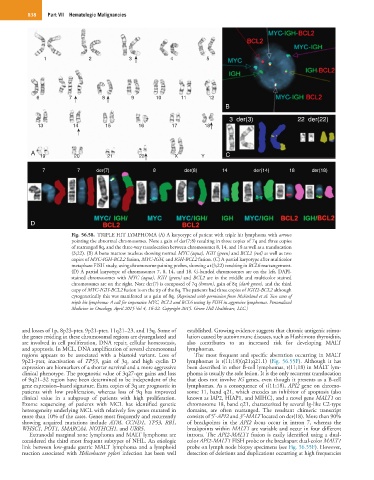
                        Fig. 56.58.  TRIPLE HIT LYMPHOMA (A) A karyotype of patient with triple hit lymphoma with arrows
                        pointing the abnormal chromosomes. Note a gain of der(7;8) resulting in three copies of 7q and three copies
                        of rearranged 8q, and the three-way translocation between chromosomes 8, 14, and 18 as well as a translocation
                        (3;22). (B) A bone marrow nucleus showing normal MYC (aqua), IGH (green) and BCL2 (red) as well as two
                        copies of MYC-IGH-BCL2 fusion, MYC-IGH, and IGH-BCL2 fusion. (C) A partial karyotype after multicolor
                        metaphase FISH study, using chromosome paining probes, showing a t(3;22) resulting in BCL6 rearrangement.
                        (D) A partial karyotype of chromosomes 7, 8, 14, and 18. G-banded chromosomes are on the left, DAPI-
                        stained chromosomes with MYC (aqua), IGH (green) and BCL2 are in the middle and multicolor stained
                        chromosomes are on the right. Note der(7) is composed of 7q (brown), gain of 8q (dark green), and the third
                        copy of MYC-IGH-BCL2 fusion is on the tip of the 8q. The patients had three copies of IGH2-BCL2 although
                        cytogenetically this was manifested as a gain of 8q. (Reprinted with permission from McFarland et al: Two cases of
                        triple hit lymphoma: A call for imperative MYC, BCL2 and BCL6 testing by FISH in aggressive lymphomas. Personalized
                        Medicine in Oncology, April 2015 Vol 4, 16-22. Copyright 2015. Green Hill Healthcare, LLC.)


        and losses of 1p, 8p23-pter, 9p21-pter, 11q21–23, and 13q. Some of   established. Growing evidence suggests that chronic antigenic stimu-
        the genes residing in these chromosomal regions are dysregulated and   lation caused by autoimmune diseases, such as Hashimoto thyroiditis,
        are involved in cell proliferation, DNA repair, cellular homeostasis,   also  contributes  to  an  increased  risk  for  developing  MALT
        and apoptosis. In MCL, DNA amplification of several chromosomal   lymphomas.
        regions  appears  to  be  associated  with  a  blastoid  variant.  Loss  of   The  most  frequent  and  specific  aberration  occurring  in  MALT
        9p21-pter,  inactivation  of  TP53,  gain  of  3q,  and  high  cyclin  D   lymphomas  is  t(11;18)(q21;q21.1)  (Fig.  56.55F).  Although  it  has
        expression are biomarkers of a shorter survival and a more aggressive   been described in other B-cell lymphomas, t(11;18) in MALT lym-
        clinical phenotype. The prognostic value of 3q27-qer gains and loss   phoma is usually the sole lesion. It is the only recurrent translocation
        of 9q21–32 region have been determined to be independent of the   that does not involve IG genes, even though it presents as a B-cell
        gene expression–based signature. Extra copies of 3q are prognostic in   lymphomas. As a consequence of t(11;18), API2 gene on chromo-
        patients  with  low  proliferation,  whereas  loss  of  9q  has  improved   some 11, band q21, which encodes an inhibitor of apoptosis (also
        clinical  value  in  a  subgroup  of  patients  with  high  proliferation.   known as IAP2, HIAP1, and MIHC), and a novel gene MALT1 on
        Exome  sequencing  of  patients  with  MCL  has  identified  genetic   chromosome 18, band q21, characterized by several Ig-like C2-type
        heterogeneity underlying MCL with relatively few genes mutated in   domains,  are  often  rearranged.  The  resultant  chimeric  transcript
        more than 10% of the cases. Genes most frequently and recurrently   consists of 5′-API2 and 3′-MALT located on der(18). More than 90%
        showing  acquired  mutations  include  ATM,  CCND1,  TP53,  RB1,   of  breakpoints  in  the  API2  locus  occur  in  intron  7,  whereas  the
        WHSC1, POT1, SMARCA4, NOTHCH1, and UBR5.              breakpoints within MALT1 are variable and occur in four different
           Extranodal marginal zone lymphoma and MALT lymphoma are   introns. The API2-MALT1 fusion is easily identified using a dual-
        considered the third most frequent subtypes of NHL. An etiologic   color API2-MALT1 FISH probe or the breakapart dual-color MALT1
        link between low-grade gastric MALT lymphoma and a lymphoid   probe on lymph node biopsy specimens (see Fig. 56.55F). However,
        reaction associated with Helicobacter pylori infection has been well   detection of deletions and duplications occurring at high frequencies

