


Page 958 - Hematology_ Basic Principles and Practice ( PDFDrive )
P. 958
Chapter 56  Conventional and Molecular Cytogenomic Basis of Hematologic Malignancies  841


                                                                                  inv(14)(q11.2q32)


                                  A


                                  B        7                            14


                                   C

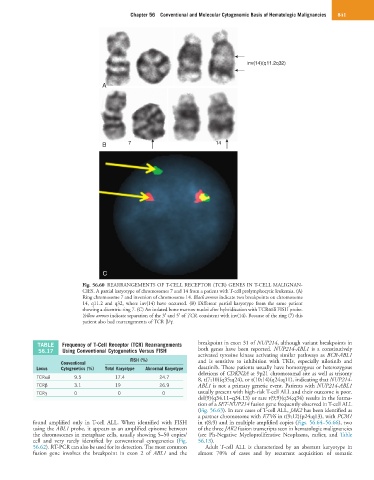
                            Fig. 56.60  REARRANGEMENTS OF T-CELL RECEPTOR (TCR) GENES IN T-CELL MALIGNAN-
                            CIES. A partial karyotype of chromosomes 7 and 14 from a patient with T-cell prolymphocytic leukemia. (A)
                            Ring chromosome 7 and inversion of chromosome 14. Black arrows indicate two breakpoints on chromosome
                            14,  q11.2  and  q32,  where  inv(14)  have  occurred.  (B)  Different  partial  karyotype  from  the  same  patient
                            showing a dicentric ring 7. (C) An isolated bone marrow nuclei after hybridization with TCRα/δ FISH probe.
                            Yellow arrows indicate separation of the 3′ and 5′ of TCR, consistent with inv(14). Because of the ring (7) this
                            patient also had rearrangements of TCR β/γ.


             TABLE   Frequency of T-Cell Receptor (TCR) Rearrangements   breakpoint in exon 31 of NUP214, although variant breakpoints in
              56.17  Using Conventional Cytogenetics Versus FISH  both  genes  have  been  reported.  NUP214-ABL1  is  a  constitutively
                                                                  activated tyrosine kinase activating similar pathways as BCR-ABL1
                                            FISH (%)              and  is  sensitive  to  inhibition  with  TKIs,  especially  nilotinib  and
                     Conventional
             Locus   Cytogenetics (%)  Total Karyotype  Abnormal Karyotype  dasatinib. These patients usually have homozygous or heterozygous
                                                                  deletions of CDKN2A at 9p21 chromosomal site as well as trisomy
             TCRαδ       9.5           17.4          24.7         8, t(7;10)(q35;q24), or t(10;14)(q24;q11), indicating that NUP214-
             TCRβ        3.1           19            26.9         ABL1 is not a primary genetic event. Patients with NUP214-ABL1
             TCRγ        0              0             0           usually present with high-risk T-cell ALL and their outcome is poor.
                                                                  del(9)(q34.11–q34.13) or rare t(9;9)(q34;q34) results in the forma-
                                                                  tion of a SET-NUP214 fusion gene frequently observed in T-cell ALL
                                                                  (Fig. 56.63). In rare cases of T-cell ALL, JAK2 has been identified as
                                                                  a partner chromosome with ETV6 in t(9;12)(p24;q13), with PCM1
            found  amplified  only  in  T-cell  ALL.  When  identified  with  FISH   in t(8;9) and in multiple amplified copies (Figs. 56.64–56.66), two
            using the ABL1 probe, it appears as an amplified episome between   of the three JAK2 fusion transcripts seen in hematologic malignancies
            the chromosomes in metaphase cells, usually showing 5–50 copies/  (see  Ph-Negative  Myeloproliferative  Neoplasms,  earlier,  and  Table
            cell  and  very  rarely  identified  by  conventional  cytogenetics  (Fig.   56.13).
            56.62). RT-PCR can also be used for its detection. The most common   Adult T-cell  ALL  is  characterized  by  an  aberrant  karyotype  in
            fusion  gene  involves  the  breakpoint  in  exon  2  of  ABL1  and  the   almost  70%  of  cases  and  by  recurrent  acquisition  of  somatic

