


Page 950 - Hematology_ Basic Principles and Practice ( PDFDrive )
P. 950
Chapter 56  Conventional and Molecular Cytogenomic Basis of Hematologic Malignancies  833


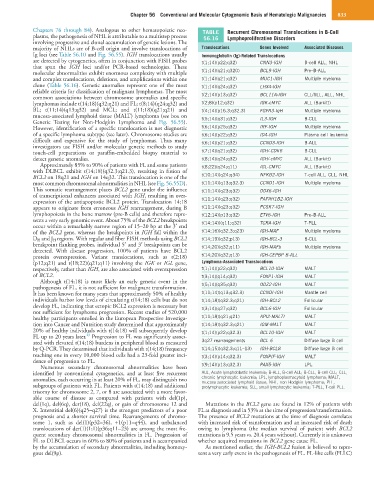
            Chapters  76  through  84).  Analogous  to  other  hematopoietic  neo-  TABLE   Recurrent Chromosomal Translocations in B-Cell
            plasms, the pathogenesis of NHL is attributable to a multistep process   56.16  Lymphoproliferative Disorders
            involving progressive and clonal accumulation of genetic lesions. The
            majority of NHLs are of B-cell origin and involve translocations of   Translocations  Genes Involved  Associated Diseases
            Ig loci (see Table 56.10 and Fig. 56.55). IGH translocations usually   Immunoglobulin (Ig)-Related Translocations
            are detected by cytogenetics, often in conjunction with FISH probes   t(1;14)(p22;q32)  CNN3-IGH  B-cell ALL, NHL
            that  span  the  IGH  loci  and/or  PCR-based  technologies.  These
            molecular abnormalities exhibit enormous complexity with multiple   t(1;14)(q21;q320)  BCL9-IGH  Pre–B-ALL
            and complex translocations, deletions, and amplifications within one   t(1;14)(q21;q32)  MUC1-IGH  Multiple myeloma
            clone (Table 56.16). Genetic anomalies represent one of the most   t(1;14)(q24;q32)  LHX4-IGH
            reliable criteria for classification of malignant lymphomas. The most
            common associations between chromosome anomalies and specific   t(2;14)(p13;q32)  BCL11A-IGH  CLL/SLL, ALL, NHL
            lymphomas include t(14;18)(q32;q21) and FL; t(8;14)(q24;q32) and   t(2;8)(p12;q32)  IGK-cMYC  ALL (Burkitt)
            BL;  t(11;14)(q13;q32)  and  MCL;  and  t(11;18)(q21;q21)  and   t(4;14)(p16.3;q32.3)  FGFR3-IqH  Multiple myeloma
            mucosa-associated lymphoid tissue (MALT) lymphoma (see box on   t(5;14)(q31;q32)  IL3-IGH  B-CLL
            Genetic  Testing  for  Non-Hodgkin  Lymphoma  and  Fig.  56.55).
            However, identification of a specific translocation is not diagnostic   t(6;14)(p25;q32)  IRF-IGH  Multiple myeloma
            of a specific lymphoma subtype (see later). Chromosome studies are   t(6;14)(p22;q32)  ID4-IGH  Plasma cell leukemia
            difficult  and  expensive  for  the  study  of  lymphomas.  Thus  many   t(6;14)(p21;q32)  CCND3-IGH  B-ALL
            investigators use FISH and/or molecular genetic methods to study
            touch-cell  preparations  or  paraffin-embedded  biopsy  material  to   t(7;14)(q21;q32)  IGH/-CDK6  B-CLL
            detect genetic anomalies.                              t(8;14)(q24;q32)   IGH/-cMYC      ALL (Burkitt)
              Approximately 85% to 90% of patients with FL and some patients   t(8;22)(q24;q11)  IGL-CMYC  ALL (Burkitt)
            with  DLBCL  exhibit  t(14;18)(q32.3;q21.3),  resulting  in  fusion  of
            BCL2 on 18q21 and IGH on 14q32. This translocation is one of the   t(10;14)(q24;q34)  NFKB2-IGH  T-cell ALL, CLL, NHL
            most common chromosomal abnormalities in NHL (see Fig. 56.55D).   t(11;14)(q13;q32.3)  CCND1-IGH  Multiple myeloma
            This somatic rearrangement places BCL2 gene under the influence   t(11;14)(q23;q32)  DDX6-IGH
            of transcriptional enhancers associated with IGH, resulting in over-
            expression of the antiapoptotic BCL2 protein. Translocation 14;18   t(11;14)(q23;q32)  PAFAH1B2-IGH
            appears to originate from erroneous IGH rearrangement, during B   t(11;14)(q23;q32)  PCSK7-IGH
            lymphopoiesis in the bone marrow (pre-B cells) and therefore repre-  t(12;14)(p13;q32)  ETV6-IGH  Pre–B-ALL
            sents a very early genomic event. About 75% of the BCL2 breakpoints   t(14;14)((q11;q32)  TCRA-IGH  T-PLL
            occur within a remarkably narrow region of 15–20 bp at the 3′ end
            of the BCL2 gene, whereas the breakpoints in IGH fall within the   t(14;16)(q32.3;q23)  IGH-MAF  Multiple myeloma
            D H  and J H  regions. With regular and fiber FISH methods using BCL2   t(14;19)(q32;p13)  IGH-BCL-3  B-CLL
            breakpoint flanking probes, individual 5′ and 3′ breakpoints can be   t(14;20)(q32;q11)  IGH-MAFb  Multiple myeloma
            detected.  With  disease  progression,  100%  of  patients  have  BCL2
            protein  overexpression.  Variant  translocations,  such  as  t(2;18)  t(14;20)(q32;q13)  IGH-CEPBP B-ALL
            (p12;q21)  and  t(18;22)(q21;q11)  involving  the  IGK  or  IGL  gene,   Lymphoma-Associated Translocations
            respectively, rather than IGH, are also associated with overexpression   t(1;14)(p22;q32)  BCL10-IGH  MALT
            of BCL2.                                               t(3;14)(q14;q32)   FOXP1-IGH      MALT
              Although  t(14;18)  is  most  likely  an  early  genetic  event  in  the
            pathogenesis of FL, it is not sufficient for malignant transformation.   t(5;14)(q35;q32)  ODZ2-IGH  MALT
            It has been known for many years that approximately 50% of healthy   t(11;14)(q13;q32.3)  CCNDI-IGH  Mantle cell
            individuals harbor low levels of circulating t(14;18) cells but do not   t(14;18)(q32.3;q21)  IGH-BCL2  Follicular
            develop FL, indicating that ectopic BCL2 expression is necessary but   t(3;14)(q27;q32)  BCL6-IGH  Follicular
            not sufficient for lymphoma progression. Recent studies of 520,000
            healthy participants enrolled in the European Prospective Investiga-  t(11;18)(q21;q21)  API2-MALTI  MALT
            tion into Cancer and Nutrition study determined that approximately   t(14;18)(q32.3;q21)  IGM-MALT  MALT
            20% of healthy individuals with t(14;18) will subsequently develop   t(1;14)(p22;q32.3)  BCL10-IGH  MALT
                             23
            FL up to 20 years later.  Progression to FL was significantly associ-
            ated with elevated t(14;18) burdens in peripheral blood as measured   3q27 rearrangements  BCL 6  Diffuse large B cell
            by Q-PCR. They determined that individuals with t(14;18) frequency   t(14;15)(q32.3;q11–13)  IGH-BCL8  Diffuse large B cell
            reaching one in every 10,000 blood cells had a 23-fold greater inci-  t(3;14)(p14;q32.3)  FOXPIF-IGH  MALT
            dence of progression to FL.
              Numerous  secondary  chromosomal  abnormalities  have  been   t(9;14)(p13;q32.3)  PAX5-IGH  LPL
            identified  by  conventional  cytogenetics,  and  at  least  five  recurrent   ALL, Acute lymphoblastic leukemia; B-ALL, B-cell ALL; B-CLL, B-cell CLL; CLL,
            anomalies, each occurring in at least 20% of FL, may distinguish two   chronic lymphocytic leukemia; LPL, lymphoplasmacytoid lymphoma; MALT,
                                                                   mucosa-associated lymphoid tissue; NHL, non-Hodgkin lymphoma; PLL,
            subgroups of patients with FL. Patients with t(14;18) and additional   prolymphocytic leukemia; SLL, small lymphocytic leukemia; T-PLL, T-cell PLL.
            trisomy for chromosome 2, 7, or 8 are associated with a more favor-
            able  course  of  disease  as  compared  with  patients  with  del(1p),
            del(1q), del(6q), der(18), del(22q), or gain of chromosome 12 and   Mutations in the BCL2 gene are found in 12% of patients with
            X. Interstitial del(6)(q25–q27) is the strongest predictors of a poor   FL at diagnosis and in 53% at the time of progression/transformation.
            prognosis and a shorter survival time. Rearrangements of chromo-  The presence of BCL2 mutations at the time of diagnosis correlates
            some  1,  such  as  del(1)(p32–36),  +1(p11–q44),  and  unbalanced   with increased risk of transformation and an increased risk of death
            translocations of der(1)(1;1)(p36;q11–23) are among the most fre-  owing  to  lymphoma  (the  median  survival  of  patient  with  BCL2
            quent secondary chromosomal abnormalities in FL. Progression of   mutations is 9.5 years vs. 20.4 years without). Currently it is unknown
            FL to DLBCL occurs in 60% to 80% of patients and is accompanied   whether acquired mutations in BCL2 gene cause FL.
            by the accumulation of secondary abnormalities, including homozy-  As mentioned earlier, the IGH-BCL2 fusion is believed to repre-
            gous del(9p).                                         sent a very early event in the pathogenesis of FL. FL-like cells (FLLC)

