


Page 954 - Hematology_ Basic Principles and Practice ( PDFDrive )
P. 954
Chapter 56  Conventional and Molecular Cytogenomic Basis of Hematologic Malignancies  837


                             MYC Amplification                    a sequence-specific transcriptional repressor that is upregulated; 25%
                                                                  of ABC-DLBCL have deletions of PRDM1 as a result of truncated
                                                                  mutations,  or  genomic  deletions,  while  an  additional  fraction  of
                                                                  patients lacks the PRDM1 protein as a result of transcriptional repres-
                                                                  sion by a constitutively active translocated BCL6 gene.
                                                                    Patients  with  non-BL  may  have  MYC  translocations  without
                                                                  additional  mutation  in  BCL2  or  BCL6  and  they  are  described  as
                                                                  having single hit lymphomas. Although the most recent studies sug-
                                                                  gested that patients with MYC+, but BCL2− and BCL6− DLBCL do
                                                                  not have an inferior outcome when compared to those who are MYC
                                                                  negative, the clinical relevance of MYC rearrangement as sole abnor-
                                                                  mality in DLBCL is still controversial with some studies indicating
                                                                  an adverse prognosis.
                                                                    Double  hit  lymphoma  (DHL)  refers  to  B-cell  lymphoma  with
                                                                  multiple  activating  oncogenes,  one  of  them  being  MYC.  Among
                                                                  DHL, those with alterations in MYC and BCL2 are the most common
                                                                  by far, occurring in 87% of patients, followed by MYC and BCL6
                                                                  rearrangements,  found  in  5%  of  patients.  Triple  hit  lymphoma
                                                                  (THL) involves rearrangements of MYC, BCL6, and BCL2 in a single
                     A                                            cell  and  are  observed  in  about  8%  of  patients  with  DLBCL
                                                                  (Fig. 56.58).
                                                                    DHL can be detected cytogenetically but cryptic gene rearrange-
                                                                  ments may be missed. FISH therefore should be used for the detection
                                                                  of DHL and THL. FISH studies can be successfully performed using
                                                                  formalin-fixed  paraffin  embedded  tissue  sections  as  well  as  fresh
                                                                  smears, touch-cell imprints.
                                                                    Because one of the translocations may be cryptic, a combination
                                                                  of three FISH probes, labeled with three colors, is especially useful
                                                                  in  identifying  these  very  complex  translocations  (see  Fig.  56.43).
                                                                  Non-IG genes also act as MYC translocation partners in 35% to 53%
                                                                  of MYC rearranged DLBCL. The t(8;9)(q24;p13), which results in
                                                                  the  juxtaposition  of  MYC  to  PAX5,  has  been  frequently  reported,
                                                                  accounting for 20% of non-IG/MYC rearrangement. Both the DHL
                                                                  and THL have complex karyotypes. Complex karyotypes are not seen
                                                                  in BL, which by definition always have single abnormality.
                                                                    The  detection  of  increased  number  of  cells  expressing  MYCs
                     B                                            correlates  well  with  the  presence  of  gene  rearrangements,  but  the
                                                                  relationship  varies. Tumors  with more  than 70% of  MYC-positive
                                                                  cells  usually  are  associated  with  gene  rearrangements,  but  MYC
                                                                  translocations can be present in up to 17% of cases with less than
                                                                  30% MYC-positive cells. The variability between the protein expres-
                                                                  sion and gene alterations makes it difficult to recommend the use of
                                                                  MYC immunohistochemistry as a screening method to detect gene
                                                                  rearrangements. The current recommendation is that all patients with
                                                                  DLBCL  have  FISH  for  MYC  rearrangements  because  combined
                                                                  alterations  in  MYC,  BCL2,  and  BCL6  confers  a  more  aggressive
                                                                  disease phenotype.
                                                                    All patients with MCL exhibit t(11;14)(q13;q32) abnormality as
                                                                  detected by FISH (see Fig. 56.55 top panel). t(11;14)(q13;q32) is also
                                                                  found  in  a  variety  of  other  B-cell  malignancies,  including  MM,
                                                                  splenic lymphoma with villous lymphocytes, and B-cell prolympho-
                                                                  cytic leukemia. Most breakpoints on chromosome 11, band q13, are
                                                                  dispersed over a region of approximately 130 kb centromeric to the
                                                                  cyclin D1 (CCND1) gene. At the molecular level, the BCL1 locus
                     C                                            (CCND1)  on  chromosome  11q13  is  juxtaposed  to  an  enhancer
                                                                  sequence within the IGH gene on 14q32, leading to overexpression
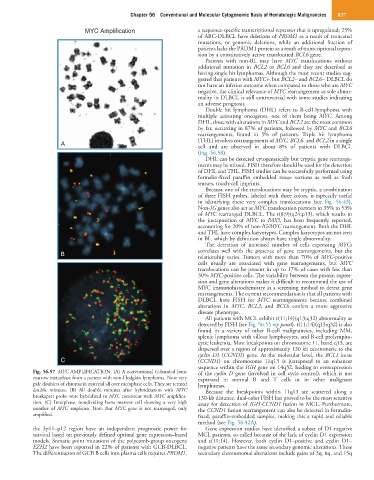
            Fig. 56.57  MYC AMPLIFICATION. (A) A conventional G-banded bone   of  the  cyclin  D  gene  (involved  in  cell  cycle  control),  which  is  not
            marrow metaphase from a patient with non-Hodgkin lymphoma. Note very   expressed  in  normal  B  and  T  cells  or  in  other  malignant
            pale doublets of chromatin material all over metaphase cells. They are termed   lymphomas.
            double  minutes.  (B)  All  double  minutes  after  hybridization  with  MYC   Because  the  breakpoints  within  11q13  are  scattered  along  a
            breakapart probe were hybridized to MYC consistent with MYC amplifica-  130-kb distance, dual-color FISH has proved to be the most sensitive
            tion.  (C)  Interphase,  nondividing  bone  marrow  cell  showing  a  very  high   assay for detection of IGH-CCND1 fusion in MCL. Furthermore,
            number  of  MYC  amplicon.  Note  that  MYC  gene  is  not  rearranged,  only   the CCND1 fusion rearrangement can also be detected in formalin-
            amplified.                                            fixed, paraffin-embedded samples, making this a rapid and reliable
                                                                  method (see Fig. 56.42A).
            the  3p11–p12  region  have  an  independent  prognostic  power  for   Gene expression studies have identified a subset of D1-negative
            survival based on previously defined optimal gene expression–based   MCL patients, so called because of the lack of cyclin D1 expression
            models. Somatic point mutations of the polycomb-group oncogene   and  t(11;14).  However,  both  cyclin  D1–positive  and  cyclin  D1–
            EZH2 have been reported in 22% of patients with GCB-DLBCL.   negative patients have the same secondary genomic alterations. These
            The differentiation of GCB B cells into plasma cells requires PRDM1,   secondary chromosomal alterations include gains of 3q, 8q, and 15q

