


Page 949 - Hematology_ Basic Principles and Practice ( PDFDrive )
P. 949
832    Part VII  Hematologic Malignancies


        or jumping translocations and is detected with a 1q21-specific FISH
        probe. Among 479 patients with newly diagnosed MM, 43% with              TCF3-PBX1/1q21
        amp lq21 with either a hypodiploid and hyperdiploid karyotype and
        del(13q)  was  associated  with  poor  prognosis  as  compared  with
        patients lacking amp1q21 (see Fig. 56.53). In a study of 92 patients
        treated with lenalidomide and dexamethasone, del(17p) and gain of
        1q21 was associated with a dismal OS. In the most comprehensive
        expression  profiling  survey  of  patients  with  MM,  reported  by  the
        Arkansas Multiple Myeloma Group using GEP70 (gene expression
        profiling of 70 genes), 30% of these genes were located on chromo-
        some 1, with most of the downregulated genes located on the short
        arms of chromosome 1 and most of the upregulated genes on 1q.
        The  mechanism  for  the  amplification  of  1q  is  believed  to  involve
        1q12 pericentromeric instability, which most commonly increases the
        copy number of 1q by a direct and/or inverted duplication. Further
        instability can result in adding a whole-arm segment of 1q to non-
        homologous  chromosomes  by  jumping  translocations  of  1q.  The
        1q12–q23 amplicon has been reported to be formed by BFB cycles
        of the 1q12 pericentromeric heterochromatin and the adjacent bands
        of 1q, resulting in an inverted repeat pattern of amplification of the
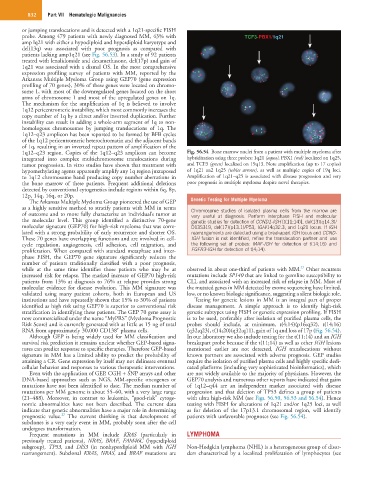
        1q12–q23  region.  Copies  of  the  1q12–q23  amplicon  can  become   Fig. 56.54  Bone marrow nuclei from a patient with multiple myeloma after
        integrated  into  complex  multichromosome  translocations  during   hybridization using three probes: 1q21 (aqua), PBX1 (red) localized on 1q25,
        tumor progression. In vitro studies have shown that treatment with   and TCF3 (green) localized on 19q13. Note amplification (up to 17 copies)
        hypomethylating agents apparently amplify any 1q region juxtaposed   of  1q21  an2  1q25  (white  arrows),  as  well  as  multiple  copies  of  19q  loci.
        to 1q12 chromosome band producing copy number aberrations in   Amplification of 1q21–q25 is associated with disease progression and very
        the  bone  marrow  of  these  patients.  Frequent  additional  deletions   poor prognosis in multiple myeloma despite novel therapies.
        detected by conventional cytogenetics include regions within 6q, 8p,
        12p, 14q, 16q, or 20p.
           The Arkansas Multiple Myeloma Group pioneered the use of GEP   Genetic Testing for Multiple Myeloma
        as a highly sensitive method to stratify patients with MM in terms   Chromosome  studies  of  isolated  plasma  cells  from  the  marrow  are
        of outcome and to more fully characterize an individual’s tumor at   very  useful  at  diagnosis.  Perform  interphase  FISH  and  molecular
        the  molecular  level.  This  group  identified  a  distinctive  70-gene   genetic studies for detection of CCND1-IGH [t(11;14)], del(13)(q14.3)/
        molecular signature (GEP70) for high-risk myeloma that was corre-  D13S319, del(17)(p13.1)/P53, IGH/14q32.3, and 1q21 locus. If IGH
        lated with a strong probability of early recurrence and shorter OS.   rearrangements are detected using a breakapart IGH locus and CCND-
        These 70 genes have overlapping functions and are involved in cell-  IGH fusion is not identified, refine the translocation partner and use
        cycle  regulation,  angiogenesis,  cell  adhesion,  cell  migration,  and   the  following  set  of  probes:  MAF-IGH  for  detection  of  t(14;16)  and
        proliferation. When compared with standard metaphase and inter-  FGFR3-IGH for detection of t(4;14).
        phase  FISH,  the  GEP70  gene  signature  significantly  reduces  the
        number  of  patients  traditionally  classified  with  a  poor  prognosis,
                                                                                                   22
        while  at  the  same  time  identifies  those  patients  who  may  be  at   observed in about one-third of patients with MM.  Other recurrent
        increased risk for relapse. The marked increase of GEP70 high-risk   mutations include SP140 that are linked to germline susceptibility to
        patients from 13% at diagnosis to 76% at relapse provides strong   CLL and associated with an increased risk of relapse in MM. Most of
        molecular  evidence  for  disease  evolution. This  MM  signature  was   the mutated genes in MM detected by exome sequencing have limited,
        validated  using  many  patient  cohorts,  both  in  European  and  US   low, or no known biologic significance, suggesting a silent biologic role.
        institutions and have repeatedly shown that 15% to 30% of patients   Testing for genetic lesions in MM is an integral part of proper
        identified as high risk using GEP70 is superior to conventional risk   disease  management.  A  simple  approach  is  to  identify  high-risk
        stratification in identifying these patients. The GEP 70 gene assay is   genetic subtypes using FISH or genetic expression profiling. If FISH
        now commercialized under the name “MyPRS” (Myeloma Prognostic   is to be used, preferably after isolation of purified plasma cells, the
        Risk Score) and is currently generated with as little as 15 ng of total   probes  should  include,  at  minimum,  t(4;14)(p16;q32),  t(14;16)
                                       +
        RNA from approximately 30,000 CD138  plasma cells.    (q32;q23), t(14;20)(q32;q11), gain of 1q and loss of 17p (Fig. 56.54).
           Although GEP is being widely used for MM classification and   In our laboratory we also include testing for the t(11;14) and an IGH
        survival risk prediction it remains unclear whether GEP-based signa-  breakapart probe because if the t(11;14) as well as other IGH lesions
        tures can predict response to specific therapies. Therefore GEP-based   mentioned  earlier  are  not  detected,  IGH  translocations  without
        signature in MM has a limited ability to predict the probability of   known partners are associated with adverse prognosis. GEP studies
        attaining a CR. Gene expression by itself may not delineate eventual   require the isolation of purified plasma cells and highly specific dedi-
        cellular behavior and responses to various therapeutic interventions.  cated platforms (including very sophisticated bioinformatics), which
           Even with the application of GEP, CGH + SNP arrays and other   are not widely available to the majority of physicians. However, the
        DNA-based  approaches  such  as  NGS,  MM-specific  oncogenes  or   GEP70 analysis and numerous other reports have indicated that gains
        mutations have not been identified to date. The median number of   of  1q12–q44  are  an  independent  marker  associated  with  disease
        mutations per MM genome is about 55–60, with a very large range   progression and that deletion of TP53 defines a group of patients
        (21–488).  Moreover,  in  contrast  to  leukemia,  “good-risk”  cytoge-  with ultra high-risk MM (see Figs. 56.50, 56.53 and 56.54). Hence
        nomic  abnormalities  have  not  been  described.  The  current  data   testing with FISH for alterations of 1q21 and/or 1q25 loci, as well
        indicate that genetic abnormalities have a major role in determining   as  for  deletion  of  the  17p13.1  chromosomal  region,  will  identify
                     27
        prognostic  value.   The  current  thinking  is  that  development  of   patients with unfavorable prognoses (see Fig. 56.54).
        subclones is a very early event in MM, probably soon after the cell
        undergoes transformation.
           Frequent  mutations  in  MM  include  KRAS  (particularly  in   LYMPHOMA
        previously  treated  patients),  NRAS,  BRAF,  FAM46C  (hyperdiploid
        subgroup),  TP53,  and  DIS3  (in  nonhyperdiploid  MM  with  IGH   Non-Hodgkin lymphoma (NHL) is a heterogeneous group of disor-
        rearrangement).  Subclonal  KRAS,  NRAS,  and  BRAF  mutations  are   ders  characterized  by  a  localized  proliferation  of  lymphocytes  (see

