


Page 1081 - Williams Hematology ( PDFDrive )
P. 1081
1056           Part VIII:  Monocytes and Macrophages                                                                                   Chapter 67:  Structure, Receptors, and Functions of Monocytes and Macrophages             1057


                                                       N
                                                       E
                                                       E                                        C
                                                                                                  C
                                                       E
                                                                                                   C
                                                        E
                                                        E  EGF-TM7
                                        N                                                 Scavenger receptor AI
                                 Toll-like                                      N
                                 receptor                                        N N                         C
                                                                                                              C
                                                                                                              C
                                                                                 N                  MARCO
                                                                                 N
                                                          C                      N
                                                  C                                N
                                                                                                       CD36
                                                                                           N
                                                                                    CD68   C
                                          CD200R
                                                                            C
                                                                                       C
                                           |
                                               |
                                          S
                                                S
                                              S
                                            S
                                     S  |  S  S  |  S
                                   CD200
                                                   C                           N                      Mannose
                                                                                                      receptor
                                                                   S
                                                                   |
                                                                   S
                                                                                     C
                                                             TREM1/DAP12            Dectin1
                                    Siglec1
                        N
                                                                                                                N
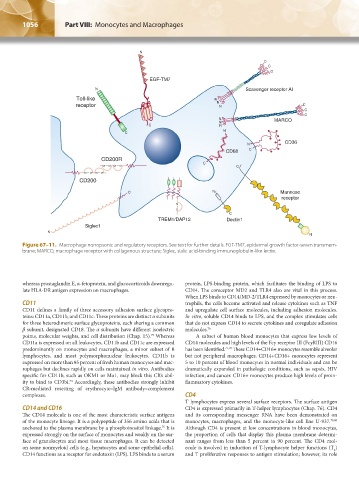
               Figure 67–11.  Macrophage nonopsonic and regulatory receptors. See text for further details. EGF-TM7, epidermal growth factor-seven transmem-
               brane; MARCO, macrophage receptor with collagenous structure; Siglec, sialic acid-binding immunoglobulin-like lectin.


               whereas prostaglandin E, α-fetoprotein, and glucocorticoids downregu-  protein, LPS-binding protein, which facilitates the binding of LPS to
               late HLA-DR antigen expression on macrophages.         CD14. The coreceptor MD2 and TLR4 also are vital in this process.
                                                                      When LPS binds to CD14/MD-2/TLR4 expressed by monocytes or neu-
               CD11                                                   trophils, the cells become activated and release cytokines such as TNF
               CD11 defines a family of three accessory adhesion surface glycopro-  and upregulate cell surface molecules, including adhesion molecules.
               teins: CD11a, CD11b, and CD11c. These proteins are distinct α subunits   In vitro, soluble CD14 binds to LPS, and the complex stimulates cells
               for three heterodimeric surface glycoproteins, each sharing a common   that do not express CD14 to secrete cytokines and coregulate adhesion
               β subunit, designated CD18. The α subunits have different isoelectric   molecules. 76
               points, molecular weights, and cell distribution (Chap. 15).  Whereas   A subset of human blood monocytes that express low levels of
                                                           73
               CD11a is expressed on all leukocytes, CD11b and CD11c are expressed   CD14 molecules and high levels of the Fcγ receptor III (FcγRIII) CD16
               predominantly on monocytes and macrophages, a minor subset of B   has been identified. 77,78  These CD14+CD16+ monocytes resemble alveolar
               lymphocytes,  and  most  polymorphonuclear  leukocytes.  CD11b  is   but not peripheral macrophages. CD14+CD16+ monocytes represent
               expressed on more than 95 percent of fresh human monocytes and mac-  5 to 10 percent of blood monocytes in normal individuals and can be
               rophages but declines rapidly on cells maintained in vitro. Antibodies   dramatically expanded in pathologic conditions, such as sepsis, HIV
               specific for CD11b, such as OKM1 or Mo1, may block this CR’s abil-  infection, and cancer. CD16+ monocytes produce high levels of proin-
               ity to bind to CD3bi.  Accordingly, these antibodies strongly inhibit   flammatory cytokines.
                               74
               CR-mediated  rosetting  of  erythrocyte–IgM  antibody–complement
               complexes.                                             CD4
                                                                      T lymphocytes express several surface receptors. The surface antigen
               CD14 and CD16                                          CD4 is expressed primarily in T-helper lymphocytes (Chap. 76). CD4
               The CD14 molecule is one of the most characteristic surface antigens   and its corresponding messenger RNA have been demonstrated on
               of the monocyte lineage. It is a polypeptide of 356 amino acids that is   monocytes, macrophages, and the monocyte-like cell line U-937. 79,80
               anchored to the plasma membrane by a phosphoinositol linkage.  It is   Although CD4 is present at low concentrations in blood monocytes,
                                                              75
               expressed strongly on the surface of monocytes and weakly on the sur-  the proportion of cells that display this plasma membrane determi-
               face of granulocytes and most tissue macrophages. It can be detected   nant ranges from less than 5 percent to 90 percent. The CD4 mol-
               on some nonmyeloid cells (e.g., hepatocytes and some epithelial cells).   ecule is involved in induction of T-lymphocyte helper functions (T )
                                                                                                                        4
               CD14 functions as a receptor for endotoxin (LPS). LPS binds to a serum   and T proliferative responses to antigen stimulation; however, its role


          Kaushansky_chapter 67_p1043-1074.indd   1056                                                                  9/21/15   10:43 AM

