


Page 1083 - Williams Hematology ( PDFDrive )
P. 1083
1058           Part VIII:  Monocytes and Macrophages                                                                                   Chapter 67:  Structure, Receptors, and Functions of Monocytes and Macrophages             1059


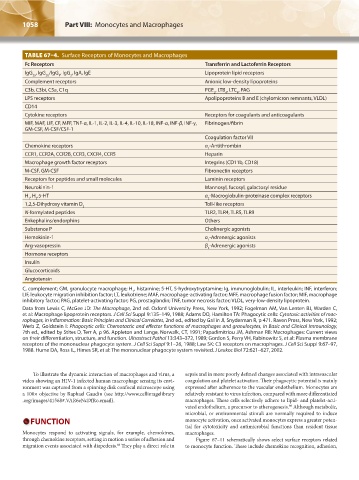
                TABLE 67–4.  Surface Receptors of Monocytes and Macrophages
                Fc Receptors                                                 Transferrin and Lactoferrin Receptors
                IgG , IgG /IgG , IgG , IgA, IgE                              Lipoprotein lipid receptors
                   2a  2b   1  3
                Complement receptors                                         Anionic low-density lipoproteins
                C3b, C3bi, C5a, C1q                                          PGE , LTB , LTC , PAG
                                                                                2  4   4
                LPS receptors                                                Apolipoproteins B and E (chylomicron remnants, VLDL)
                CD14
                Cytokine receptors                                           Receptors for coagulants and anticoagulants
                MIF, MAF, LIF, CF, MFF, TNF-α, IL-1, IL-2, IL-3, IL-4, IL-10, IL-18, INF-α, INF-β, INF-γ,   Fibrinogen/fibrin
                GM-CSF, M-CSF/CSF-1
                                                                             Coagulation factor VII
                Chemokine receptors                                          α -Antithrombin
                                                                              1
                CCR1, CCR2A, CCR2B, CCR3, CXCR4, CCR5                        Heparin
                Macrophage growth factor receptors                           Integrins (CD11b, CD18)
                M-CSF, GM-CSF                                                Fibronectin receptors
                Receptors for peptides and small molecules                   Laminin receptors
                Neurokinin-1                                                 Mannosyl, fucosyl, galactosyl residue
                H , H ,5-HT                                                  α -Macroglobulin-proteinase complex receptors
                 1  2                                                         2
                1,2,5-Dihydroxy vitamin D                                    Toll-like receptors
                                    3
                N-formylated peptides                                        TLR2, TLR4, TLR5, TLR9
                Enkephalins/endorphins                                       Others
                Substance P                                                  Cholinergic agonists
                Hemokinin-1                                                  α -Adrenergic agonists
                                                                              1
                Arg-vasopressin                                              β -Adrenergic agonists
                                                                              2
                Hormone receptors
                Insulin
                Glucocorticoids
                Angiotensin
               C, complement; GM, granulocyte macrophage; H , histamine; 5-HT, 5-hydroxytryptamine; Ig, immunoglobulin; IL, interleukin; INF, interferon;
                                                    1
               LIF, leukocyte migration inhibition factor; LT, leukotriene; MAF, macrophage-activating factor; MFF, macrophage fusion factor; MIF, macrophage
               inhibitory factor; PAG, platelet-activating factor; PG, prostaglandin; TNF, tumor necrosis factor; VLDL, very-low-density lipoprotein.
               Data from Lewis C, McGee JD: The Macrophage, 2nd ed. Oxford University Press, New York, 1992; Fogelman AM, Van Lenten BJ, Warden C,
               et al: Macrophage lipoprotein receptors. J Cell Sci Suppl 9:135–149, 1988; Adams DO, Hamilton TA: Phagocytic cells: Cytotoxic activities of mac-
               rophages, in Inflammation: Basic Principles and Clinical Correlates, 2nd ed., edited by Gallin JI, Snyderman R, p 471. Raven Press, New York, 1992;
               Werb Z, Goldstein I: Phagocytic cells: Chemotactic and effector functions of macrophages and granulocytes, in Basic and Clinical Immunology,
               7th ed., edited by Stites D, Terr A, p 96. Appleton and Lange, Norwalk, CT, 1991; Papadimitriou JM, Ashman RB: Macrophages: Current views
               on their differentiation, structure, and function. Ultrastruct Pathol 13:343–372, 1989; Gordon S, Perry VH, Rabinowitz S, et al: Plasma membrane
               receptors of the mononuclear phagocyte system. J Cell Sci Suppl 9:1–26, 1988; Law SK: C3 receptors on macrophages. J Cell Sci Suppl 9:67–97,
               1988. Hume DA, Ross IL, Himes SR, et al: The mononuclear phagocyte system revisited. J Leukoc Biol 72:621–627, 2002.


                   To illustrate the dynamic interaction of macrophages and virus, a   sepsis and in more poorly defined changes associated with intravascular
               video showing an HIV-1 infected human macrophage sensing its envi-  coagulation and platelet activation. Their phagocytic potential is mainly
               ronment was captured from a spinning disk confocal microscope using   expressed after adherence to the vascular endothelium. Monocytes are
               a 100× objective by Raphael Gaudin (see http://www.cellimagelibrary   relatively resistant to virus infection, compared with more differentiated
               .org/images/41568#.VAR6eNcDfRo.email).                 macrophages. These cells selectively adhere to lipid- and platelet-acti-
                                                                      vated endothelium, a precursor to atherogenesis.  Although metabolic,
                                                                                                         89
                                                                      microbial, or environmental stimuli are normally required to induce
                    FUNCTION                                          monocyte activation, once activated monocytes express a greater poten-
                                                                      tial  for cytotoxicity and antimicrobial functions than resident tissue
               Monocytes  respond to  activating  signals,  for  example,  chemokines,   macrophages.
               through chemokine receptors, setting in motion a series of adhesion and   Figure  67–11 schematically shows select surface receptors related
               migration events associated with diapedesis.  They play a direct role in   to monocyte function. These include chemokine recognition, adhesion,
                                               88


          Kaushansky_chapter 67_p1043-1074.indd   1058                                                                  9/21/15   10:43 AM

