


Page 1086 - Williams Hematology ( PDFDrive )
P. 1086
1060  Part VIII:  Monocytes and Macrophages  Chapter 67:  Structure, Receptors, and Functions of Monocytes and Macrophages  1061


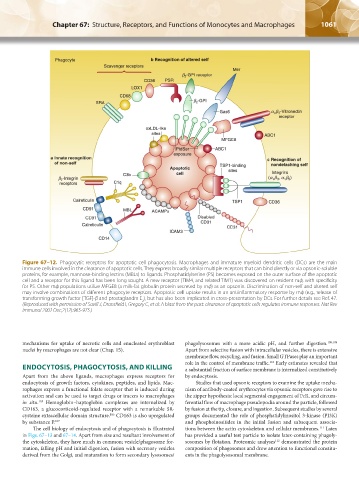
                  Figure 67–12.  Phagocytic receptors for apoptotic cell phagocytosis. Macrophages and immature myeloid dendritic cells (DCs) are the main
                  immune cells involved in the clearance of apoptotic cells. They express broadly similar multiple receptors that can bind directly or via opsonic-soluble
                  proteins, for example, mannose-binding lectins (MBLs) to ligands. Phosphatidylserine (PS) becomes exposed on the outer surface of the apoptotic
                  cell and a receptor for this ligand has been long sought. A new receptor (TIM4, and related TIM1) was discovered on resident mф, with specificity
                  for PS. Other mф populations utilize MFGE8 (a milk-fat globulin protein secreted by mф) as an opsonin. Discrimination of non-self and altered self
                  may involve combinations of different phagocyte receptors. Apoptotic cell uptake results in an antiinflammatory response by mф (e.g., release of
                  transforming growth factor [TGF]-β and prostaglandin E ), but has also been implicated in cross-presentation by DCs. For further details see Ref. 47.
                                                          2
                  (Reproduced with permission of Savill J, Dransfield I, Gregory C, et al: A blast from the past: clearance of apoptotic cells regulates immune responses. Nat Rev
                  Immunol 2002 Dec;2(12):965-975.)


                  mechanisms for uptake of  necrotic cells and enucleated erythroblast   phagolysosomes with a more acidic pH, and further digestion. 108,109
                  nuclei by macrophages are not clear (Chap. 15).       Apart from selective fusion with intracellular vesicles, there is extensive
                                                                        membrane flow, recycling, and fusion. Small GTPases play an important
                                                                        role in the control of membrane traffic.  Early estimates revealed that
                                                                                                     110
                  ENDOCYTOSIS, PHAGOCYTOSIS, AND KILLING                a substantial fraction of surface membrane is internalized constitutively
                  Apart from the above ligands, macrophages express receptors for   by endocytosis.
                  endocytosis of growth factors, cytokines, peptides, and lipids. Mac-  Studies that used opsonic receptors to examine the uptake mecha-
                  rophages express a functional folate receptor that is induced during   nism of antibody-coated erythrocytes via opsonic receptors gave rise to
                  activation and can be used to target drugs or tracers to macrophages   the zipper hypothesis: local segmental engagement of FcR, and circum-
                  in situ.  Hemoglobin–haptoglobin complexes  are internalized by   ferential flow of macrophage pseudopodia around the particle, followed
                       105
                  CD163, a glucocorticoid-regulated receptor with a remarkable SR-  by fusion at the tip, closure, and ingestion. Subsequent studies by several
                  cysteine extracellular domain structure.  CD163 is also upregulated   groups documented the role of phosphatidylinositol 3-kinase (PI3K)
                                               106
                  by substance P. 107                                   and phosphoinositides in the  initial fusion and subsequent associa-
                     The cell biology of endocytosis and of phagocytosis is illustrated   tions between the actin cytoskeleton and cellular membranes.  Latex
                                                                                                                     111
                  in Figs. 67–13 and 67–14. Apart from size and resultant involvement of   has provided a useful test particle to isolate latex-containing phagoly-
                  the cytoskeleton, they have much in common; vesicle/phagosome for-  sosomes by flotation. Proteomic analyses  demonstrated the protein
                                                                                                       112
                  mation, falling pH and initial digestion, fusion with secretory vesicles   composition of phagosomes and drew attention to functional constitu-
                  derived from the Golgi, and maturation to form secondary lysosomes/  ents in the phagolysosomal membrane.


          Kaushansky_chapter 67_p1043-1074.indd   1061                                                                  9/21/15   10:43 AM

