


Page 1087 - Williams Hematology ( PDFDrive )
P. 1087
1062           Part VIII:  Monocytes and Macrophages                                                                                   Chapter 67:  Structure, Receptors, and Functions of Monocytes and Macrophages             1063


                                                Phagocytosis                    Endocytosis


                                                            Actin polymerization
                                                            Pseudopod formation/
                                                            membrane invagination
                              Antigen                       Membrane recruitment
                             presentation                   Membrane closure
                                                                                              Early endosome
                                                                  Rab4, Rab5,
                                                               other fusion proteins

                              Partial degradation             Phagosome maturation
                                                                by interaction with
                                                                endocytic pathway
                                                                                              Late endosome
                                                                 Rab7, Rab9
                                                                  Cathepsin


                                                                  Phagolysosome
                                                                                           Lysosome
                                                                     LAMP1
                                                                     LAMP2
                                                                     LAMP3


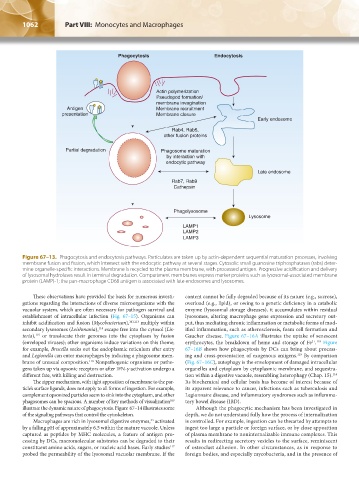
               Figure 67–13.  Phagocytosis and endocytosis pathways. Particulates are taken up by actin-dependent sequential maturation processes, involving
               membrane fusion and fission, which intersect with the endocytic pathway at several stages. Cytosolic small guanosine triphosphatases (rabs) deter-
               mine organelle-specific interactions. Membrane is recycled to the plasma membrane, with processed antigen. Progressive acidification and delivery
               of lysosomal hydrolases result in terminal degradation. Compartment membranes express marker proteins such as lysosomal-associated membrane
               protein (LAMP)-1; the pan-macrophage CD68 antigen is associated with late endosomes and lysosomes.


                   These observations have provided the basis for numerous investi-  content cannot be fully degraded because of its nature (e.g., sucrose),
               gations regarding the interactions of diverse microorganisms with the   overload (e.g., lipid), or owing to a genetic deficiency in a catabolic
               vacuolar system, which are often necessary for pathogen survival and   enzyme (lysosomal storage diseases), it accumulates within residual
               establishment of intracellular infection (Fig. 67–15). Organisms can   lysosomes, altering macrophage gene expression and secretory out-
               inhibit acidification and fusion (Mycobacterium), 101,113  multiply within   put, thus mediating chronic inflammation or metabolic forms of mod-
               secondary lysosomes (Leishmania),  escape free into the cytosol (Lis-  ified inflammation, such as atherosclerosis, foam cell formation and
                                         114
               teria),  or translocate their genomes into the cytoplasm by fusion   Gaucher disease.  Figure 67–16A illustrates the uptake of senescent
                    115
               (enveloped viruses); other organisms induce variations on this theme;   erythrocytes, the breakdown of heme and storage of Fe .   Figure
                                                                                                                2+ 118
               for example, Brucella seeks out the endoplasmic reticulum after entry   67–16B shows how phagocytosis by DCs can bring about process-
               and Legionella can enter macrophages by inducing a phagosome mem-  ing and cross-presentation of exogenous antigens.  By comparison
                                                                                                            119
               brane of unusual composition.  Nonpathogenic organisms or patho-  (Fig. 67–16C), autophagy is the envelopment of damaged intracellular
                                      116
               gens taken up via opsonic receptors or after IFN-γ activation undergo a   organelles and cytoplasm by cytoplasmic membrane, and sequestra-
               different fate, with killing and destruction.          tion within a digestive vacuole, resembling heterophagy (Chap. 15).
                                                                                                                       116
                   The zipper mechanism, with tight apposition of membrane to the par-  Its biochemical and cellular basis has become of interest because of
               ticle’s surface ligands, does not apply to all forms of ingestion. For example,   its apparent relevance to cancer, infections such as tuberculosis and
               complement opsonized particles seem to sink into the cytoplasm, and other   Legionnaire disease, and inflammatory syndromes such as inflamma-
               phagosomes can be spacious. A number of key methods of visualization    tory bowel disease (IBD).
                                                                 109
               illustrate the dynamic nature of phagocytosis. Figure  67–14 illustrates some   Although the phagocytic mechanism has been investigated in
               of the signaling pathways that control the cytoskeleton.  depth, we do not understand fully how the process of internalization
                   Macrophages are rich in lysosomal digestive enzymes,  activated   is controlled. For example, ingestion can be thwarted by attempts to
                                                          33
               by a falling pH of approximately 6.5 within the mature vacuole. Unless   ingest too large a particle or foreign surface, or by close apposition
               captured as peptides by MHC  molecules,  a feature of antigen  pro-  of plasma membrane to noninternalizable immune complexes. This
               cessing by DCs, macromolecular substrates can be degraded to their   results in redirecting secretory vesicles to the surface, reminiscent
               constituent amino acids, sugars, or nucleic acid bases. Early studies    of osteoclast adhesion. In other circumstances, as in response to
                                                                 117
               probed the permeability of the lysosomal vacuolar membrane. If the   foreign bodies, and especially mycobacteria, and in the presence of


          Kaushansky_chapter 67_p1043-1074.indd   1062                                                                  9/21/15   10:43 AM

