


Page 1088 - Williams Hematology ( PDFDrive )
P. 1088
1062  Part VIII:  Monocytes and Macrophages  Chapter 67:  Structure, Receptors, and Functions of Monocytes and Macrophages  1063


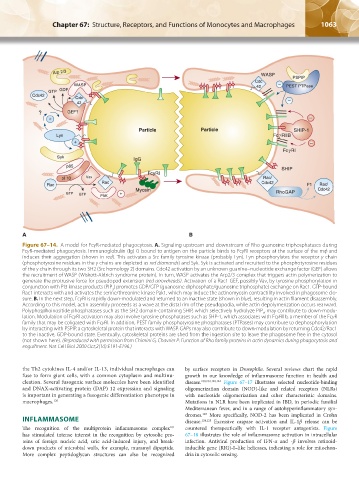
                  Figure 67–14.  A model for FcγR-mediated phagocytosis. A. Signaling upstream and downstream of Rho guanosine triphosphatases during
                  FcγR-mediated phagocytosis. Immunoglobulin (Ig) G bound to antigen on the particle binds to FcγRI receptors at the surface of the mф and
                  induces their aggregation (shown in red). This activates a Src family tyrosine kinase (probably Lyn). Lyn phosphorylates the receptor γ chain
                  (phosphotyrosine residues in the γ chains are depicted as red diamonds) and Syk. Syk is activated and recruited to the phosphotyrosine residues
                  of the γ chain through its two SH2 (Src homology 2) domains. Cdc42 activation by an unknown guanine–nucleotide exchange factor (GEF) allows
                  the recruitment of WASP (Wiskott-Aldrich syndrome protein). In turn, WASP activates the Arp2/3 complex that triggers actin polymerization to
                  generate the protrusive force for pseudopod extension (red arrowheads). Activation of a Rac1 GEF, possibly Vav, by tyrosine phosphorylation in
                  conjunction with PI3 kinase products (PIP ) promotes GDP/GTP (guanosine diphosphate/guanosine triphosphate) exchange on Rac1. GTP-bound
                                                3
                  Rac1 interacts with and activates the serine/threonine kinase Pak1, which may induce the actinomyosin contractility involved in phagosome clo-
                  sure. B. In the next step, FcγRI is rapidly down-modulated and returned to an inactive state (shown in blue), resulting in actin filament disassembly.
                  According to this model, actin assembly proceeds as a wave at the distal rim of the pseudopodia, while actin depolymerization occurs rearward.
                  Polyphosphoinositide phosphatases such as the SH2 domain-containing SHIP, which selectively hydrolyze PIP , may contribute to down-modu-
                                                                                                  3
                  lation. Modulation of FcγRI activation may also involve tyrosine phosphatases such as SHP-1, which associates with FcγRIIb, a member of the FcγR
                  family that may be coligated with FcγRI. In addition, PEST family phosphotyrosine phosphatases (PTPases) may contribute to dephosphorylation
                  by interacting with PSPIP, a cytoskeletal protein that interacts with WASP. GAPs may also contribute to down-modulation by returning Cdc42/Rac1
                  to the inactive, GDP-bound state. Eventually, cytoskeletal proteins are shed from the ingestion site to leave the phagosome free in the cytosol
                  (not shown here). (Reproduced with permission from Chimini G, Chavrier P: Function of Rho family proteins in actin dynamics during phagocytosis and
                  engulfment. Nat Cell Biol 2000 Oct;2(10):E191-E196.)


                  the Th2 cytokines IL-4 and/or IL-13, individual macrophages can   by surface receptors in  Drosophila. Several reviews chart the rapid
                  fuse to form giant cells, with a common cytoplasm and multinu-  growth in our knowledge of inflammasome function in health and
                  cleation. Several fusogenic surface molecules have been identified   disease. 100,102,121,122   Figure 67–17 illustrates selected nucleotide-binding
                  and DNAX-activating protein (DAP) 12 expression and signaling   oligomerization domain (NOD)-like and related receptors  (NLRs)
                  is important in generating a fusogenic differentiation phenotype in   with nucleotide oligomerization and other characteristic domains.
                  macrophages. 120                                      Mutations in NLR have been implicated in IBD, in periodic familial
                                                                        Mediterranean fever, and in a range of autohyperinflammatory syn-
                                                                        dromes.  More specifically, NOD-2 has been implicated in Crohn
                                                                              123
                  INFLAMMASOME                                          disease. 124,125  Excessive  caspase activation and IL-1β release can be
                                                                   101
                  The recognition of the multiprotein inflammasome complex    countered therapeutically with IL-1 receptor antagonists.  Figure
                  has stimulated intense interest in the recognition by cytosolic pro-  67–18 illustrates the role of inflammasome activation in intracellular
                  teins of foreign nucleic acid, uric acid-induced injury, and break-  infection.  Antiviral  production  of  IFN-α  and  -β  involves  retinoid-
                  down products of microbial walls, for example, muramyl dipeptide.   inducible gene (RIG)-I–like helicases, indicating a role for mitochon-
                  More complex peptidoglycan structures can also be recognized   dria in cytosolic sensing.


          Kaushansky_chapter 67_p1043-1074.indd   1063                                                                  9/21/15   10:43 AM

