


Page 1767 - Williams Hematology ( PDFDrive )
P. 1767
1742           Part XI:  Malignant Lymphoid Diseases                                                                                                                                             Chapter 107:  Myeloma           1743


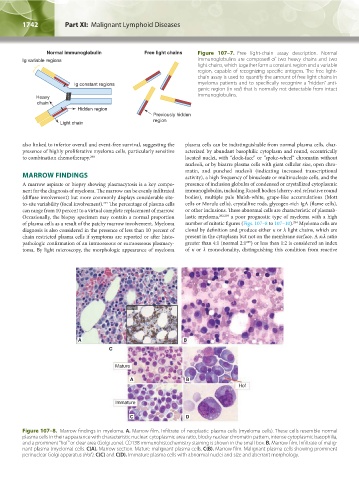
                        Normal immunoglobulin           Free light chains  Figure 107–7.  Free light-chain assay description. Normal
               Ig variable regions                                        immunoglobulins are composed of two heavy chains and two
                                                                          light chains, which together form a constant region and a variable
                                                                          region, capable of recognizing specific antigens. The free light-
                                                                          chain assay is used to quantify the amount of free light chains in
                                 Ig constant regions                      myeloma patients and to specifically recognize a “hidden” anti-
                                                                          genic region (in red) that is normally not detectable from intact
                    Heavy                                                 immunoglobulins.
                    chain
                                  Hidden region
                                                           Previously hidden
                                                           region
                            Light chain


               also linked to inferior overall and event-free survival, suggesting the   plasma cells can be indistinguishable from normal plasma cells, char-
               presence of highly proliferative myeloma cells, particularly sensitive   acterized by abundant basophilic cytoplasm and round, eccentrically
               to combination chemotherapy. 290                       located nuclei, with “clock-face” or “spoke-wheel” chromatin without
                                                                      nucleoli, or by bizarre plasma cells with giant cellular size, open chro-
                                                                      matin, and punched nucleoli (indicating increased transcriptional
               MARROW FINDINGS                                        activity), a high frequency of binucleate or multinucleate cells, and the
               A marrow aspirate or biopsy showing plasmacytosis is a key compo-  presence of inclusion globules of condensed or crystallized cytoplasmic
               nent for the diagnosis of myeloma. The marrow can be evenly infiltrated   immunoglobulin, including Russell bodies (cherry-red refractive round
               (diffuse involvement) but more commonly displays considerable site-  bodies), multiple pale bluish-white, grape-like accumulations (Mott
               to-site variability (focal involvement).  The percentage of plasma cells   cells or Morula cells), crystalline rods, glycogen-rich IgA (flame cells),
                                           291
               can range from 10 percent to a virtual complete replacement of marrow.   or other inclusions. These abnormal cells are characteristic of plasmab-
               Occasionally, the biopsy specimen may contain a normal proportion   lastic myeloma, 292,293  a poor prognostic type of myeloma with a high
                                                                                                          294
               of plasma cells as a result of the patchy marrow involvement. Myeloma   number of mitotic figures (Figs. 107–8 to 107–10).  Myeloma cells are
               diagnosis is also considered in the presence of less than 10 percent of   clonal by definition and produce either κ or λ light chains, which are
               chain restricted plasma cells if symptoms are reported or after histo-  present in the cytoplasm but not on the membrane surface. A κ:λ ratio
                                                                                          295
               pathologic confirmation of an intraosseous or extraosseous plasmacy-  greater than 4:1 (normal 2:1 ) or less than 1:2 is considered an index
               toma. By light microscopy, the morphologic appearance of myeloma   of  κ or  λ monoclonality, distinguishing this condition from reactive


                                  A                                  B
                                            C

                                               Mature

                                                   A                  B
                                                                                        Hof


                                               Immature

                                                   C                  D

               Figure 107–8.  Marrow findings in myeloma. A. Marrow film. Infiltrate of neoplastic plasma cells (myeloma cells). These cells resemble normal
               plasma cells in their appearance with characteristic nuclear: cytoplasmic area ratio, blocky nuclear chromatin pattern, intense cytoplasmic basophilia,
               and a prominent “hof” or clear area (Golgi zone). CD138 immunohistochemistry staining is shown in the small box. B. Marrow film. Infiltrate of malig-
               nant plasma (myeloma) cells. C(A). Marrow section. Mature malignant plasma cells. C(B). Marrow film. Malignant plasma cells showing prominent
               perinuclear Golgi apparatus (Hof). C(C) and C(D). Immature plasma cells with abnormal nuclei and size and aberrant morphology.


          Kaushansky_chapter 107_p1733-1772.indd   1742                                                                 9/21/15   12:34 PM

