


Page 1769 - Williams Hematology ( PDFDrive )
P. 1769
1744           Part XI:  Malignant Lymphoid Diseases                                                                                                                                             Chapter 107:  Myeloma           1745


               Figure 107–11.  Kappa-lambda staining.


               plasmacytosis.   Two-parameter  flow  cytometry  staining  for nuclear
                          296
               DNA content by propidium iodide and anti-κ and anti-λ light-chains
               can also be used to quantitate marrow involvement (Fig. 107–11).
                                                                 297
               Myeloma cells are normally CD138+, CD45–, CD38+, and CD19– ,
                                                                298
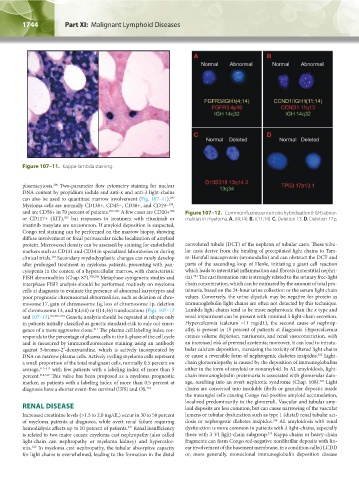
               and are CD56+ in 70 percent of patients. 299–301  A few cases are CD20+    Figure 107–12.  Common fluorescence in situ hybridization (FISH) abnor-
                                                                 302
               or CD117+ (KIT),  but responses to treatment with rituximab or   malities in myeloma. A. t(4;14). B. t(11;14). C. Deletion 13. D. Deletion 17p.
                             303
               imatinib mesylate are uncommon. If amyloid deposition is suspected,
               Congo red staining can be performed on the marrow biopsy, showing
               diffuse involvement or focal perivascular niche localization of amyloid
               protein. Microvessel density can be assessed by staining for endothelial   convoluted tubule (DCT) of the nephron of tubular casts. These tubu-
               markers such as CD131 and CD34 in specialized laboratories or during   lar casts derive from the binding of precipitated light chains to Tam-
               clinical trials.  Secondary myelodysplastic changes can rarely develop   m-Horsfall mucoprotein (uromodulin) and can obstruct the DCT and
                         304
               after prolonged treatment in myeloma patients, presenting with pan-  parts of the ascending loop of Henle, initiating a giant cell reaction
               cytopenia in the context of a hypercellular marrow, with characteristic   which leads to interstitial inflammation and fibrosis (interstitial nephri-
                                                                         321
               FISH abnormalities (Chap. 87). 305,306  Metaphase cytogenetic studies and   tis).  The cast formation rate is strongly related to the urinary free-light
               interphase FISH analysis should be performed routinely on myeloma   chain concentration, which can be estimated by the amount of total pro-
               cells at diagnosis to evaluate the presence of abnormal karyotypes and   teinuria, based on the 24-hour urine collection or the serum light chain
               poor prognostic chromosomal abnormalities, such as deletion of chro-  values. Conversely, the urine dipstick may be negative for protein as
               mosome 17, gain of chromosome 1q, loss of chromosome 1p, deletion   immunoglobulin light chains are often not detected by this technique.
               of chromosome 13, and t(4;14) or t(14;16) translocations (Figs. 107–12   Lambda light chains tend to be more nephrotoxic than the κ type and
               and 107–13). 63,307–310  Genetic analysis should be repeated at relapse only   renal impairment can be present with minimal λ light-chain secretion.
               in patients initially classified as genetic standard-risk to rule out emer-  Hypercalcemia (calcium >11 mg/dL), the second cause of nephrop-
               gence of a more aggressive clone.  The plasma cell labeling index cor-  athy, is present in 15 percent of patients at diagnosis. Hypercalcemia
                                       311
               responds to the percentage of plasma cells in the S-phase of the cell cycle   creates volume depletion, natriuresis, and renal vasoconstriction, with
               and is measured by immunofluorescence staining using an antibody   an increased risk of prerenal azotemia; moreover, it can lead to intratu-
               against 5-bromo-2′-deoxyuridine, which is actively incorporated by   bular calcium deposition, increasing the toxicity of filtered light chains
                                                                                                                  322
               DNA on marrow plasma cells. Actively cycling myeloma cells represent   or cause a reversible form of nephrogenic diabetes insipidus.  Light-
               a small proportion of the total malignant cells, normally 0.5 percent on   chain glomerulopathy is caused by the deposition of immunoglobulins
               average, 312–317  with few patients with a labeling index of more than 5   either in the form of amyloid or nonamyloid. In AL amyloidosis, light-
               percent. 318,319  This value has been proposed as a myeloma prognostic   chain immunoglobulin proteinuria is associated with glomerular dam-
               marker, as patients with a labeling index of more than 0.5 percent at   age, resulting into an overt nephrotic syndrome (Chap. 108).  Light
                                                                                                                   323
               diagnosis have a shorter event-free survival (EFS) and OS. 318  chains are converted into insoluble fibrils or granular deposits inside
                                                                      the mesangial cells causing Congo red-positive amyloid accumulation,
                                                                      localized predominantly in the glomeruli. Vascular and tubular amy-
               RENAL DISEASE                                          loid deposits are less common, but can cause narrowing of the vascular
               Increased creatinine levels (>1.5 to 2.0 mg/dL) occur in 30 to 50 percent   lumens or tubular dysfunction such as type 1 (distal) renal tubular aci-
               of myeloma patients at diagnosis, while overt renal failure requiring   dosis or nephrogenic diabetes insipidus.  AL amyloidosis with renal
                                                                                                   324
               hemodialysis affects up to 10 percent of patients.  Renal insufficiency   dysfunction is more common in patients with λ light-chains, especially
                                                   247
                                                                                                  325
               is related to two major causes: myeloma cast nephropathy (also called   those with λ VI light-chain subgroup.  Kappa chains or heavy-chain
               light-chain cast nephropathy or myeloma kidney) and hypercalce-  fragments can form Congo red-negative nonfibrillar deposits with lin-
                   320
               mia.  In myeloma cast nephropathy, the tubular absorptive capacity   ear involvement of the basement membrane, in a condition called LCDD
               for light chains is overwhelmed, leading to the formation in the distal   or, more generally, monoclonal immunoglobulin deposition disease


          Kaushansky_chapter 107_p1733-1772.indd   1744                                                                 9/21/15   12:34 PM

