


Page 1941 - Williams Hematology ( PDFDrive )
P. 1941
1916           Part XII:  Hemostasis and Thrombosis                                                                                        Chapter 113:  Molecular Biology and Biochemistry of the Coagulation Factors           1917


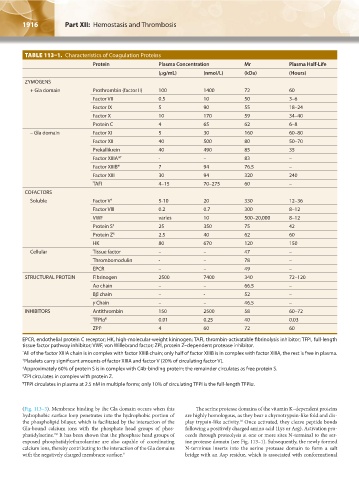
                TABLE 113–1.  Characteristics of Coagulation Proteins
                                       Protein               Plasma Concentration         Mr             Plasma Half-Life
                                                             (μg/mL)        (nmol/L)      (kDa)          (Hours)
                ZYMOGENS
                  + Gla domain         Prothrombin (factor II)  100         1400          72             60
                                       Factor VII            0.5            10            50             3–6
                                       Factor IX             5              90            55             18–24
                                       Factor X              10             170           59             34–40
                                       Protein C             4              65            62             6–8
                  – Gla domain         Factor XI             5              30            160            60–80
                                       Factor XII            40             500           80             50–70
                                       Prekallikrein         40             490           85             35
                                       Factor XIIIA* †       -              –             83             –
                                       Factor XIIIB*         7              94            76.5           –
                                       Factor XIII           30             94            320            240
                                       TAFI                  4–15           70–275        60             –
                COFACTORS
                  Soluble              Factor V †            5-10           20            330            12–36
                                       Factor VIII           0.2            0.7           300            8–12
                                       VWF                   varies         10            500–20,000     8–12
                                       Protein S ‡           25             350           75             42
                                       Protein Z §           2.5            40            62             60
                                       HK                    80             670           120            150
                  Cellular             Tissue factor         –              –             47             –
                                       Thrombomodulin        -              –             78             –
                                       EPCR                  –              –             49             –
                STRUCTURAL PROTEIN     Fibrinogen            2500           7400          340            72–120
                                       Aα chain              –              –             66.5           –
                                       Bβ chain              –              -             52             –
                                       γ Chain               –              –             46.5           –
                INHIBITORS             Antithrombin          150            2500          58             60–72
                                       TFPIα ¶               0.01           0.25          40             0.03
                                       ZPI §                 4              60            72             60

               EPCR, endothelial protein C receptor; HK, high-molecular-weight kininogen; TAFI, thrombin-activatable fibrinolysis inhibitor; TFPI, full-length
               tissue factor pathway inhibitor; VWF, von Willebrand factor; ZPI, protein Z–dependent protease inhibitor.
               * All of the factor XIIIA chain is in complex with factor XIIIB chain; only half of factor XIIIB is in complex with factor XIIIA, the rest is free in plasma.
               † Platelets carry significant amounts of factor XIIIA and factor V (20% of circulating factor V).
               ‡ Approximately 60% of protein S is in complex with C4b-binding protein; the remainder circulates as free protein S.
               § ZPI circulates in complex with protein Z.
               ¶ TFPI circulates in plasma at 2.5 nM in multiple forms; only 10% of circulating TFPI is the full-length TFPIα.


               (Fig. 113–3). Membrane binding by the Gla domain occurs when this   The serine protease domains of the vitamin K–dependent proteins
               hydrophobic surface loop penetrates into the hydrophobic portion of   are highly homologous, as they bear a chymotrypsin-like fold and dis-
               the phospholipid bilayer, which is facilitated by the interaction of the   play trypsin-like activity.  Once activated, they cleave peptide bonds
                                                                                        10
               Gla-bound calcium ions with the phosphate head groups of phos-  following a positively charged amino acid (Lys or Arg). Activation pro-
               phatidylserine.  It has been shown that the phosphate head groups of   ceeds through proteolysis at one or more sites N-terminal to the ser-
                          7,8
               exposed phosphatidylethanolamine are also capable of coordinating   ine protease domain (see Fig. 113–1). Subsequently, the newly formed
               calcium ions, thereby contributing to the interaction of the Gla domains   N-terminus  inserts into the serine protease domain to form a  salt
               with the negatively charged membrane surface. 9        bridge with an Asp residue, which is associated with conformational


          Kaushansky_chapter 113_p1915-1948.indd   1916                                                                 9/21/15   2:39 PM

