


Page 1946 - Williams Hematology ( PDFDrive )
P. 1946
1920  Part XII:  Hemostasis and Thrombosis  Chapter 113:  Molecular Biology and Biochemistry of the Coagulation Factors  1921


                       1        2       34        5    6  7   8         at this position dramatically reduces factor IX activity resulting in
                  Gene                                          13 kb   hemophilia B. 46,47  An O-linked fucose (Ser61) and glucose (Ser63) are
                                                                        found in the EGF 1 domain, in addition to several O-linked glycans in
                                                                        the activation peptide (Thr159, Thr169, Thr172, and Thr179). Further
                                                                        modification of the activation peptide includes N-linked glycosylation
                   mRNA                      2.7 kb                     of Asn residues 157 and 167, which modulates the circulating levels of
                                                                        factor IX. 48–50
                                                                            Factor IX binds with high affinity to the extracellular matrix com-
                                                                        ponent collagen IV via residue Lys5 in the Gla domain. 51,52  Although
                                                                        factor IX variants incapable of collagen IV binding exhibit a greater
                    Exon  1   2  34    5   6     7      8
                   Protein  Pro  GLA EGF 1EGF 2  CR  Catalytic domain   recovery, collagen IV association generates an extravascular reservoir
                                                                        of factor IX that enables prolonged action of factor IX at a hemostatic
                  Figure 113–7.  Relationship of gene structure to protein structure in   relevant region.
                  factor VII. The exons, introns, mRNA, and protein structure are as indi-
                  cated. The mRNA is 2.7 kb with a small 5′ untranslated region and a   Factor IX Activation and Factor IXa Activity
                  relatively large 3′ untranslated region (light blue). In the protein, Pro indi-  Limited proteolysis of factor IX at both Arg145 and Arg180 by either
                  cates the prepro leader sequence, GLA indicates the γ-carboxy glutamic   the tissue factor–factor VIIa complex or factor XIa results in the release
                  acid (Gla) domain, and epidermal growth factor (EGF)-1 and -2, as well
                  as the serine protease (catalytic) domain, are indicated. CR indicates the   of the activation peptide and generation of factor IXa (see Fig. 113–1).
                  connecting region that comprises the site of proteolytic activation.  Cleavage at Arg180 generates factor IXaα, which displays catalytic activ-
                                                                        ity toward synthetic substrates only, whereas fully active factor IXaβ is
                                                                        formed following cleavage at Arg145. 53,54
                  although the reported prevalences vary between countries. Homozy-  Factor IXa is a two-chain serine protease (Mr ≈45,000) that is com-
                  gotes and compound heterozygotes develop a hemorrhagic diathesis   posed of a light chain of 145 residues (Mr ≈17,000) and the catalytic
                  that may vary from mild to severe.                    heavy chain of 235 residues (Mr ≈28,000), which are covalently linked
                     The human gene mutation database (http://www.hgmd.org) lists   via a disulfide bond.
                  258 mutations in the factor VII gene. The majority of these are missense   Factor IXa has a low catalytic efficiency as a result of impaired
                  mutations, but splicing and regulatory mutations also occur. Small   access of substrates to the active site that results from steric and elec-
                                                                                      55
                  deletions account for almost 10 percent of the documented mutations.   trostatic repulsion.  Reversible interaction with the cofactor VIIIa on
                  Other gross gene abnormalities appear to be uncommon.  anionic membranes and subsequent factor X binding leads to rear-
                     The factor VII gene harbors many common polymorphisms of   rangement of the regions surrounding the active site and proteolytic
                  which three are notable: Arg353Gln in the catalytic domain, a 10-bp   factor X activation.
                  insertion in the promotor region, and a variable number of 37 bp repeats   The primary plasma inhibitor of factor IXa is the serpin anti-
                  in intron 7.  The minor alleles of these polymorphisms are associated   thrombin, and this inhibition is enhanced by heparin (see Table  113–4),
                          43
                  with decreased levels of factor VII and explain up to 30 percent of the   which induces a conformational change in antithrombin that is required
                  variation in activated factor VII levels. Furthermore, the minor alleles   for simultaneous active site and exosite interactions with factor IXa. 56
                  have been claimed to lower the risk of myocardial infarction. However,
                  this finding has not led to routine genotyping in the management of this   Gene Structure and Variations
                  disorder. The relationship between factor VII levels, factor VII polymor-  The gene encoding factor IX (F9) is located on chromosome Xq27.1 and
                                                                                      57
                  phisms, and venous thrombosis has not been established with certainty.  covers nearly 25 kb.  It is divided into eight exons from which a mature
                                                                        mRNA molecule is transcribed with an ultimate length of 2802 bases
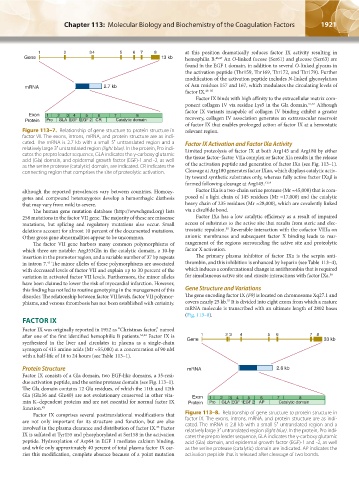
                                                                        (Fig. 113–8).
                  FACTOR IX
                  Factor IX was originally reported in 1952 as “Christmas factor,” named
                  after one of the first identified hemophilia B patients. 34,44  Factor IX is   1  2 3  4  5  6  7  8
                  synthesized  in  the  liver  and  circulates  in  plasma  as  a  single-chain   Gene                 33 kb
                  zymogen of 415 amino acids (Mr ≈55,000) at a concentration of 90 nM
                  with a half-life of 18 to 24 hours (see Table  113–1).

                  Protein Structure                                      mRNA                          2.8 kb
                  Factor IX consists of a Gla domain, two EGF-like domains, a 35-resi-
                  due activation peptide, and the serine protease domain (see Fig. 113–1).
                  The Gla domain contains 12 Gla residues, of which the 11th and 12th
                  Gla (Glu36 and Glu40) are not evolutionary conserved in other vita-  Exon
                                                                                       3
                                                                                                               8
                                                                                          4
                                                                                                  6
                                                                                             5
                  min K–dependent proteins and are not essential for normal factor IX   Protein  1 Pro  2 GLA EGF 1EGF 2  AP  7 Catalytic domain
                  function. 45
                     Factor IX comprises several posttranslational modifications that   Figure 113–8.  Relationship of gene structure to protein structure in
                  are not only important for its structure and function, but are also   factor IX. The exons, introns, mRNA, and protein structure are as indi-
                  involved in the plasma clearance and distribution of factor IX.  Factor   cated. The mRNA is 2.8 kb with a small 5′ untranslated region and a
                                                               35
                                                                        relatively large 3′ untranslated region (light blue). In the protein, Pro indi-
                  IX is sulfated at Tyr155 and phosphorylated at Ser158 in the activation   cates the prepro leader sequence, GLA indicates the γ-carboxy glutamic
                  peptide. Hydroxylation of Asp64 in EGF 1 mediates calcium binding,   acid (Gla) domain, and epidermal growth factor (EGF)-1 and -2, as well
                  and while only approximately 40 percent of total plasma factor IX car-  as the serine protease (catalytic) domain are indicated. AP indicates the
                  ries this modification, complete absence because of a point mutation   activation peptide that is released after cleavage of two bonds.


          Kaushansky_chapter 113_p1915-1948.indd   1921                                                                 9/21/15   2:39 PM

