


Page 1944 - Williams Hematology ( PDFDrive )
P. 1944
1918  Part XII:  Hemostasis and Thrombosis  Chapter 113:  Molecular Biology and Biochemistry of the Coagulation Factors  1919


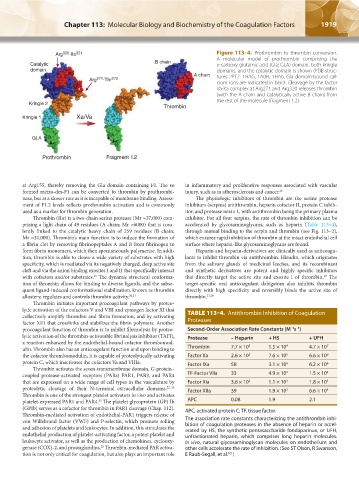
                             Arg 320 -IIe 321                                      Figure 113–4.  Prothrombin to thrombin conversion.
                                                                                   A molecular model of prothrombin comprising the
                    Catalytic                                 B chain              γ-carboxy glutamic acid (Gla; GLA) domain, both kringle
                    domain                                                         domains, and the catalytic domain is shown (PDB struc-
                                                                           A chain  tures 2PF2, 1HAG, 1A0H, 1HAI). Gla domain-bound cal-
                                        Arg 271 -Thr 272
                                                                                   cium ions are indicated in black. Cleavage by the factor
                                                                                   Va-Xa complex at Arg271 and Arg320 releases thrombin
                                                                                   (with the A chain and catalytically active B chain) from
                                                                                   the rest of the molecule (fragment 1.2).
                    Kringle 2
                                                                 Thrombin
                  Kringle 1         Xa/Va


                     GLA


                        Prothrombin           Fragment 1.2


                  at Arg155, thereby removing the Gla domain containing F1. The so   in inflammatory and proliferative responses associated with vascular
                  formed meizo-des-F1 can be converted to thrombin by prothrombi-  injury, such as in atherosclerosis and cancer. 26
                  nase, but at a slower rate as it is incapable of membrane binding. Assess-  The physiologic inhibitors of thrombin  are the serine protease
                  ment of F1.2 levels reflects prothrombin activation and is commonly   inhibitors (serpins) antithrombin, heparin cofactor II, protein C inhib-
                  used as a marker for thrombin generation.             itor, and protease nexin 1, with antithrombin being the primary plasma
                     Thrombin (IIα) is a two-chain serine protease (Mr ≈37,000) com-  inhibitor. For all four serpins, the rate of thrombin inhibition can be
                  prising a light chain of 49 residues (A chain; Mr ≈6000) that is cova-  accelerated by glycosaminoglycans, such as heparin (Table 113–4),
                  lently linked to the catalytic heavy chain of 259 residues (B chain;   through mutual binding to the serpin and thrombin (see Fig. 113–2),
                  Mr ≈31,000). Thrombin’s main function is to induce the formation of   which ensures rapid inhibition of thrombin at the intact endothelial cell
                  a fibrin clot by removing fibrinopeptides A and B from fibrinogen to   surface where heparin-like glycosaminoglycans are found.
                  form fibrin monomers, which then spontaneously polymerize. In addi-  Heparin and heparin-derivatives are clinically used as anticoagu-
                  tion, thrombin is able to cleave a wide variety of substrates with high   lants to inhibit thrombin via antithrombin. Hirudin, which originates
                  specificity, which is mediated via its negatively charged, deep active site   from the salivary glands of medicinal leeches, and its recombinant
                  cleft and via the anion binding exosites I and II that specifically interact   and  synthetic  derivatives  are  potent  and  highly  specific  inhibitors
                  with cofactors and/or substrates.  The dynamic structural conforma-  that directly target the  active site and exosite I  of thrombin.  The
                                                                                                                       27
                                          19
                  tion of thrombin allows for binding to diverse ligands, and the subse-  target-specific oral anticoagulant dabigatran also inhibits thrombin
                  quent ligand-induced conformational stabilization, known as thrombin   directly with high specificity and reversibly binds the active site of
                  allostery, regulates and controls thrombin activity. 20,21  thrombin. 27,28
                     Thrombin initiates important procoagulant pathways by proteo-
                  lytic activation of the cofactors V and VIII and zymogen factor XI that
                  collectively amplify thrombin and fibrin formation, and by activating   TABLE 113–4.  Antithrombin Inhibition of Coagulation
                  factor XIII that crosslinks and stabilizes the fibrin polymers. Another   Proteases
                  procoagulant function of thrombin is to inhibit fibrinolysis by proteo-  Second-Order Association Rate Constants (M s )
                                                                                                            –1 –1
                  lytic activation of the thrombin-activatable fibrinolysis inhibitor (TAFI),   Protease  – Heparin  + H5  + UFH
                  a reaction enhanced by the endothelial-bound cofactor thrombomod-
                  ulin. Thrombin also has an anticoagulant function and upon binding to   Thrombin  7.7 × 10 3  1.5 × 10 4  4.7 × 10 7
                  the cofactor thrombomodulin, it is capable of proteolytically activating   Factor Xa  2.6 × 10 3  7.6 × 10 5  6.6 × 10 6
                  protein C, which inactivates the cofactors Va and VIIIa.  Factor IXa  58          3.1 × 10 4    6.2 × 10 6
                     Thrombin activates the seven-transmembrane domain, G-protein–
                  coupled protease-activated receptors (PARs) PAR1, PAR3, and PAR4   TF-Factor VIIa  33  4.9 × 10 3  1.5 × 10 4
                  that are expressed on a wide range of cell types in the vasculature by   Factor Xia  3.6 × 10 2  1.1 × 10 3  1.8 × 10 5
                  proteolytic cleavage of their N-terminal extracellular domains. 22–25    Factor XIIa  39  1.9 × 10 3  6.6 × 10 4
                  Thrombin is one of the strongest platelet activators in vivo and activates
                  platelet-expressed PAR1 and PAR4.  The platelet glycoprotein (GP) Ib   APC  0.08  1.9           2.1
                                           25
                  (GPIb) serves as a cofactor for thrombin in PAR1 cleavage (Chap. 112).   APC, activated protein C; TF, tissue factor.
                  Thrombin-mediated activation of endothelial-PAR1 triggers release of
                  von Willebrand factor (VWF) and P-selectin, which promote rolling   The association rate constants characterizing the antithrombin inhi-
                  and adhesion of platelets and leukocytes. In addition, this stimulates the   bition of coagulation proteases in the absence of heparin or accel-
                                                                        erated by H5, the synthetic pentasaccharide fondaparinux, or UFH,
                  endothelial production of platelet-activating factor, a potent platelet and   unfractionated heparin, which comprises long heparin molecules.
                  leukocyte activator, as well as the production of chemokines, cyclooxy-  In vivo, natural glycosaminoglycan molecules on endothelium and
                  genase (COX)-2, and prostaglandins.  Thrombin-mediated PAR activa-  other cells accelerate the rate of inhibition. (See ST Olson, R Swanson,
                                            25
                  tion is not only critical for coagulation, but also plays an important role   E Raub-Segall, et al. )
                                                                                       321


          Kaushansky_chapter 113_p1915-1948.indd   1919                                                                 9/21/15   2:39 PM

