


Page 1943 - Williams Hematology ( PDFDrive )
P. 1943
1918           Part XII:  Hemostasis and Thrombosis                                                                                        Chapter 113:  Molecular Biology and Biochemistry of the Coagulation Factors           1919


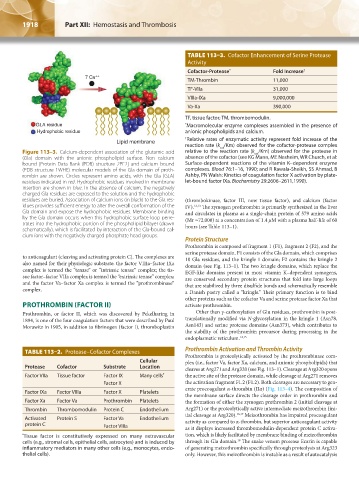
                                                                       TABLE 113–3.  Cofactor Enhancement of Serine Protease
                                                                       Activity
                                                                       Cofactor-Protease *         Fold Increase †
                                    7 Ca ++
                                                                       TM-Thrombin                 11,000
                                                                       TF-VIIa                     31,000
                                                                       VIIIa-IXa                   9,000,000
                                                                       Va-Xa                       390,000
                                                                      TF, tissue factor; TM, thrombomodulin.
                    GLA residue                                       * Macromolecular enzyme complexes assembled in the presence of
                    Hydrophobic residue                               anionic phospholipids and calcium.
                                                                      † Relative rates of enzymatic activity represent fold increase of the
                                               Lipid membrane
                                                                      reaction rate (k /Km) observed for the cofactor-protease complex
                                                                                  cat
               Figure 113–3.  Calcium-dependent association of the glutamic acid   relative to the reaction rate (k /Km) observed for the protease in
                                                                                             cat
               (Gla) domain with the anionic phospholipid surface. Non–calcium   absence of the cofactor (see KG Mann, ME Nesheim, WR Church, et al:
               bound [Protein Data Bank (PDB) structure 2PF2] and calcium bound   Surface-dependent reactions of the vitamin K–dependent enzyme
               (PDB structure 1WHE) molecular models of the Gla domain of proth-  complexes. Blood 76:1–16, 1990; and R Rawala-Sheikh, SS Ahmad, B
               rombin are shown. Circles represent amino acids, with the Gla (GLA)   Ashby, PN Walsh: Kinetics of coagulation factor X activation by plate-
               residues indicated in red. Hydrophobic residues involved in membrane   let-bound factor IXa. Biochemistry 29:2606–2611,1990).
               insertion are shown in blue. In the absence of calcium, the negatively
               charged Gla residues are exposed to the solution and the hydrophobic
               residues are buried. Association of calcium ions (in black) to the Gla res-  (thrombokinase, factor III, now tissue factor), and calcium (factor
               idues provides sufficient energy to alter the overall conformation of the   IV). 12,13  The zymogen prothrombin is primarily synthesized in the liver
               Gla domain and expose the hydrophobic residues. Membrane binding   and circulates in plasma as a single-chain protein of 579 amino acids
               by the Gla domain occurs when this hydrophobic surface loop pene-  (Mr ≈72,000) at a concentration of 1.4 μM with a plasma half-life of 60
               trates into the hydrophobic portion of the phospholipid bilayer (drawn   hours (see Table  113–1).
               schematically), which is facilitated by interaction of the Gla-bound cal-
               cium ions with the negatively charged phosphate head groups.
                                                                      Protein Structure
                                                                      Prothrombin is composed of fragment 1 (F1), fragment 2 (F2), and the
                                                                      serine protease domain. F1 consists of the Gla domain, which comprises
               to anticoagulant (cleaving and activating protein C). The complexes are   10 Gla residues, and the kringle 1 domain; F2 contains the kringle 2
               also named for their physiologic substrate: the factor VIIIa–factor IXa   domain (see Fig. 113–1). The two kringle domains, which replace the
               complex is termed the “tenase” or “intrinsic tenase” complex; the tis-  EGF-like  domains  present  in most vitamin  K–dependent zymogens,
               sue factor–factor VIIa complex is termed the “extrinsic tenase” complex;   are conserved secondary protein structures that fold into large loops
               and the factor Va–factor Xa complex is termed the “prothrombinase”   that are stabilized by three disulfide bonds and schematically resemble
               complex.
                                                                      a Danish pastry called a “kringle.” Their primary function is to bind
                                                                      other proteins such as the cofactor Va and serine protease factor Xa that
               PROTHROMBIN (FACTOR II)                                activate prothrombin.
               Prothrombin, or factor II, which was discovered by Pekelharing in   Other than γ-carboxylation of Glu residues, prothrombin is post-
               1894, is one of the four coagulation factors that were described by Paul   translationally modified via N-glycosylation in the kringle 1 (Asn78,
               Morawitz in 1905, in addition to fibrinogen (factor I), thromboplastin   Asn143) and serine protease domains (Asn373), which contributes to
                                                                      the stability of the prothrombin precursor during processing in the
                                                                      endoplasmatic reticulum. 14,15

                TABLE 113–2.  Protease–Cofactor Complexes             Prothrombin Activation and Thrombin Activity
                                                                      Prothrombin is proteolytically activated by the prothrombinase com-
                                                       Cellular       plex (i.e., factor Va, factor Xa, calcium, and anionic phospholipids) that
                Protease   Cofactor        Substrate   Location       cleaves at Arg271 and Arg320 (see Fig. 113–1). Cleavage at Arg320 opens
                Factor VIIa  Tissue factor  Factor IX  Many cells *   the active site of the protease domain, while cleavage at Arg271 removes
                                           Factor X                   the activation fragment F1.2 (F1.2). Both cleavages are necessary to gen-
                                                                      erate procoagulant α-thrombin (IIα) (Fig. 113–4). The composition of
                Factor IXa  Factor VIIIa   Factor X    Platelets
                                                                      the membrane surface directs the cleavage order in prothrombin and
                Factor Xa  Factor Va       Prothrombin  Platelets     the formation of either the zymogen prethrombin 2 (initial cleavage at
                Thrombin   Thrombomodulin  Protein C   Endothelium    Arg271) or the proteolytically active intermediate meizothrombin (ini-
                                                                      tial cleavage at Arg320). 16,17  Meizothrombin has impaired procoagulant
                Activated   Protein S      Factor Va   Endothelium
                protein C                  Factor VIIIa               activity as compared to α-thrombin, but superior anticoagulant activity
                                                                      as it displays increased thrombomodulin-dependent protein C activa-
               * Tissue factor is constitutively expressed on many extravascular   tion, which is likely facilitated by membrane binding of meizothrombin
                                                                                        18
               cells (e.g., stromal cells, epithelial cells, astrocytes) and is induced by   through its Gla domain.  The snake venom protease Ecarin is capable
               inflammatory mediators in many other cells (e.g., monocytes, endo-  of generating meizothrombin specifically through proteolysis at Arg323
               thelial cells).                                        only. However, this meizothrombin is instable as a result of autocatalysis


          Kaushansky_chapter 113_p1915-1948.indd   1918                                                                 9/21/15   2:39 PM

