


Page 1945 - Williams Hematology ( PDFDrive )
P. 1945
1920           Part XII:  Hemostasis and Thrombosis                                                                                        Chapter 113:  Molecular Biology and Biochemistry of the Coagulation Factors           1921


                     12 34  56    78 9101112               1314       and N-linked (Asn154 in the connecting region, Asn322 in the serine
                Gene                                          20 kb   protease domain) glycosylation.
                                                                      Factor VII Activation and Factor VIIa Activity
                                                                      Factor VII is proteolytically activated once it has formed a high-affin-
                                                                      ity complex with its cofactor tissue factor. A number of coagulation
                mRNA                       2 kb
                                                                      proteases including thrombin and factors IXa and XIIa are capable of
                                                                      cleaving factor VII at Arg152 to generate factor VIIa (see Fig. 113–1),
                                                                      with factor Xa being considered the most potent and physiologically
                                                                                             36
                                                                      relevant activator of factor VII.  Autoactivation can also occur, which
                 Exon  1   2 34 5  6  7  8 9  10  11  12  1314        is initiated by minute amounts (approximately 0.1 nM) of preexisting
                Protein  Pro GLA Kringle 1 Kringle 2 LC  Catalytic domain
                                                                      factor VIIa. 37
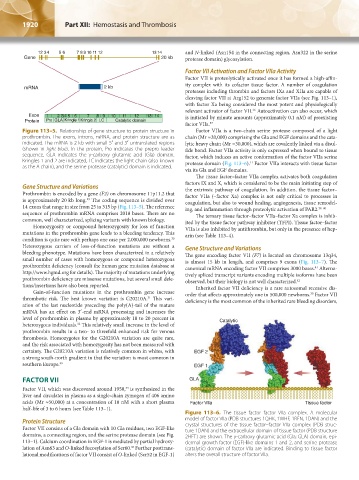
               Figure 113–5.  Relationship of gene structure to protein structure in   Factor VIIa is a two-chain serine protease composed of a light
               prothrombin. The exons, introns, mRNA, and protein structure are as   chain (Mr ≈20,000) comprising the Gla and EGF domains and the cata-
               indicated. The mRNA is 2 kb with small 5′ and 3′ untranslated regions   lytic heavy chain (Mr ≈30,000), which are covalently linked via a disul-
               (shown  in  light blue).  In  the  protein,  Pro  indicates  the  prepro  leader   fide bond. Factor VIIa activity is only expressed when bound to tissue
               sequence, GLA indicates the γ-carboxy glutamic acid (Gla) domain,   factor, which induces an active conformation of the factor VIIa serine
               Kringles 1 and 2 are indicated, LC indicates the light chain (also known   protease domain (Fig. 113–6).  Factor VIIa interacts with tissue factor
                                                                                            11
               as the A chain), and the serine protease (catalytic) domain is indicated.
                                                                      via its Gla and EGF domains.
                                                                          The tissue factor–factor VIIa complex activates both coagulation
                                                                      factors IX and X, which is considered to be the main initiating step of
               Gene Structure and Variations                          the extrinsic pathway of coagulation. In addition, the tissue factor–
               Prothrombin is encoded by a gene (F2) on chromosome 11p11.2 that   factor VIIa (–factor Xa) complex is not only critical to processes in
               is approximately 20 kb long.  The coding sequence is divided over   coagulation, but also to wound healing, angiogenesis, tissue remodel-
                                     29
               14 exons that range in size from 25 to 315 bp (Fig. 113–5). The reference   ing, and inflammation through proteolytic activation of PAR2. 38–40
               sequence of prothrombin mRNA comprises 2018 bases. There are no   The ternary tissue factor–factor VIIa–factor Xa complex is inhib-
               common, well characterized, splicing variants with known biology.  ited by the tissue factor pathway inhibitor (TFPI). Tissue factor–factor
                   Homozygosity or compound heterozygosity for loss of function   VIIa is also inhibited by antithrombin, but only in the presence of hep-
               mutations in the prothrombin gene leads to a bleeding tendency. This   arin (see Table  113–4).
               condition is quite rare with perhaps one case per 2,000,000 newborns.
                                                                 30
               Heterozygous carriers of loss-of-function mutations are without a   Gene Structure and Variations
               bleeding phenotype. Mutations have been characterized in a relatively   The gene encoding factor VII (F7) is located on chromosome 13q34,
               small number of cases with homozygous or compound heterozygous   is almost 15 kb in length, and comprises 9 exons (Fig. 113–7). The
               prothrombin deficiency (consult the human gene mutation database at   canonical mRNA encoding factor VII comprises 3000 bases.  Alterna-
                                                                                                                 41
               http://www.hgmd.org for details). The majority of mutations underlying   tively spliced transcript variants encoding multiple isoforms have been
               prothrombin deficiency are missense mutations, but several small dele-  observed, but their biology is not well characterized. 42
               tions/insertions have also been reported.                  Inherited factor VII deficiency is a rare autosomal recessive dis-
                   Gain-of-function mutations in the prothrombin gene increase   order that affects approximately one in 500,000 newborns.  Factor VII
                                                                                                                30
               thrombotic risk. The best known variation is G20210A.  This vari-  deficiency is the most common of the inherited rare bleeding disorders,
                                                         31
               ation of the last nucleotide preceding the poly(A)-tail of the mature
               mRNA has an effect on 3′-end mRNA processing and increases the
               level of prothrombin in plasma by approximately 10 to 20 percent in   Catalytic
               heterozygous individuals.  This relatively small increase in the level of
                                  32
               prothrombin results in a two- to threefold enhanced risk for venous
               thrombosis. Homozygotes for the G20210A variation are quite rare,
               and the risk associated with homozygosity has not been measured with
               certainty. The G20210A variation is relatively common in whites, with   EGF 2
               a strong south-north gradient in that the variation is most common in
               southern Europe. 33                                       EGF 1

               FACTOR VII                                              GLA
               Factor VII, which was discovered around 1950,  is synthesized in the
                                                  34
               liver and circulates in plasma as a single-chain zymogen of 406 amino
               acids (Mr ≈50,000) at a concentration of 10 nM with a short plasma   Factor Vlla               Tissue factor
               half-life of 3 to 6 hours (see Table  113–1).
                                                                      Figure 113–6.  The tissue factor–factor  VIIa complex. A molecular
               Protein Structure                                      model of factor VIIa (PDB structures 1QHK, 1WHF, 1RFN, 1DAN) and the
               Factor VII consists of a Gla domain with 10 Gla residues, two EGF-like   crystal structures of the tissue factor–factor VIIa complex (PDB struc-
                                                                      ture 1DAN) and the extracellular domain of tissue factor (PDB structure
               domains, a connecting region, and the serine protease domain (see Fig.   2HFT) are shown. The γ-carboxy glutamic acid (Gla; GLA) domain, epi-
               113–1). Calcium coordination in EGF-1 is mediated by partial hydroxy-  dermal growth factor (EGF)-like domains 1 and 2, and serine protease
               lation of Asn63 and O-linked fucosylation of Ser60.  Further posttrans-  (catalytic) domain of factor VIIa are indicated. Binding to tissue factor
                                                    35
               lational modifications of factor VII consist of O-linked (Ser52 in EGF-1)   alters the overall structure of factor VIIa.


          Kaushansky_chapter 113_p1915-1948.indd   1920                                                                 9/21/15   2:39 PM

