


Page 1948 - Williams Hematology ( PDFDrive )
P. 1948
1922  Part XII:  Hemostasis and Thrombosis  Chapter 113:  Molecular Biology and Biochemistry of the Coagulation Factors  1923


                  is uncertainty about whether common gene variations influence the   12  3   456           7  8     9
                  level of factor X in plasma. 85                        Gene                                          11 kb
                  PROTEIN C

                  Protein  C,  which  plays  a  central  role  in  the  anticoagulant  pathway,
                  was discovered in 1960, and being the third protein peak (“peak C”)   mRNA       1.8 kb
                  observed in a vitamin K–dependent plasma protein purification, it was
                  named protein C. 86,87  Protein C is synthesized in the liver and circulates
                  in plasma as a two-chain zymogen of 417 amino acids (Mr ≈62,000) at a
                  concentration of 65 nM with a half-life of 6 to 8 hours (see Table  113–1).  Exon  2  3  4 5  6  7  8  9
                                                                         Protein  Pro  GLA EGF 1EGF 2  AP  Catalytic domain
                  Protein Structure
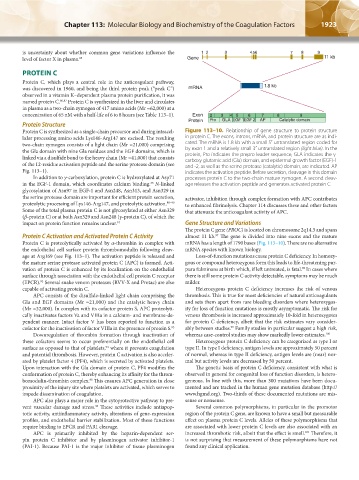
                  Protein C is synthesized as a single-chain precursor and during intracel-  Figure 113–10.  Relationship of gene structure to protein structure
                  lular processing amino acids Lys146-Arg147 are excised. The resulting   in protein C. The exons, introns, mRNA, and protein structure are as indi-
                  two-chain zymogen consists of a light chain (Mr ≈21,000) comprising   cated. The mRNA is 1.8 kb with a small 5′ untranslated region coded for
                  the Gla domain with nine Gla residues and the EGF domains, which is   by exon 1 and a relatively small 3′ untranslated region (light blue). In the
                  linked via a disulfide bond to the heavy chain (Mr ≈41,000) that consists   protein, Pro indicates the prepro leader sequence, GLA indicates the γ-
                                                                        carboxy glutamic acid (Gla) domain, and epidermal growth factor (EGF)-1
                  of the 12-residue activation peptide and the serine protease domain (see   and -2, as well as the serine protease (catalytic) domain, are indicated. AP
                  Fig. 113–1).                                          indicates the activation peptide. Before secretion, cleavage in this domain
                     In addition to γ-carboxylation, protein C is hydroxylated at Asp71   processes protein C to the two-chain mature zymogen. A second cleav-
                  in the EGF-1 domain, which coordinates calcium binding.  N-linked   age releases the activation peptide and generates activated protein C.
                                                             35
                  glycosylation of Asn97 in EGF-1 and Asn248, Asn313, and Asn329 in
                  the serine protease domain are important for efficient protein secretion,   activator, inhibition through complex formation with APC contributes
                  proteolytic processing of Lys146-Arg147, and proteolytic activation. 88–90    to enhanced fibrinolysis. Chapter 114 discusses these and other factors
                  Some of the total plasma protein C is not glycosylated at either Asn329   that attenuate the anticoagulant activity of APC.
                  (β-protein C) or at both Asn329 and Asn248 (γ-protein C), of which the
                  impact on protein function remains unclear. 91        Gene Structure and Variations
                                                                        The protein C gene (PROC) is located on chromosome 2q14.3 and spans
                  Protein C Activation and Activated Protein C Activity  almost 11 kb.  The gene is divided into nine exons and the mature
                                                                                   97
                  Protein C is proteolytically activated by α-thrombin in complex with   mRNA has a length of 1790 bases (Fig. 113–10). There are no alternative
                  the endothelial cell surface protein thrombomodulin following cleav-  mRNA species with known biology.
                  age at Arg169 (see Fig. 113–1). The activation peptide is released and   Loss-of-function mutations cause protein C deficiency. In homozy-
                  the mature serine protease activated protein C (APC) is formed. Acti-  gous or compound heterozygous form this leads to life-threatening pur-
                  vation of protein C is enhanced by its localization on the endothelial   pura fulminans at birth which, if left untreated, is fatal.  In cases where
                                                                                                                98
                  surface through association with the endothelial cell protein C receptor   there is still some protein C activity detectable, symptoms may be much
                  (EPCR).  Several snake venom proteases (RVV-X and Protac) are also   milder.
                        92
                  capable of activating protein C.                          Heterozygous protein C deficiency increases the risk of venous
                     APC consists of the disulfide-linked light chain comprising the   thrombosis. This is true for most deficiencies of natural anticoagulants
                  Gla and EGF domains (Mr ≈21,000) and the catalytic heavy chain   and sets them apart from rare bleeding disorders where heterozygos-
                  (Mr ≈32,000). In complex with its cofactor protein S, APC proteolyti-  ity for loss of function mutations is mostly asymptomatic. The risk for
                  cally inactivates factors Va and VIIIa in a calcium- and membrane-de-  venous thrombosis is increased approximately 10-fold in heterozygotes
                  pendent manner. Intact factor V has been reported to function as a   for protein C deficiency, albeit that the risk estimates vary consider-
                  cofactor for the inactivation of factor VIIIa in the presence of protein S. 93  ably between studies.  Family studies in particular suggest a high risk,
                                                                                        99
                     Downregulation of thrombin formation through inactivation of   whereas case-control studies may show markedly lower estimates. 100
                  these cofactors seems to occur preferentially on the endothelial cell   Heterozygous protein C deficiency can be categorized as type I or
                  surface as opposed to that of platelets,  where it prevents coagulation   type II. In type I deficiency, antigen levels are approximately 50 percent
                                              94
                  and potential thrombosis. However, protein C activation is also acceler-  of normal, whereas in type II deficiency, antigen levels are (near) nor-
                  ated by platelet factor 4 (PF4), which is secreted by activated platelets.   mal but activity levels are decreased by 50 percent.
                  Upon interaction with the Gla domain of protein C, PF4 modifies the   The genetic basis of protein C deficiency, consistent with what is
                  conformation of protein C, thereby enhancing its affinity for the throm-  observed in general for congenital loss of function disorders, is hetero-
                  bomodulin-thrombin complex.  This ensures APC generation in close   geneous. In line with this, more than 300 mutations have been docu-
                                        95
                  proximity of the injury site where platelets are activated, which serves to   mented and are tracked in the human gene mutation database (http://
                  impede dissemination of coagulation.                  www.hgmd.org). Two-thirds of these documented mutations are mis-
                     APC also plays a major role in the cytoprotective pathway to pre-  sense or nonsense.
                  vent vascular damage and stress.  These activities include antiapop-  Several common polymorphisms, in particular in the promotor
                                          96
                  totic activity, antiinflammatory activity, alterations of gene-expression   region of the protein C gene, are known to have a small but measurable
                  profiles, and endothelial barrier stabilization. Most of these functions   effect on plasma protein C levels. Alleles of these polymorphisms that
                  require binding to EPCR and PAR1 cleavage.            are associated with lower protein C levels are also associated with an
                     APC is primarily inhibited by the heparin-dependent ser-  increased thrombotic risk, albeit that the effect is small.  Therefore, it
                                                                                                                 101
                  pin protein C inhibitor and by plasminogen activator inhibitor-1   is not surprising that measurement of these polymorphisms have not
                  (PAI-1). Because PAI-1 is the major inhibitor of tissue plasminogen   found any clinical application.


          Kaushansky_chapter 113_p1915-1948.indd   1923                                                                 9/21/15   2:39 PM

