


Page 1947 - Williams Hematology ( PDFDrive )
P. 1947
1922           Part XII:  Hemostasis and Thrombosis                                                                                        Chapter 113:  Molecular Biology and Biochemistry of the Coagulation Factors           1923


                   A defect or deficiency in factor IX leads to hemophilia B. Chap-  of factor Xa at adjacent C-terminal Arg or Lys residues also results in
               ter 123 discusses the prevalence, clinical characteristics, and molecular   the generation of factor Xaβ and factor Xaβ derivatives. 73,74  While the
               genetics of hemophilia B in detail.                    coagulation activity is eliminated in the factor Xaβ derivatives, they are
                   Conversely, increased levels of  factor  IX are a  strong risk  fac-  capable of interacting with the zymogen plasminogen and enhance its
               tor for venous thrombosis.  This is in agreement with a rare gain of   tissue plasminogen activator-mediated conversion to plasmin, thereby
                                   58
               function mutation (Arg335Leu; factor IX Padua), which renders the   promoting fibrinolysis. 75
               protein hyperfunctional and is associated with familial early-onset   A primary plasma inhibitor of factor Xa is the serpin anti-
               thrombophilia. 59                                      thrombin, and this inhibition is enhanced by heparin (see Table  113–4),
                                                                      which induces a conformational change in antithrombin that is required
                                                                      for simultaneous active site and exosite interactions with factor Xa.
                                                                                                                        76
               FACTOR X                                               Another  potent  factor  Xa  inhibitor  is  TFPI,  which  inhibits  both  the
               Factor X was originally reported in the late 1950s as the “Stuart-Prower   ternary tissue factor–factor VIIa–factor Xa complex as well as free fac-
               factor,” named after the first two identified factor X–deficient patients. 60–62    tor Xa, for which protein S functions as a cofactor. 77,78  Free factor Xa is
               Factor X is primarily synthesized in the liver and circulates in plasma as   also inhibited by the protein Z/protein Z–dependent protease inhibitor
               a two-chain zymogen of 445 amino acids (Mr ≈59,000) at a concentra-  (ZPI) complex on membranes. 79
               tion of 170 nM with a half-life of 34 to 40 hours (see Table  113–1).  Low-molecular-weight heparin and synthetic derivatives (e.g.
                                                                      fondaparinux) are clinically used as anticoagulants to enhance factor
               Protein Structure                                      Xa inhibition by antithrombin specifically. The target-specific oral anti-
               Factor X is synthesized as a single-chain precursor and during intracel-  coagulants rivaroxaban, apixaban, edoxaban, and analogues directly
               lular processing, the three-amino acid peptide Arg140-Lys141-Arg142   inhibit both free factor Xa and prothrombinase complex-assembled
               is excised. The resulting two-chain zymogen consists of a light chain   factor Xa with high specificity through a high-affinity, reversible inter-
               (Mr ≈16,000), comprising the Gla domain with 11 Gla residues and the   action with the factor Xa active site. 80–83
               EGF domains, which is linked via a disulfide bond to the heavy chain
               (Mr ≈42,000) that consists of a 52-residue activation peptide and the   Gene Structure and Variations
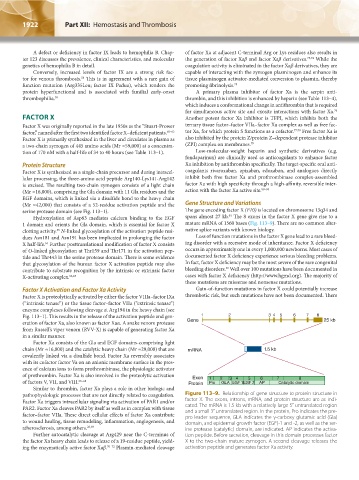
               serine protease domain (see Fig. 113–1).               The gene encoding factor X (F10) is located on chromosome 13q34 and
                                                                                     84
                   Hydroxylation of Asp63 mediates calcium binding to the EGF   spans almost 27 kb.  The 8 exons in the factor X gene give rise to a
               1 domain and orients the Gla domain, which is essential for factor X   mature mRNA of 1560 bases (Fig. 113–9). There are no common alter-
               clotting activity.  N-linked glycosylation of the activation peptide resi-  native splice variants with known biology.
                           35
               dues Asn181 and Asn191 has been implicated in prolonging the factor   Loss of function mutations in the factor X gene lead to a rare bleed-
               X half-life.  Further posttranslational modification of factor X consists   ing disorder with a recessive mode of inheritance. Factor X deficiency
                       63
               of O-linked glycosylation at Thr159 and Thr171 in the activation pep-  occurs in approximately one in every 1,000,000 newborns. Most cases of
               tide and Thr443 in the serine protease domain. There is some evidence   documented factor X deficiency experience serious bleeding problems.
               that glycosylation of the human factor X activation peptide may also   In fact, factor X deficiency may be the most severe of the rare congenital
                                                                                    30
               contribute to substrate recognition by the intrinsic or extrinsic factor   bleeding disorders.  Well over 100 mutations have been documented in
               X-activating complex. 64,65                            cases with factor X deficiency (http://www.hgmd.org). The majority of
                                                                      these mutations are missense and nonsense mutations.
               Factor X Activation and Factor Xa Activity                 Gain-of-function mutations in factor X could potentially increase
               Factor X is proteolytically activated by either the factor VIIIa–factor IXa   thrombotic risk, but such mutations have not been documented. There
               (“intrinsic tenase”) or the tissue factor–factor VIIa (“extrinsic tenase”)
               enzyme complexes following cleavage at Arg194 in the heavy chain (see
               Fig. 113–1). This results in the release of the activation peptide and gen-  1  2  34  5   6    7  8
               eration of factor Xa, also known as factor Xaα. A snake venom protease   Gene                        25 kb
               from Russell’s viper venom (RVV-X) is capable of generating factor Xa
               in a similar manner.
                   Factor Xa consists of the Gla and EGF domains-comprising light
               chain (Mr ≈16,000) and the catalytic heavy chain (Mr ≈29,000) that are   mRNA    1.5 kb
               covalently linked via a disulfide bond. Factor Xa reversibly associates
               with its cofactor factor Va on an anionic membrane surface in the pres-
               ence of calcium ions to form prothrombinase, the physiologic activator
               of prothrombin. Factor Xa is also involved in the proteolytic activation   Exon
                                                                                               6
                                                                                           5
                                                                                     34
                                                                                                            8
               of factors V, VII, and VIII. 66–68                      Protein  1 Pro  2 GLA EGF 1EGF 2  AP  7 Catalytic domain
                   Similar to thrombin, factor Xa plays a role in other biologic and
               pathophysiologic processes that are not directly related to coagulation.   Figure 113–9.  Relationship of gene structure to protein structure in
               Factor Xa triggers intracellular signaling via activation of PAR1 and/or   factor X. The exons, introns, mRNA, and protein structure are as indi-
               PAR2. Factor Xa cleaves PAR2 by itself as well as in complex with tissue   cated. The mRNA is 1.5 kb with a relatively large 5′ untranslated region
               factor–factor VIIa. These direct cellular effects of factor Xa contribute   and a small 3′ untranslated region. In the protein, Pro indicates the pre-
                                                                      pro leader sequence, GLA indicates the γ-carboxy glutamic acid (Gla)
               to wound healing, tissue remodeling, inflammation, angiogenesis, and   domain, and epidermal growth factor (EGF)-1 and -2, as well as the ser-
               atherosclerosis, among others. 26,69                   ine protease (catalytic) domain, are indicated. AP indicates the activa-
                   Further autocatalytic cleavage at Arg429 near the C-terminus of   tion peptide. Before secretion, cleavage in this domain processes factor
               the factor Xa heavy chain leads to release of a 19-residue peptide, yield-  X to the two-chain mature zymogen. A second cleavage releases the
               ing the enzymatically active factor Xaβ. 70–72  Plasmin-mediated cleavage   activation peptide and generates factor Xa activity.


          Kaushansky_chapter 113_p1915-1948.indd   1922                                                                 9/21/15   2:39 PM

