


Page 1949 - Williams Hematology ( PDFDrive )
P. 1949
1924           Part XII:  Hemostasis and Thrombosis                                                                                        Chapter 113:  Molecular Biology and Biochemistry of the Coagulation Factors           1925


                  THE PROCOAGULANT COFACTORS                          Protein Structure

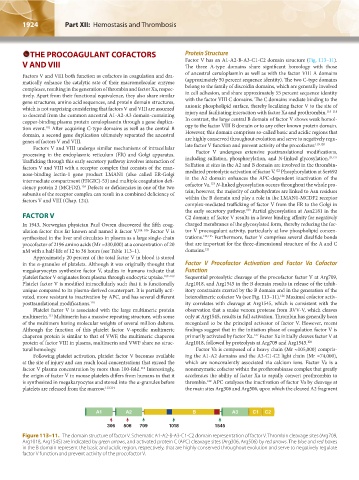
               V AND VIII                                             Factor V has an A1-A2-B-A3-C1-C2 domain structure (Fig. 113–11).
                                                                      The  three  A-type  domains  share  significant  homology  with  those
                                                                      of ancestral ceruloplasmin as well as with the factor VIII A domains
               Factors V and VIII both function as cofactors in coagulation and dra-
               matically enhance the catalytic rate of their macromolecular enzyme   (approximately 50 percent sequence identity). The two C-type domains
               complexes, resulting in the generation of thrombin and factor Xa, respec-  belong to the family of discoidin domains, which are generally involved
               tively. Apart from their functional equivalence, they also share similar   in cell adhesion, and share approximately 55 percent sequence identity
               gene structures, amino acid sequences, and protein domain structures,   with the factor VIII C domains. The C domains mediate binding to the
               which is not surprising considering that factors V and VIII are assumed   anionic phospholipid surface, thereby localizing factor V to the site of
                                                                                                                     115–118
               to descend from the common ancestral A1-A2-A3 domain-containing   injury and facilitating interaction with factor Xa and prothrombin.
               copper-binding plasma protein ceruloplasmin through a gene duplica-  In contrast, the large central B domain of factor V shows weak homol-
               tion event.  After acquiring C-type domains as well as the central B   ogy to the factor VIII B domain or to any other known protein domain.
                       102
               domain, a second gene duplication ultimately separated the ancestral   However, this domain comprises so-called basic and acidic regions that
               genes of factors V and VIII.                           are highly conserved throughout evolution and serve to negatively regu-
                                                                                                                  119,120
                   Factors V and VIII undergo similar mechanisms of intracellular   late factor V function and prevent activity of the procofactor.
               processing in the endoplasmic reticulum (ER) and Golgi apparatus.   Factor V undergoes extensive posttranslational modifications,
                                                                                                                      35,121
               Trafficking through this early secretory pathway involves interaction of   including sulfation, phosphorylation, and N-linked glycosylation.
               factors V and VIII with a receptor complex that consists of the man-  Sulfation at sites in the A2 and B domain are involved in the thrombin-
                                                                                                    122
               nose-binding lectin-1  gene  product  LMAN1 (also called  ER-Golgi   mediated proteolytic activation of factor V.  Phosphorylation at Ser692
               intermediate compartment (ERGIC)-53) and multiple coagulation defi-  in the A2 domain enhances the APC-dependent inactivation of the
                                                                              123
               ciency protein 2 (MCFD2).  Defects or deficiencies in one of the two   cofactor Va.  N-linked glycosylation occurs throughout the whole pro-
                                   103
               subunits of the receptor complex can result in a combined deficiency of   tein; however, the majority of carbohydrates are linked to Asn residues
               factors V and VIII (Chap. 124).                        within the B domain and play a role in the LMAN1-MCDF2 receptor
                                                                      complex-mediated trafficking of factor V from the ER to the Golgi in
                                                                      the early secretory pathway.  Partial glycosylation at Asn2181 in the
                                                                                          103
               FACTOR V                                               C2 domain of factor V results in a lower binding affinity for negatively
               In 1943, Norwegian physician Paul Owren discovered the fifth coag-  charged membranes of the glycosylated form, thereby reducing the fac-
               ulation factor thus far known and named it factor V. 104–106  Factor V is   tor V procoagulant activity, particularly at low phospholipid concen-
               synthesized in the liver and circulates in plasma as a large single-chain   trations. 124,125  Furthermore, factor V comprises several disulfide bonds
               procofactor of 2196 amino acids (Mr ≈330,000) at a concentration of 20   that are important for the three-dimensional structure of the A and C
               nM with a half-life of 12 to 36 hours (see Table  113–1).  domains. 121
                   Approximately 20 percent of the total factor V in blood is stored
               in the α-granules of platelets. Although it was originally thought that   Factor V Procofactor Activation and Factor Va Cofactor
               megakaryocytes  synthesize factor V, studies  in humans indicate  that   Function
               platelet factor V originates from plasma through endocytic uptake. 107–109    Sequential proteolytic cleavage of the procofactor factor V at Arg709,
               Platelet factor V is modified intracellularly such that it is functionally   Arg1018, and Arg1545 in the B domain results in release of the inhib-
               unique compared to its plasma-derived counterpart. It is partially acti-  itory constraints exerted by the B domain and in the generation of the
               vated, more resistant to inactivation by APC, and has several different   heterodimeric cofactor Va (see Fig. 113–11).  Maximal cofactor activ-
                                                                                                      126
               posttranslational modifications. 110                   ity correlates with cleavage at Arg1545, which is consistent with the
                   Platelet factor V is associated with the large multimeric protein   observation that a snake venom protease from RVV-V, which cleaves
               multimerin.  Multimerin has a massive repeating structure, with some   only at Arg1545, results in full activation. Thrombin has generally been
                        111
               of the multimers having molecular weights of several million daltons.   recognized to be the principal activator of factor V. However, recent
               Although the function of this platelet factor V-specific multimeric   findings suggest that in the initiation phase of coagulation factor V is
               chaperon protein is similar to that of VWF, the multimeric chaperon   primarily activated by factor Xa.  Factor Xa initially cleaves factor V at
                                                                                             127
               protein of factor VIII in plasma, multimerin and VWF share no struc-  Arg1018, followed by proteolysis at Arg709 and Arg1545. 128
               tural homology.                                            Factor Va is composed of a heavy chain (Mr ≈105,000) compris-
                   Following platelet activation, platelet factor V becomes available   ing the A1-A2 domains and the A3-C1-C2 light chain (Mr ≈74,000),
               at the site of injury and can reach local concentrations that exceed the   which  are  noncovalently  associated  via  calcium  ions.  Factor  Va  is  a
               factor V plasma concentration by more than 100-fold.  Interestingly,   nonenzymatic cofactor within the prothrombinase complex that greatly
                                                       112
               the origin of factor V in mouse platelets differs from humans in that it   accelerates the ability of factor Xa to rapidly convert prothrombin to
               is synthesized in megakaryocytes and stored into the α-granules before   thrombin.  APC catalyzes the inactivation of factor Va by cleavage at
                                                                             129
               platelets are released from the marrow. 113,114        the main sites Arg306 and Arg506, upon which the cleaved A2 fragment


                                        A1        A2                    B             A3     C1  C2

                                            306  506   709       1018           1545
               Figure 113–11.  The domain structure of factor V. Schematic A1-A2-B-A3-C1-C2 domain representation of factor V. Thrombin cleavage sites (Arg709,
               Arg1018, Arg1545) are indicated by green arrows, and activated protein C (APC) cleavage sites (Arg306, Arg506) by red arrows. The blue and red boxes
               in the B domain represent the basic and acidic region, respectively, that are highly conserved throughout evolution and serve to negatively regulate
               factor V function and prevent activity of the procofactor V.


          Kaushansky_chapter 113_p1915-1948.indd   1924                                                                 9/21/15   2:39 PM

