


Page 1958 - Williams Hematology ( PDFDrive )
P. 1958
1932  Part XII:  Hemostasis and Thrombosis  Chapter 113:  Molecular Biology and Biochemistry of the Coagulation Factors  1933


                                                                            During  fibrin  monomer  polymerization,  other  plasma  proteins
                        D                  E                  D         also bind to the surface of the developing meshwork. These include ele-
                                                                        ments of the fibrinolytic system and a variety of adhesive proteins, such
                                                                        as fibronectin, thrombospondin, and VWF. These surface proteins influ-
                                                                        ence the generation, crosslinking, and lysis of fibrin. Fibrin(ogen) also
                                                                        has specific integrin-binding sites that are essential for platelet binding.
                                                                        The thrombin that initiates fibrin polymerization also activates factor
                                                                        XIII, which stabilizes the fibrin polymer by crosslinking. Factor XIIIa
                                                                        also crosslinks other bound proteins, for example, PAI-1, vitronectin,
                                                                        fibronectin, and α -antiplasmin, to the fibrin network.
                                                                                     2
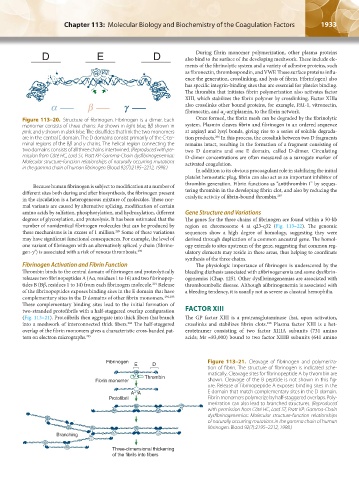
                  Figure 113–20.  Structure of fibrinogen. Fibrinogen is a dimer. Each   Once formed, the fibrin mesh can be degraded by the fibrinolytic
                  monomer consists of three chains: Aα shown in light blue, Bβ shown in   system. Plasmin cleaves fibrin and fibrinogen in an ordered sequence
                  pink, and γ shown in dark blue. The disulfides that link the two monomers   at arginyl and lysyl bonds, giving rise to a series of soluble degrada-
                  are in the central E domain. The D domains consist primarily of the C-ter-  tion products.  In this process, the crosslink between two D fragments
                                                                                  296
                  minal regions of the Bβ and γ chains. The helical region connecting the   remains intact, resulting in the formation of a fragment consisting of
                  two domains consists of all three chains intertwined. (Reproduced with per-  two D domains and one E domain, called D-dimer. Circulating
                  mission from Côté HC, Lord ST, Pratt KP: Gamma-Chain dysfibrinogenemias:   D-dimer concentrations are often measured as a surrogate marker of
                  Molecular structure-function relationships of naturally occurring mutations   activated coagulation.
                  in the gamma chain of human fibrinogen. Blood 92(7):2195–2212, 1998.)
                                                                            In addition to its obvious procoagulant role in stabilizing the initial
                                                                        platelet hemostatic plug, fibrin can also act as an important inhibitor of
                     Because human fibrinogen is subject to modification at a number of   thrombin generation. Fibrin functions as “antithrombin I” by seques-
                  different sites both during and after biosynthesis, the fibrinogen present   tering thrombin in the developing fibrin clot, and also by reducing the
                  in the circulation is a heterogeneous mixture of molecules. These nor-  catalytic activity of fibrin-bound thrombin. 297
                  mal variants are caused by alternative splicing, modification of certain
                  amino acids by sulfation, phosphorylation, and hydroxylation, different   Gene Structure and Variations
                  degrees of glycosylation, and proteolysis. It has been estimated that the   The genes for the three chains of fibrinogen are found within a 50-kb
                  number of nonidentical fibrinogen molecules that can be produced by   region on chromosome 4 at q23-q32 (Fig. 113–22). The genomic
                  these mechanisms is in excess of 1 million.  Some of these variations   sequences show a high degree of homology, suggesting they were
                                                 289
                  may have significant functional consequences. For example, the level of   derived through duplication of a common ancestral gene. The homol-
                  one variant of fibrinogen with an alternatively spliced γ chain (fibrino-  ogy extends to sites upstream of the gene, suggesting that common reg-
                  gen-γ′) is associated with a risk of venous thrombosis. 290  ulatory elements may reside in these areas, thus helping to coordinate
                                                                        synthesis of the three chains.
                  Fibrinogen Activation and Fibrin Function                 The physiologic importance of fibrinogen is underscored by the
                  Thrombin binds to the central domain of fibrinogen and proteolytically   bleeding diathesis associated with afibrinogenemia and some dysfibrin-
                  releases two fibrinopeptides A (Aα, residues 1 to 16) and two fibrinopep-  ogenemias (Chap. 125). Other dysfibrinogenemias are associated with
                  tides B (Bβ, residues 1 to 14) from each fibrinogen molecule.  Release   thromboembolic disease. Although afibrinogenemia is associated with
                                                             291
                  of the fibrinopeptides exposes binding sites in the E domain that have   a bleeding tendency, it is usually not as severe as classical hemophilia.
                  complementary sites in the D domains of other fibrin monomers. 292,293
                  These complementary binding sites lead to the initial formation of
                  two-stranded protofibrils with a half-staggered overlap configuration   FACTOR XIII
                  (Fig. 113–21). Protofibrils then aggregate into thick fibers that branch   The GP factor XIII is a protransglutaminase that, upon activation,
                  into a meshwork of interconnected thick fibers.  The half-staggered   crosslinks and stabilizes  fibrin  clots.  Plasma factor XIII is a het-
                                                     294
                                                                                                    298
                  overlap of the fibrin monomers gives a characteristic cross-banded pat-  erotetramer consisting of two factor XIIIA subunits (731 amino
                  tern on electron micrographs. 295                     acids; Mr ≈83,000) bound to two factor XIIIB subunits (641 amino


                                              Fibrinogen                        Figure 113–21.  Cleavage of fibrinogen and polymeriza-
                                                       E     D
                                                                                tion of fibrin. The structure of fibrinogen is indicated sche-
                                                 a            a                 matically. Cleavage sites for fibrinopeptide A by thrombin are
                                                           Thrombin
                                          Fibrin monomer                        shown. Cleavage of the B peptide is not shown in this fig-
                                                                                ure. Release of fibrinopeptide A exposes binding sites in the
                                                 a            a
                                                      AA                        E domain that match complementary sites in the D domain.
                                               Protofibril                      Fibrin monomers polymerize by half-staggered overlaps. Poly-
                                                                                merization can also lead to branched structures. (Reproduced
                                                                                with permission from Côté HC, Lord ST, Pratt KP: Gamma-Chain
                                                                                dysfibrinogenemias: Molecular structure-function relationships
                                                                                of naturally occurring mutations in the gamma chain of human
                                                                                fibrinogen. Blood 92(7):2195–2212, 1998.)
                             Branching

                                                Three-dimensional thickening
                                                of the fibrils into fibers


          Kaushansky_chapter 113_p1915-1948.indd   1933                                                                 9/21/15   2:40 PM

