


Page 1956 - Williams Hematology ( PDFDrive )
P. 1956
1930  Part XII:  Hemostasis and Thrombosis  Chapter 113:  Molecular Biology and Biochemistry of the Coagulation Factors  1931


                        1   2              3       4  5      6          Protein Structure
                                                                12 kb
                   Gene                                         12  kb  Mature single-chain thrombomodulin comprises 557 residues (Mr
                                                                        ≈78,000) and is composed of a lectin-like domain, a hydrophobic
                                                                        region, six EGF-like domains, a serine- and threonine-rich region, a
                                                                        transmembrane domain, and a 23-residue cytoplasmic tail. The highly
                                              2.3 kb
                   mRNA                       2.3 kb                    charged lectin-like domains bear homology to the C-type lectins. Post-
                                                                        translational modifications include five N-linked glycosylation sites that
                                                                        are located in the lectin-like and EGF-4 and -5 domains. O-linked gly-
                                                                        cosylation in the serine- and threonine-rich region (Ser474) supports
                                                                        attachment of a glycosaminoglycan, a chondroitin sulfate moiety, which
                     Exon  1   2     3       4       5      6           forms a low-affinity binding site for thrombin.
                   Protein  Pro     Extracellular domain  Tran Cyto
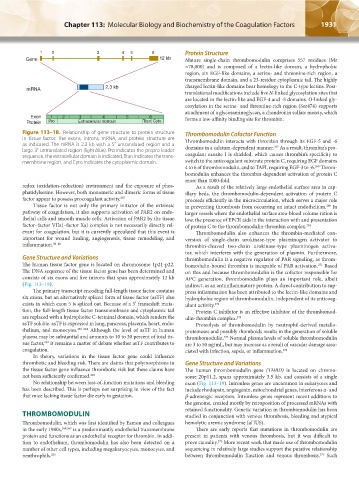
                  Figure 113–18.  Relationship of gene structure to protein structure   Thrombomodulin Cofactor Function
                  in  tissue  factor. The  exons,  introns,  mRNA,  and  protein  structure  are   Thrombomodulin interacts with thrombin through its EGF-5 and -6
                  as indicated. The mRNA is 2.3 kb with a 5′ untranslated region and a   domains in a calcium-dependent manner.  As a result, thrombin’s pro-
                                                                                                      267
                  large 3′ untranslated region (light blue). Pro indicates the prepro leader   coagulant exosite I is shielded, which causes thrombin’s specificity to
                  sequence, the extracellular domain is indicated, Tran indicates the trans-
                  membrane region, and Cyto indicates the cytoplasmic domain.  switch to the anticoagulant substrate protein C, requiring EGF domains
                                                                        4 to 6 of thrombomodulin, and to TAFI, requiring EGF-3 to -6.  Throm-
                                                                                                                    268
                                                                        bomodulin enhances the thrombin-dependent activation of protein C
                                                                        more than 1000-fold.
                  redox  (oxidation-reduction) environment  and the  exposure  of  phos-  As a result of the relatively large endothelial surface area in cap-
                  phatidylserine. However, both monomeric and dimeric forms of tissue   illary beds, the thrombomodulin-dependent activation of protein C
                  factor appear to possess procoagulant activity. 255   proceeds efficiently in the microcirculation, which serves a major role
                     Tissue  factor  is  not  only  the  primary  initiator  of  the  extrinsic   in preventing thrombosis from occurring on intact endothelium.  In
                                                                                                                        269
                  pathway of coagulation, it also supports activation of PAR2 on endo-  larger vessels where the endothelial surface area-blood volume ration is
                  thelial cells and smooth muscle cells. Activation of PAR2 by the tissue   low, the presence of EPCR aids in the interaction with and presentation
                  factor–factor VIIa(–factor Xa) complex is not necessarily directly rel-  of protein C to the thrombomodulin-thrombin complex. 270
                  evant for coagulation, but it is currently speculated that this event is   Thrombomodulin also enhances the thrombin-mediated con-
                  important for wound healing, angiogenesis, tissue remodeling, and   version of single-chain urokinase-type plasminogen activator to
                  inflammation. 38–40                                   thrombin-cleaved two-chain urokinase-type plasminogen activa-
                                                                        tor, which interferes with the generation of plasmin. Furthermore,
                  Gene Structure and Variations                         thrombomodulin is a negative regulator of PAR signaling, as throm-
                  The human tissue factor gene is located on chromosome 1p21-p22.   bomodulin-bound thrombin is incapable of PAR activation.  Based
                                                                                                                     271
                  The DNA sequence of the tissue factor gene has been determined and   on this and because thrombomodulin is the cofactor responsible for
                  consists of six exons and five introns that span approximately 12 kb   APC generation, thrombomodulin plays an important role, albeit
                  (Fig. 113–18).                                        indirect, as an antiinflammatory protein. A direct contribution to sup-
                     The primary transcript encoding full-length tissue factor contains   press inflammation has been attributed to the lectin-like domains and
                  six exons, but an alternatively spliced form of tissue factor (asTF) also   hydrophobic region of thrombomodulin, independent of its anticoag-
                  exists in which exon 5 is spliced out. Because of a 3′ frameshift muta-  ulant activity. 272
                  tion, the full-length tissue factor transmembrane and cytoplasmic tail   Protein C inhibitor is an effective inhibitor of the thrombomod-
                  are replaced with a hydrophobic C-terminal domain, which renders the   ulin-thrombin complex. 273
                  asTF soluble. asTF is expressed in lung, pancreas, placenta, heart, endo-  Proteolysis of thrombomodulin by neutrophil-derived metallo-
                  thelium, and monocytes. 259–261  Although the level of asTF in human   proteinases and possibly rhomboids results in the generation of soluble
                  plasma may be substantial and amounts to 10 to 30 percent of total tis-  thrombomodulin.  Normal plasma levels of soluble thrombomodulin
                                                                                     274
                  sue factor,  it remains a matter of debate whether asTF contributes to   are 3 to 50 ng/mL, but may increase as a result of vascular damage asso-
                         262
                  coagulation.                                          ciated with infection, sepsis, or inflammation. 274
                     In theory, variations in the tissue factor gene could influence
                  thrombotic and bleeding risk. There are claims that polymorphisms in   Gene Structure and Variations
                  the tissue factor gene influence thrombotic risk but these claims have   The human  thrombomodulin  gene  (THBD) is  located  on chromo-
                  not been sufficiently confirmed. 263                  some 20p11.2, spans approximately 3.5 kb, and consists of a single
                     No relationship between loss-of-function mutations and bleeding   exon (Fig. 113–19). Intronless genes are uncommon in eukaryotes and
                  has been described. This is perhaps not surprising in view of the fact   include rhodopsin, angiogenin, mitochondrial genes, interferons α- and
                  that mice lacking tissue factor die early in gestation.  β-adrenergic receptors. Intronless genes represent recent additions to
                                                                        the genome, created mostly by retroposition of processed mRNAs with
                                                                        retained functionality. Genetic variation in thrombomodulin has been
                  THROMBOMODULIN                                        studied in conjunction with venous thrombosis, bleeding and atypical
                  Thrombomodulin, which was first identified by Esmon and colleagues   hemolytic uremic syndrome (aHUS).
                  in the early 1980s, 264,265  is a predominantly endothelial transmembrane   There are early reports that mutations in thrombomodulin are
                  protein and functions as an endothelial receptor for thrombin. In addi-  present in patients with venous thrombosis, but it was difficult to
                                                                                   275
                  tion to endothelium, thrombomodulin has also been detected on a   prove causality.  More recent work that made use of thrombomodulin
                  number of other cell types, including megakaryocytes, monocytes, and   sequencing in relatively large studies support the putative relationship
                                                                                                                      276
                  neuthrophils. 266                                     between thrombomodulin  function  and  venous thrombosis.   Such


          Kaushansky_chapter 113_p1915-1948.indd   1931                                                                 9/21/15   2:40 PM

