


Page 1954 - Williams Hematology ( PDFDrive )
P. 1954
1928  Part XII:  Hemostasis and Thrombosis  Chapter 113:  Molecular Biology and Biochemistry of the Coagulation Factors  1929


                  occurs at three sites in the apple 1, 2, and 4 domains (Asn82, Asn114,   Deficiencies of factor XI in humans can lead to a bleeding ten-
                                                                                                                224
                  Asn335)  and  at  two  sites  in  the  serine  protease  domain  (Asn432,   dency, although not as severe as in hemophilia A or B.  Deficiency of
                                                                                                                       225
                  Asn473).                                              factor XI is relatively common among Ashkenazi Jews in Israel.  The
                                                                        human gene mutation database lists 232 mutations in the factor XI gene
                  Factor XI Activation and Activity                     (www.hgmd.org).
                  Activation of a factor XI subunit to factor XIa proceeds through prote-  Increased levels of factor XI are a risk factor for venous throm-
                  olysis at Arg369 in the N-terminal region of the serine protease domain   bosis.  Genetic variations in the form of common single nucleotide
                                                                            226
                  and yields two-chain activated factor XIa. There are several catalysts   polymorphisms (SNPs) seem to play a role in determining the level of
                  capable of factor XI activation, which include the contact factor XIIa,   factor XI and contribute to thrombotic risk. 227
                  thrombin, or factor XIa itself in the presence of negatively charged
                  surfaces. 208,209  However, their mechanisms differ as factor XI must be a
                  dimer to be activated by factor XIIa, whereas thrombin and factor XIa   THE CONTACT SYSTEM: FACTOR XII,
                                  210
                  lack this requirement.  An activated factor XI dimer may comprise   PREKALLIKREIN, AND HIGH-MOLECULAR
                  either one (1/2-factor XIa) or two factor XIa subunits. 211
                     Following activation of factor XI, binding sites for the substrate   WEIGHT KININOGEN
                  factor IX become available in the apple 3 domain and serine protease
                  domain of factor XIa. 212,213  Factor XIa proteolytically activates factor IX   Factor XII, HK, and PK are part of the contact system in blood coag-
                  to factor IXa in a calcium-dependent but phospholipid-independent   ulation, which is triggered following contact activation of factor XII
                  manner. Both forms of the factor XIa dimer as well as monomeric factor   mediated via a negatively charged surface. PK is synthesized in the liver,
                  XIa activate factor IX in a similar manner. 211       circulates as a zymogen, and is highly homologous to factor XI (see
                     Accumulating evidence supports the notion that factor XIIa–  Table  113–1). Conversion into the serine protease proceeds through
                  dependent activation of factor XI is not essential to normal hemostasis,   limited proteolysis by activated factor XII, and the generated kallikrein
                  but is important in pathologic thrombus formation. 214–216  Thrombin-  reciprocally activates more factor XII. HK, which is also synthesized in
                  mediated activation of factor XI, on the other hand, seems most signifi-  the liver, is a nonenzymatic cofactor that circulates in complex with fac-
                  cant under conditions of low tissue factor and is assumed to enhance   tor XI or PK (see Table  113–1). HK is cleaved at two sites by kallikrein
                  clot stability through thrombin-activation of TAFI. 217,218  to release the bioactive nonapeptide bradykinin, a potent vasodilator.
                     Factor XI has been reported to interact with platelet GPIb, which is   The contact system is at the basis of the activated partial throm-
                  mediated through a site within the apple 3 domain, and to platelet apo-  boplastin time (APTT) assay that is widely used in clinical practice. In
                  lipoprotein E receptor 2 (ApoER2). 219,220  It has been proposed that the   this clinical laboratory test, the negatively charged surface is provided
                  dimeric structure allows for simultaneous interaction with the platelet   by reagents such as glass, kaolin, celite, or ellagic acid. Factor XIIa acti-
                  by one subunit, thereby localizing factor XI to the site of clot formation,   vates factor XI, which then activates factor IX. Despite HK and PK
                  while binding to factor IX with the other subunit. 221  being required for a normal APTT, they appear to be dispensable for
                                                                                      228
                     Factor XIa function is regulated by the serpins protease nexin 1,   coagulation in vivo.  Individuals who are deficient in any of these fac-
                  antithrombin, C1-inhibitor, α -protease inhibitor, protein Z–dependent   tors do not have a bleeding tendency, even after significant trauma or
                                       1
                  protease inhibitor, and α -antiplasmin. 216,222  Platelets also contain a fac-  surgery. However, factor XII, HK, and PK do participate in bacteremia
                                   2
                  tor XIa inhibitor, the Kunitz-type inhibitor protease nexin 2. 223  or inflammatory responses in acute-phase reactions that do not involve
                                                                        the coagulation, but the classical complement system. 228
                  Gene Structure and Variations
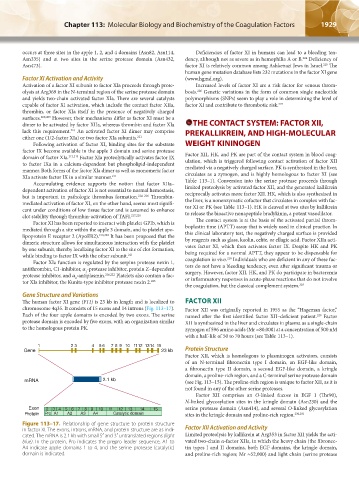
                  The human factor XI gene (F11) is 23 kb in length and is localized to   FACTOR XII
                  chromosome 4q35. It consists of 15 exons and 14 introns (Fig. 113–17).   Factor  XII  was  originally  reported  in  1955  as  the  “Hageman  factor,”
                  Each of the four apple domains is encoded by two exons. The serine   named after the first identified factor XII–deficient patient.  Factor
                                                                                                                     229
                  protease domain is encoded by five exons, with an organization similar   XII is synthesized in the liver and circulates in plasma as a single-chain
                  to the homologous protein PK.                         zymogen of 596 amino acids (Mr ≈80,000) at a concentration of 500 nM
                                                                        with a half-life of 50 to 70 hours (see Table  113–1).
                       1          2 3    4  56  78 9101112131415
                  Gene                                          23 kb   Protein Structure
                                                                        Factor XII, which  is  homologous to  plasminogen activators, consists
                                                                        of an N-terminal fibronectin type I domain, an EGF-like domain,
                                                                        a fibronectin type II domain, a second EGF-like domain, a kringle
                                                                        domain, a proline-rich region, and a C-terminal serine protease domain
                   mRNA                      2.1 kb                     (see Fig. 113–15). The proline-rich region is unique to factor XII, as it is
                                                                        not found in any of the other serine proteases.
                                                                            Factor  XII  comprises  an  O-linked fucose  in  EGF  1  (Thr90),
                                                                        N-linked glycosylation sites in the kringle domain (Asn230) and the
                    Exon  2 34  56  7  8 9  10  11  12  13  14  15      serine protease domain (Asn414), and several O-linked glycosylation
                   Protein  ProA1  A2  A3  A4   Catalytic domain        sites in the kringle domain and proline-rich region. 230,231
                  Figure 113–17.  Relationship of gene structure to protein structure
                  in factor XI. The exons, introns, mRNA, and protein structure are as indi-  Factor XII Activation and Activity
                  cated. The mRNA is 2.1 kb with small 5′ and 3′ untranslated regions (light   Limited proteolysis by kallikrein at Arg353 in factor XII yields the acti-
                  blue). In the protein, Pro indicates the prepro leader sequence, A1 to   vated two-chain α-factor XIIa, in which the heavy chain (the fibronec-
                  A4 indicate apple domains 1 to 4, and the serine protease (catalytic)   tin types I and II domains, both EGF  domains, the kringle domain,
                  domain is indicated.                                  and proline-rich region; Mr ≈52,000) and light chain (serine protease


          Kaushansky_chapter 113_p1915-1948.indd   1929                                                                 9/21/15   2:40 PM

