


Page 254 - Williams Hematology ( PDFDrive )
P. 254
228  Part IV:  Molecular and Cellular Hematology  Chapter 16:  Cell-Cycle Regulation and Hematologic Disorders        229


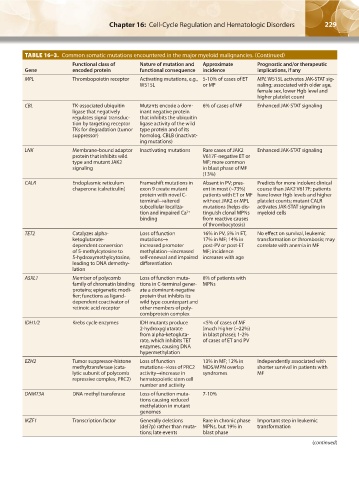
                   TABLE 16–3.  Common somatic mutations encountered in the major myeloid malignancies. (Continued)
                                   Functional class of   Nature of mutation and   Approximate    Prognostic and/or therapeutic
                   Gene            encoded protein       functional consequence  incidence       implications, if any
                   MPL             Thrombopoietin receptor  Activating mutations, e.g.,  5-10% of cases of ET   MPL W515L activates JAK-STAT sig-
                                                         W515L                or MF              naling; associated with older age,
                                                                                                 female sex, lower Hgb level and
                                                                                                 higher platelet count
                   CBL             TK-associated ubiquitin   Mutants encode a dom-  6% of cases of MF  Enhanced JAK-STAT signaling
                                   ligase that negatively    inant negative protein
                                   regulates signal transduc-  that inhibits the ubiquitin
                                   tion by targeting receptor   ligase activity of the wild
                                   TKs for degradation (tumor   type protein and of its
                                   suppressor)           homolog, CBLB (inactivat-
                                                         ing mutations)
                   LNK             Membrane-bound adaptor   Inactivating mutations  Rare cases of JAK2   Enhanced JAK-STAT signaling
                                   protein that inhibits wild                 V617F-negative ET or
                                   type and mutant JAK2                       MF; more common
                                   signaling                                  in blast phase of MF
                                                                              (13%)
                   CALR            Endoplasmic reticulum   Frameshift mutations in   Absent in PV; pres-  Predicts for more indolent clinical
                                   chaperone (calreticulin)  exon 9 create mutant    ent in most (~73%)   course than JAK2 V617F; patients
                                                         protein with novel C-   patients with ET or MF  have lower Hgb levels and higher
                                                         terminal→altered     without JAK2 or MPL   platelet counts; mutant CALR
                                                         subcellular localiza-  mutations (helps dis-  activates JAK-STAT signaling in
                                                         tion and impaired Ca    tinguish clonal MPNs   myeloid cells
                                                                         2+
                                                         binding              from reactive causes
                                                                              of thrombocytosis)
                   TET2            Catalyzes alpha-      Loss of function     16% in PV, 5% in ET,   No effect on survival, leukemic
                                   ketoglutarate-        mutations→           17% in MF; 14% in   transformation or thrombosis; may
                                   dependent conversion   increased promoter   post-PV or post-ET   correlate with anemia in MF
                                   of 5-methylcytosine to   methylation→increased   MF; incidence
                                   5-hydroxymethylcytosine,   self-renewal and impaired  increases with age
                                   leading to DNA demethy-  differentiation
                                   lation
                   ASXL1           Member of polycomb    Loss of function muta-  8% of patients with
                                   family of chromatin binding  tions in C-terminal gener-  MPNs
                                   proteins; epigenetic modi-  ate a dominant-negative
                                   fier; functions as ligand-   protein that inhibits its
                                   dependent coactivator of   wild type counterpart and
                                   retinoic acid receptor  other members of poly-
                                                         combprotein complex
                   IDH1/2          Krebs cycle enzymes   IDH mutants produce   <5% of cases of MF
                                                         2-hydroxyglutarate   (much higher (~22%)
                                                         from alpha-ketogluta-  in blast phase); 1-2%
                                                         rate, which inhibits TET   of cases of ET and PV
                                                         enzymes, causing DNA
                                                         hypermethylation
                   EZH2            Tumor suppressor-histone   Loss of function    13% in MF; 12% in   Independently associated with
                                   methyltransferase (cata-  mutations→loss of PRC2   MDS/MPN overlap   shorter survival in patients with
                                   lytic subunit of polycomb   activity→increase in   syndromes  MF
                                   repressive complex, PRC2)  hematopoietic stem cell
                                                         number and activity
                   DNMT3A          DNA methyl transferase  Loss of function muta-  7-10%
                                                         tions causing reduced
                                                         methylation in mutant
                                                         genomes
                   IKZF1           Transcription factor  Generally deletions   Rare in chronic phase   Important step in leukemic
                                                         (del7p) rather than muta-  MPNs, but 19% in   transformation
                                                         tions; late events   blast phase
                                                                                                                   (continued)


          Kaushansky_chapter 16_p0213-0246.indd   229                                                                   9/18/15   11:57 PM

