


Page 257 - Williams Hematology ( PDFDrive )
P. 257
232            Part IV:  Molecular and Cellular Hematology                                                                                                Chapter 16:  Cell-Cycle Regulation and Hematologic Disorders             233


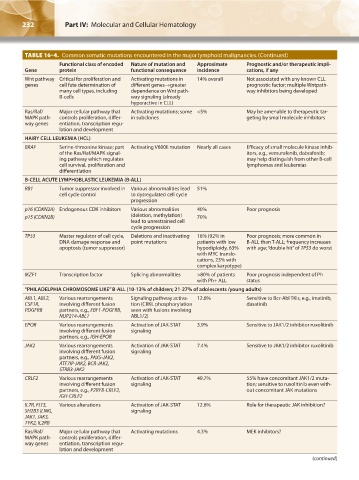
                TABLE 16–4.  Common somatic mutations encountered in the major lymphoid malignancies.(Continued)
                            Functional class of encoded   Nature of mutation and   Approximate   Prognostic and/or therapeutic impli-
                Gene        protein                 functional consequence  incidence      cations, if any
                Wnt pathway  Critical for proliferation and   Activating mutations in   14% overall  Not associated with any known CLL
                genes       cell fate determination of   different genes→greater           prognostic factor; multiple Wntpath-
                            many cell types, including   dependence on Wnt path-           way inhibitors being developed
                            B-cells                 way signaling (already
                                                    hyperactive in CLL)
                Ras/Raf/    Major cellular pathway that   Activating mutations; some  <5%  May be amenable to therapeutic tar-
                MAPK path-  controls proliferation, differ-  in subclones                  geting by small molecule inhibitors
                way genes   entiation, transcription regu-
                            lation and development
                HAIRY CELL LEUKEMIA (HCL)
                BRAF        Serine-threonine kinase; part   Activating V600E mutation  Nearly all cases  Efficacy of small molecule kinase inhib-
                            of the Ras/Raf/MAPK signal-                                    itors, e.g., vemurafenib, dabrafenib;
                            ing pathway which regulates                                    may help distinguish from other B-cell
                            cell survival, proliferation and                               lymphomas and leukemias
                            differentiation
                B-CELL ACUTE LYMPHOBLASTIC LEUKEMIA (B-ALL)
                RB1         Tumor suppressor involved in  Various abnormalities lead   51%
                            cell cycle control      to dysregulated cell cycle
                                                    progression
                p16 (CDKN2A) Endogenous CDK inhibitors  Various abnormalities   40%        Poor prognosis
                p15 (CDKN2B)                        (deletion, methylation)   70%
                                                    lead to unrestrained cell
                                                    cycle progression
                TP53        Master regulator of cell cycle,   Deletions and inactivating   16% (92% in   Poor prognosis; more common in
                            DNA damage response and   point mutations     patients with low   B-ALL than T-ALL; frequency increases
                            apoptosis (tumor suppressor)                  hypodiploidy, 63%   with age; “double hit” of TP53 do worst
                                                                          with MYC translo-
                                                                          cations, 23% with
                                                                          complex karyotype)
                IKZF1       Transcription factor    Splicing abnormalities  >80% of patients   Poor prognosis independent of Ph
                                                                          with Ph+ ALL     status
                “PHILADELPHIA CHROMOSOME LIKE” B-ALL (10-13% of children; 21-27% of adolescents /young adults)
                ABL1, ABL2,   Various rearrangements   Signaling pathway activa-  12.6%    Sensitive to Bcr-Abl TKIs, e.g., imatinib,
                CSF1R,      involving different fusion   tion (CRKL phosphorylation        dasatinib
                PDGFRB      partners, e.g., EBF1-PDGFRB,   seen with fusions involving
                            NUP214-ABL1             ABL1/2)
                EPOR        Various rearrangements   Activation of JAK-STAT   3.9%         Sensitive to JAK1/2 inhibitor ruxolitinib
                            involving different fusion   signaling
                            partners, e.g., IGH-EPOR
                JAK2        Various rearrangements   Activation of JAK-STAT   7.4%         Sensitive to JAK1/2 inhibitor ruxolitinib
                            involving different fusion   signaling
                            partners, e.g., PAX5-JAK2,
                            ATF7IP-JAK2, BCR-JAK2,
                            STRB3-JAK2
                CRLF2       Various rearrangements   Activation of JAK-STAT   49.7%        55% have concomitant JAK1/2 muta-
                            involving different fusion   signaling                         tion; sensitive to ruxolitinib even with-
                            partners, e.g., P2RY8-CRLF2,                                   out concomitant JAK mutations
                            IGH-CRLF2
                IL7R, FLT3,   Various alterations   Activation of JAK-STAT   12.6%         Role for therapeutic JAK inhibition?
                SH2B3 (LNK),                        signaling
                JAK1, JAK3,
                TYK2, IL2RB
                Ras/Raf/    Major cellular pathway that   Activating mutations  4.3%       MEK inhibitors?
                MAPK path-  controls proliferation, differ-
                way genes   entiation, transcription regu-
                            lation and development
                                                                                                                 (continued)


          Kaushansky_chapter 16_p0213-0246.indd   232                                                                   9/18/15   11:57 PM

