


Page 256 - Williams Hematology ( PDFDrive )
P. 256
230  Part IV:  Molecular and Cellular Hematology  Chapter 16:  Cell-Cycle Regulation and Hematologic Disorders        231


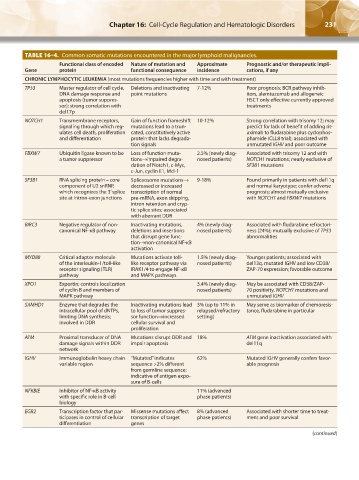
                   TABLE 16–4.  Common somatic mutations encountered in the major lymphoid malignancies.
                              Functional class of encoded   Nature of mutation and   Approximate   Prognostic and/or therapeutic impli-
                   Gene       protein                 functional consequence  incidence      cations, if any
                   CHRONIC LYMPHOCYTIC LEUKEMIA (most mutations frequencies higher with time and with treatment)
                   TP53       Master regulator of cell cycle,   Deletions and inactivating   7-12%  Poor prognosis; BCR pathway inhib-
                              DNA damage response and   point mutations                      itors, alemtuzumab and allogeneic
                              apoptosis (tumor suppres-                                      HSCT only effective currently approved
                              sor); strong correlation with                                  treatments
                              del17p
                   NOTCH1     Transmembrane receptors,   Gain of function frameshift  10-12%  Strong correlation with trisomy 12; may
                              signaling through which reg-  mutations lead to a trun-        predict for lack of benefit of adding rit-
                              ulates cell death, proliferation  cated, constitutively active   uximab to fludarabine plus cyclophos-
                              and differentiation     protein that lacks degrada-            phamide (CLL8 trial); associated with
                                                      tion signals                           unmutated IGHV and poor outcome
                   FBXW7      Ubiquitin ligase known to be   Loss of function muta-  2.5% (newly diag-  Associated with trisomy 12 and with
                              a tumor suppressor      tions→impaired degra-  nosed patients)  NOTCH1 mutations; nearly exclusive of
                                                      dation of Notch1, c-Myc,               SF3B1 mutations
                                                      c-Jun, cyclin E1, Mcl-1
                   SF3B1      RNA splicing protein – core   Spliceosome mutations→   9-18%   Found primarily in patients with del11q
                              component of U2 snRNP,   decreased or increased                and normal karyotype; confer adverse
                              which recognizes the 3’ splice  transcription of normal        prognosis; almost mutually exclusive
                              site at intron-exon junctions  pre-mRNA, exon skipping,        with NOTCH1 and FBXW7 mutations
                                                      intron retention and cryp-
                                                      tic splice sites; associated
                                                      with aberrant DDR
                   BIRC3      Negative regulator of non-  Inactivating mutations,   4% (newly diag-  Associated with fludarabine refractori-
                              canonical NF-κB pathway  deletions and insertions   nosed patients)  ness (24%); mutually exclusive of TP53
                                                      that disrupt gene func-                abnormalities
                                                      tion→non-canonical NF-κB
                                                      activation
                   MYD88      Critical adaptor molecule   Mutations activate toll-  1.5% (newly diag-  Younger patients; associated with
                              of the interleukin-1/toll-like   like receptor pathway via   nosed patients)  del13q, mutated IGHV and low CD38/
                              receptor signaling (TLR)   IRAK1/4 to engage NF-κB             ZAP-70 expression; favorable outcome
                              pathway                 and MAPK pathways
                   XPO1       Exportin; controls localization               3.4% (newly diag-  May be associated with CD38/ZAP-
                              of cyclin B and members of                    nosed patients)  70 positivity, NOTCH1 mutations and
                              MAPK pathway                                                   unmutated IGHV
                   SAMHD1     Enzyme that degrades the   Inactivating mutations lead  3% (up to 11% in   May serve as biomarker of chemoresis-
                              intracellular pool of dNTPs,   to loss of tumor suppres-  relapsed/refractory   tance, fludarabine in particular
                              limiting DNA synthesis;   sor function→increased   setting)
                              involved in DDR         cellular survival and
                                                      proliferation
                   ATM        Proximal transducer of DNA   Mutations disrupt DDR and  18%    ATM gene inactivation associated with
                              damage signals within DDR   impair apoptosis                   del11q
                              network
                   IGHV       Immunoglobulin heavy chain  “Mutated” indicates   62%          Mutated IGHV generally confers favor-
                              variable region         sequence >2% different                 able prognosis
                                                      from germline sequence;
                                                      indicative of antigen expo-
                                                      sure of B-cells
                   NFKBIE     Inhibitor of NF-κB activity                   11% (advanced
                              with specific role in B-cell                  phase patients)
                              biology
                   EGR2       Transcription factor that par-  Missense mutations affect   8% (advanced   Associated with shorter time to treat-
                              ticipates in control of cellular   transcription of target   phase patients)  ment and poor survival
                              differentiation         genes
                                                                                                                   (continued)


          Kaushansky_chapter 16_p0213-0246.indd   231                                                                   9/18/15   11:57 PM

