


Page 258 - Williams Hematology ( PDFDrive )
P. 258
232  Part IV:  Molecular and Cellular Hematology  Chapter 16:  Cell-Cycle Regulation and Hematologic Disorders        233


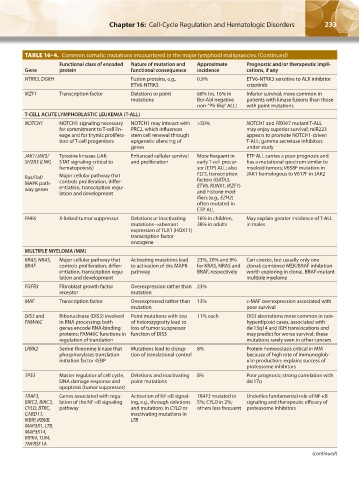
                   TABLE 16–4.  Common somatic mutations encountered in the major lymphoid malignancies.(Continued)
                              Functional class of encoded   Nature of mutation and   Approximate   Prognostic and/or therapeutic impli-
                   Gene       protein                 functional consequence  incidence      cations, if any
                   NTRK3, DGKH                        Fusion proteins, e.g.,   0.9%          ETV6-NTRK3 sensitive to ALK inhibitor
                                                      ETV6-NTRK3                             crizotinib
                   IKZF1      Transcription factor    Deletions or point    68% (vs. 16% in   Inferior survival; more common in
                                                      mutations             Bcr-Abl negative   patients with kinase fusions than those
                                                                            non-”Ph-like” ALL)  with point mutations
                   T-CELL ACUTE LYMPHOBLASTIC LEUKEMIA (T-ALL)
                   NOTCH1     NOTCH1 signaling necessary   NOTCH1 may interact with   >50%   NOTCH1 and FBXW7 mutant T-ALL
                              for commitment to T-cell lin-  PRC2, which influences          may enjoy superior survival; miR223
                              eage and for thymic prolifera-  stem cell renewal through      appears to promote NOTCH1-driven
                              tion of T-cell progenitors  epigenetic silencing of            T-ALL; gamma secretase inhibitors
                                                      genes                                  under study
                   JAK1/JAK3/  Tyrosine kinases (JAK-  Enhanced cellular survival   More frequent in   ETP ALL carries a poor prognosis and
                   SH2B3 (LNK)  STAT signaling critical to   and proliferation  early T-cell precur-  has a mutational spectrum similar to
                              hematopoiesis)                                sor (ETP) ALL; also   myeloid tumors; V658F mutation in
                   Ras/Raf/   Major cellular pathway that                   FLT3, transcription   JAK1 homologous to V617F in JAK2
                                                                            factors (GATA3,
                   MAPK path-  controls proliferation, differ-              ETV6, RUNX1, IKZF1)
                   way genes  entiation, transcription regu-
                              lation and development                        and histone mod-
                                                                            ifiers (e.g., EZH2)
                                                                            often mutated in
                                                                            ETP ALL
                   PHF6       X-linked tumor suppressor  Deletions or inactivating   16% in children,   May explain greater incidence of T-ALL
                                                      mutations→aberrant    38% in adults    in males
                                                      expression of TLX1 (HOX11)
                                                      transcription factor
                                                      oncogene
                   MULTIPLE MYELOMA (MM)
                   KRAS, NRAS,   Major cellular pathway that   Activating mutations lead   23%, 20% and 6%   Can coexist, but usually only one
                   BRAF       controls proliferation, differ-  to activation of the MAPK   for KRAS, NRAS and  clonal; combined MEK/BRAF inhibition
                              entiation, transcription regu-  pathway       BRAF, respectively  worth exploring in clonal, BRAF-mutant
                              lation and development                                         multiple myeloma
                   FGFR3      Fibroblast growth factor   Overexpression rather than  23%
                              receptor                mutation
                   MAF        Transcription factor    Overexpressed rather than   13%        c-MAF overexpression associated with
                                                      mutation                               poor survival
                   DIS3 and   Ribonuclease (DIS3) involved   Point mutations with loss   11% each  DIS3 aberrations more common in non-
                   FAM46C     in RNA processing; both   of heterozygosity lead to            hyperdiploid cases; associated with
                              genes encode RNA-binding   loss of tumor suppressor            del13q14 and IGH translocations and
                              proteins; FAM46C functions in  function of DIS3                may predict for worse survival; these
                              regulation of translation                                      mutations rarely seen in other cancers
                   LRRK2      Serine threonine kinase that   Mutations lead to disrup-  8%   Protein homeostasis critical in MM
                              phosphorylates translation   tion of translational control     because of high rate of immunoglob-
                              initiation factor 4EBP                                         ulin production; explains success of
                                                                                             proteasome inhibitors
                   TP53       Master regulator of cell cycle,   Deletions and inactivating   8%  Poor prognosis; strong correlation with
                              DNA damage response and   point mutations                      del17p
                              apoptosis (tumor suppressor)
                   TRAF3,     Genes associated with regu-  Activation of NF-κB signal-  TRAF3 mutated in   Underlies fundamental role of NF-κB
                   BIRC2, BIRC3,   lation of the NF-κB signaling   ing, e.g., through deletions   5%; CYLD in 2%;   signaling and therapeutic efficacy of
                   CYLD, BTRC,   pathway              and mutations in CYLD or   others less frequent  proteasome inhibitors
                   CARD11,                            inactivating mutations in
                   IKBIP, IKBKB,                      LTB
                   MAP3K1, LTB,
                   MAP3K14,
                   RIPK4, TLR4,
                   TNFRSF1A
                                                                                                                   (continued)


          Kaushansky_chapter 16_p0213-0246.indd   233                                                                   9/18/15   11:57 PM

