


Page 261 - Williams Hematology ( PDFDrive )
P. 261
236            Part IV:  Molecular and Cellular Hematology                                                                                                Chapter 16:  Cell-Cycle Regulation and Hematologic Disorders             237


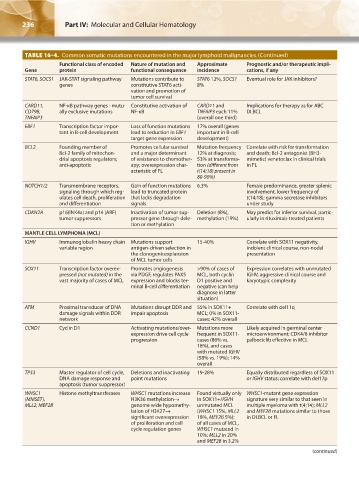
                TABLE 16–4.  Common somatic mutations encountered in the major lymphoid malignancies.(Continued)
                            Functional class of encoded   Nature of mutation and   Approximate   Prognostic and/or therapeutic impli-
                Gene        protein                 functional consequence  incidence      cations, if any
                STAT6, SOCS1  JAK-STAT signaling pathway   Mutations contribute to   STAT6 12%, SOCS1   Eventual role for JAK inhibitors?
                            genes                   constitutive STAT6 acti-  8%
                                                    vation and promotion of
                                                    tumor cell survival
                CARD11,     NF-κB pathway genes - mutu-  Constitutive activation of   CARD11 and   Implications for therapy as for ABC
                CD79B,      ally exclusive mutations  NF-κB               TNFAIP3 each 11%   DLBCL
                TNFAIP3                                                   (overall one third)
                EBF1        Transcription factor impor-  Loss of function mutations   17% overall (genes
                            tant in B-cell development  lead to reduction in EBF1   important in B-cell
                                                    target gene expression  development)
                BCL2        Founding member of      Promotes cellular survival   Mutation frequency  Correlate with risk for transformation
                            Bcl-2 family of mitochon-  and a major determinant   12% at diagnosis;   and death; Bcl-2 antagonist (BH3-
                            drial apoptosis regulators;   of resistance to chemother- 53% at transforma-  mimetic) venetoclax in clinical trials
                            anti-apoptotic          apy; overexpression char-  tion (different from   in FL
                                                    acteristic of FL      t(14;18) present in
                                                                          80-90%)
                NOTCH1/2    Transmembrane receptors,   Gain of function mutations  6.3%    Female predominance, greater splenic
                            signaling through which reg-  lead to truncated protein        involvement, lower frequency of
                            ulates cell death, proliferation  that lacks degradation       t(14;18); gamma secretase inhibitors
                            and differentiation     signals                                under study
                CDKN2A      p16(INK4a) and p14 (ARF)   Inactivation of tumor sup-  Deletion (8%),   May predict for inferior survival, partic-
                            tumor suppressors       pressor gene through dele- methylation (19%)  ularly in rituximab-treated patients
                                                    tion or methylation
                MANTLE CELL LYMPHOMA (MCL)
                IGHV        Immunoglobulin heavy chain  Mutations support    15-40%        Correlate with SOX11 negativity,
                            variable region         antigen-driven selection in            indolent clinical course, non-nodal
                                                    the clonogenicexplansion               presentation
                                                    of MCL tumor cells
                SOX11       Transcription factor overex-  Promotes angiogenesis   >90% of cases of   Expression correlates with unmutated
                            pressed (not mutated) in the   via PDGF, regulates PAX5   MCL, both cyclin   IGHV, aggressive clinical course and
                            vast majority of cases of MCL  expression and blocks ter-  D1 positive and   karyotypic complexity
                                                    minal B-cell differentiation  negative (can help
                                                                          diagnose in latter
                                                                          situation)
                ATM         Proximal transducer of DNA   Mutations disrupt DDR and  55% in SOX11+   Correlate with del11q
                            damage signals within DDR   impair apoptosis  MCL; 0% in SOX11-
                            network                                       cases; 42% overall
                CCND1       Cyclin D1               Activating mutations/over-  Mutations more   Likely acquired in germinal center
                                                    expression drive cell cycle   frequent in SOX11-   microenvironment; CDK4/6 inhibitor
                                                    progression           cases (86% vs.   palbociclib effective in MCL
                                                                          18%), and cases
                                                                          with mutated IGHV
                                                                          (58% vs. 19%); 14%
                                                                          overall
                TP53        Master regulator of cell cycle,   Deletions and inactivating   19-28%  Equally distributed regardless of SOX11
                            DNA damage response and   point mutations                      or IGHV status; correlate with del17p
                            apoptosis (tumor suppressor)
                WHSC1       Histone methyltransferases  WHSC1 mutations increase   Found virtually only  WHSC1-mutant gene expression
                (MMSET),                            H3K36 methylation→    in SOX11+/IGVH   signature very similar to that seen in
                MLL2, MEF2B                         genome wide hypomethy-  unmutated MCL   multiple myeloma with t(4;14); MLL2
                                                    lation of H3K27→      (WHSC1 15%, MLL2   and MEF2B mutations similar to those
                                                    significant overexpression   18%, MEF2B 5%);   in DLBCL or FL
                                                    of proliferation and cell   of all cases of MCL,
                                                    cycle regulation genes  WHSC1 mutated in
                                                                          10%; MLL2 in 20%
                                                                          and MEF2B in 3.2%
                                                                                                                 (continued)


          Kaushansky_chapter 16_p0213-0246.indd   236                                                                   9/18/15   11:57 PM

