


Page 259 - Williams Hematology ( PDFDrive )
P. 259
234            Part IV:  Molecular and Cellular Hematology                                                                                                Chapter 16:  Cell-Cycle Regulation and Hematologic Disorders             235


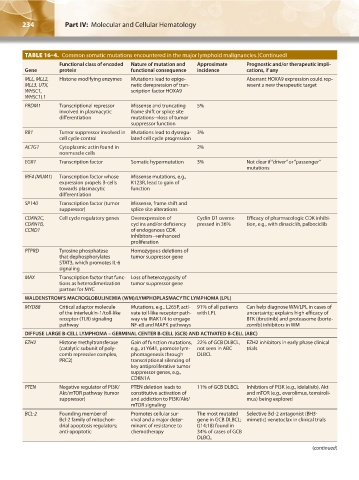
                TABLE 16–4.  Common somatic mutations encountered in the major lymphoid malignancies.(Continued)
                            Functional class of encoded   Nature of mutation and   Approximate   Prognostic and/or therapeutic impli-
                Gene        protein                 functional consequence  incidence      cations, if any
                MLL, MLL2,   Histone modifying enzymes  Mutations lead to epige-           Aberrant HOXA9 expression could rep-
                MLL3, UTX,                          netic derepression of tran-            resent a new therapeutic target
                WHSC1,                              scription factor HOXA9
                WHSC1L1
                PRDM1       Transcriptional repressor   Missense and truncating   5%
                            involved in plasmacytic   frame shift or splice site
                            differentiation         mutations→loss of tumor
                                                    suppressor function
                RB1         Tumor suppressor involved in  Mutations lead to dysregu-  3%
                            cell cycle control      lated cell cycle progression
                ACTG1       Cytoplasmic actin found in                    2%
                            nonmuscle cells
                EGR1        Transcription factor    Somatic hypermutation  3%              Not clear if “driver” or “passenger”
                                                                                           mutations
                IRF4 (MUM1)  Transcription factor whose   Missense mutations, e.g.,
                            expression propels B-cells   K123R, lead to gain of
                            towards plasmacytic     function
                            differentiation
                SP140       Transcription factor (tumor   Missense, frame shift and
                            suppressor)             splice site alterations
                CDKN2C,     Cell cycle regulatory genes  Overexpression of   Cyclin D1 overex-  Efficacy of pharmacologic CDK inhibi-
                CDKN1B,                             cyclins and/or deficiency   pressed in 36%  tion, e.g., with dinaciclib, palbociclib
                CCND1                               of endogenous CDK
                                                    inhibitors→enhanced
                                                    proliferation
                PTPRD       Tyrosine phosphatase    Homozygous deletions of
                            that dephosphorylates   tumor suppressor gene
                            STAT3, which promotes IL-6
                            signaling
                MAX         Transcription factor that func- Loss of heterozygosity of
                            tions as heterodimerization   tumor suppressor gene
                            partner for MYC
                WALDENSTROM’S MACROGLOBULINEMIA (WM)/LYMPHOPLASMACYTIC LYMPHOMA (LPL)
                MYD88       Critical adaptor molecule   Mutations, e.g., L265P, acti-  91% of all patients   Can help diagnose WM/LPL in cases of
                            of the interleukin-1/toll-like   vate toll-like receptor path-  with LPL  uncertainty; explains high efficacy of
                            receptor (TLR) signaling   way via IRAK1/4 to engage           BTK (ibrutinib) and proteasome (borte-
                            pathway                 NF-κB and MAPK pathways                zomib) inhibitors in WM
                DIFFUSE LARGE B-CELL LYMPHOMA – GERMINAL CENTER B-CELL (GCB) AND ACTIVATED B-CELL (ABC)
                EZH2        Histone methyltransferase   Gain of function mutations,  22% of GCB DLBCL,   EZH2 inhibitors in early phase clinical
                            (catalytic subunit of poly-  e.g., at Y641, promote lym-  not seen in ABC   trials
                            comb repressive complex,   phomagenesis through   DLBCL
                            PRC2)                   transcriptional silencing of
                                                    key antiproliferative tumor
                                                    suppressor genes, e.g.,
                                                    CDKN1A
                PTEN        Negative regulator of PI3K/  PTEN deletion leads to   11% of GCB DLBCL  Inhibtiors of PI3K (e.g., idelalisib), Akt
                            Akt/mTOR pathway (tumor   constitutive activation of           and mTOR (e.g., everolimus, temsiroli-
                            suppressor)             and addiction to PI3K/Akt/             mus) being explored
                                                    mTOR signaling
                BCL-2       Founding member of      Promotes cellular sur-  The most mutated   Selective Bcl-2 antagonist (BH3-
                            Bcl-2 family of mitochon-  vival and a major deter-  gene in GCB DLBCL;  mimetic) venetoclax in clinical trials
                            drial apoptosis regulators;   minant of resistance to   t(14;18) found in
                            anti-apoptotic          chemotherapy          34% of cases of GCB
                                                                          DLBCL
                                                                                                                 (continued)


          Kaushansky_chapter 16_p0213-0246.indd   234                                                                   9/18/15   11:57 PM

