


Page 255 - Williams Hematology ( PDFDrive )
P. 255
230            Part IV:  Molecular and Cellular Hematology                                                                                                Chapter 16:  Cell-Cycle Regulation and Hematologic Disorders             231


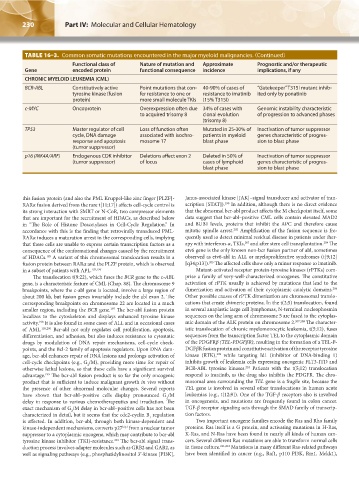
                TABLE 16–3.  Common somatic mutations encountered in the major myeloid malignancies. (Continued)
                                Functional class of    Nature of mutation and   Approximate   Prognostic and/or therapeutic
                Gene            encoded protein        functional consequence  incidence      implications, if any
                CHRONIC MYELOID LEUKEMIA (CML)
                BCR-ABL         Constitutively active   Point mutations that con-  40-90% of cases of   “Gatekeeper” T315I mutant inhib-
                                tyrosine kinase (fusion   fer resistance to one or   resistance to imatinib   ited only by ponatinib
                                protein)               more small molecule TKIs  (15% T315I)
                c-MYC           Oncoprotein            Overexpression often due  34% of cases with   Genomic instability characteristic
                                                       to acquired trisomy 8  clonal evolution    of progression to advanced phases
                                                                            (trisomy 8)
                TP53            Master regulator of cell   Loss of function often   Mutated in 25-30% of  Inactivation of tumor suppressor
                                cycle, DNA damage      associated with isochro-  patients in myeloid   genes characteristic of progres-
                                response and apoptosis   mosome 17          blast phase       sion to blast phase
                                (tumor suppressor)
                p16 (INK4A/ARF)  Endogenous CDK inhibitor   Deletions affect exon 2   Deleted in 50% of   Inactivation of tumor suppressor
                                (tumor suppressor)     of locus             cases of lymphoid   genes characteristic of progres-
                                                                            blast phase       sion to blast phase


               this fusion protein (and also the PML Kruppel-like zinc finger [PLZF]-  Janus-associated kinase [JAK]–signal transducer and activator of tran-
                                                                                   198
               RARα fusion derived from the rare t[11;17]) affects cell-cycle control is   scription [STAT]).  In addition, although there is no direct evidence
               its strong interaction with SMRT or N-CoR, two corepressor elements   that the abnormal bcr-abl product affects the M checkpoint itself, some
               that are important for the recruitment of HDACs, as described below   data suggest that bcr-abl–positive CML cells contain elevated MAD2
               in  “The  Role  of Histone  Deacetylases  in  Cell-Cycle  Regulation.” In   and  BUB1  levels,  proteins  that  inhibit  the  APC  and  therefore  cause
                                                                                      202
               accordance with this is the finding that retrovirally transduced PML-  mitotic spindle arrest.  Amplification of the fusion sequence is fre-
               RARα induces a maturation arrest in the corresponding cells, implying   quently used to detect minimal residual disease in patients under ther-
               that these cells are unable to express certain transcription factors as a   apy with interferon-α, TKIs,  and after stem cell transplantation.  The
                                                                                          203
                                                                                                                    204
               consequence of the conformational changes caused by the recruitment   etv6 gene is the only known non-bcr fusion partner of abl, sometimes
               of HDACs.  A variant of this chromosomal translocation results in a   observed as etv6-abl in ALL or myeloproliferative syndromes (t[9;12]
                       195
                                                                              205
               fusion protein between RARα and the PLZF protein, which is observed   [q34;p13]).  The affected cells show only a minor response to imatinib.
               in a subset of patients with APL. 195,196                  Mutant-activated receptor protein-tyrosine kinases (rPTKs) com-
                   The translocation t(9:22), which fuses the BCR gene to the c-ABL   prise a family of very-well-characterized oncogenes. The constitutive
               gene, is a characteristic feature of CML (Chap. 88). The chromosome 9   activation of rPTK usually is achieved by mutations that lead to the
               breakpoints, where the c-abl gene is located, involve a large region of   dimerization and activation of their cytoplasmic catalytic domains.
                                                                                                                       206
               about 200 kb, but fusion genes invariably include the abl exon 2. The   Other possible causes of rPTK dimerization are chromosomal translo-
               corresponding breakpoints on chromosome 22 are located in a much   cations that create chimeric proteins. In the t(2;5) translocation, found
               smaller region, including the BCR gene.  The bcr-abl fusion protein   in several anaplastic large cell lymphomas, N-terminal nucleophosmin
                                             197
               localizes to the cytoskeleton  and displays enhanced  tyrosine  kinase   sequences on the long arm of chromosome 5 are fused to the cytoplas-
               activity.  It is also found in some cases of ALL and in occasional cases   mic domain of the ALK protein on chromosome 2. 207,208  The character-
                     198
               of AML. 199,200  Bcr-abl not only regulates cell proliferation, apoptosis,   istic translocation of chronic myelomonocytic leukemia, t(5;12), fuses
               differentiation, and adhesion, but also induces resistance to cytostatic   sequences from the transcription factor TEL to the cytoplasmic domain
               drugs by modulation of DNA repair mechanisms, cell-cycle check-  of the PDGFRβ (TEL-PDGFβR), resulting in the formation of a TEL-P-
               points, and the Bcl-2 family of apoptosis regulators. Upon DNA dam-  DGFβR fusion protein and constitutive activation of the receptor tyrosine
                                                                                 209
               age, bcr-abl enhances repair of DNA lesions and prolongs activation of   kinase (RTK),  while targeting Id1 (inhibitor of DNA-binding 1)
               cell-cycle checkpoints (e.g., G /M), providing more time for repair of   inhibits growth of leukemia cells expressing oncogenic FLT3-ITD and
                                     2
               otherwise lethal lesions, so that these cells have a significant survival   BCR-ABL tyrosine kinases.  Patients with the t(5;12) translocation
                                                                                          210
               advantage.  The bcr-abl fusion product is so far the only oncogenic   respond to imatinib, as the drug also inhibits the PDGFR. The chro-
                       199
               product that is sufficient to induce malignant growth in vivo without   mosomal area surrounding the TEL gene is a fragile site, because the
               the presence of other abnormal molecular changes. Several reports   TEL gene is involved in several other translocations in human acute
               have  shown that bcr-abl–positive  cells  display  pronounced  G /M   leukemias (e.g., t[12;9]). One of the TGF-β receptors also is involved
                                                                2
               delay in response to various chemotherapeutics and irradiation. The   in oncogenesis, and mutations are frequently found in colon cancer.
               exact mechanism of G /M delay in bcr-abl–positive cells has not been   TGF-β receptor signaling acts through the SMAD family of transcrip-
                                2
               characterized in detail, but it seems that the cdc2-cyclin B  regulation   tion factors.
                                                          1
               is affected. In addition, bcr-abl,  through both  kinase-dependent and   Two important oncogene families encode the Ras and Rho family
               kinase-independent mechanisms, converts p27 kip1  from a nuclear tumor   proteins. Ras itself is a G protein, and activating mutations in H-Ras,
               suppressor to a cytoplasmic oncogene, which may contribute to bcr-abl   K-Ras, and N-Ras have been found in nearly all kinds of human can-
               tyrosine kinase inhibitor (TKI)-resistance.  The bcr-abl signal trans-  cers. Several different Ras mutations are able to transform normal cells
                                              201
               duction process involves adapter molecules such as GRB2 and GAB2, as   in tissue culture. 211,212  Mutations in many different Ras-related pathways
               well as signaling pathways (e.g., phosphatidylinositol 3′-kinase [PI3K],   have been identified in cancer (e.g., Raf1, p110 PI3K, Rin1, Mekk1),


          Kaushansky_chapter 16_p0213-0246.indd   230                                                                   9/18/15   11:57 PM

