


Page 260 - Williams Hematology ( PDFDrive )
P. 260
234  Part IV:  Molecular and Cellular Hematology  Chapter 16:  Cell-Cycle Regulation and Hematologic Disorders        235


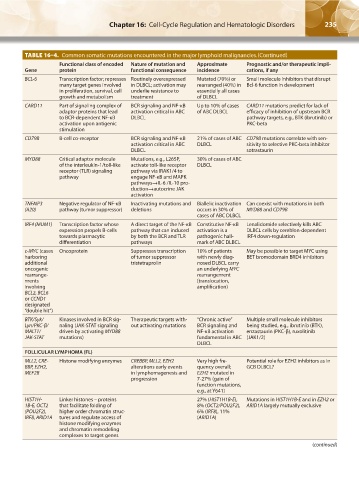
                   TABLE 16–4.  Common somatic mutations encountered in the major lymphoid malignancies.(Continued)
                              Functional class of encoded   Nature of mutation and   Approximate   Prognostic and/or therapeutic impli-
                   Gene       protein                 functional consequence  incidence      cations, if any
                   BCL-6      Transcription factor; represses  Routinely overexpressed   Mutated (70%) or   Small molecule inhibitors that disrupt
                              many target genes involved   in DLBCL; activation may   rearranged (40%) in  Bcl-6 function in development
                              in proliferation, survival, cell   underlie resistance to   essentially all cases
                              growth and metabolism   treatment             of DLBCL
                   CARD11     Part of signaling complex of   BCR signaling and NF-κB   Up to 10% of cases   CARD11 mutations predict for lack of
                              adaptor proteins that lead   activation critical in ABC   of ABC DLBCL  efficacy of inhibition of upstream BCR
                              to BCR-dependent NF-κB   DLBCL                                 pathway targets, e.g., BTK (ibrutinib) or
                              activation upon antigenic                                      PKC-beta
                              stimulation
                   CD79B      B-cell co-receptor      BCR signaling and NF-κB   21% of cases of ABC  CD79B mutations correlate with sen-
                                                      activation critical in ABC   DLBCL     sitivity to selective PKC-beta inhibitor
                                                      DLBCL                                  sotrastaurin
                   MYD88      Critical adaptor molecule   Mutations, e.g., L265P,   30% of cases of ABC
                              of the interleukin-1/toll-like   activate toll-like receptor   DLBCL
                              receptor (TLR) signaling   pathway via IRAK1/4 to
                              pathway                 engage NF-κB and MAPK
                                                      pathways→IL-6 /IL-10 pro-
                                                      duction→autocrine JAK
                                                      activation
                   TNFAIP3    Negative regulator of NF-κB   Inactivating mutations and  Biallelic inactivation  Can coexist with mutations in both
                   (A20)      pathway (tumor suppressor)  deletions         occurs in 30% of   MYD88 and CD79B
                                                                            cases of ABC DLBCL
                   IRF4 (MUM1)  Transcription factor whose   A direct target of the NF-κB  Constitutive NF-κB   Lenalidomide selectively kills ABC
                              expression propels B-cells   pathway that can induced   activation is a   DLBCL cells by cereblon-dependent
                              towards plasmacytic     by both the BCR and TLR   pathogenic hall-  IRF4 down-regulation
                              differentiation         pathways              mark of ABC DLBCL
                   c-MYC (cases  Oncoprotein          Suppresses transcription   10% of patients   May be possible to target MYC using
                   harboring                          of tumor suppressor   with newly diag-  BET bromodomain BRD4 inhibitors
                   additional                         tristetraprolin       nosed DLBCL carry
                   oncogenic                                                an underlying MYC
                   rearrange-                                               rearrangement
                   ments                                                    (translocation,
                   involving                                                amplification)
                   BCL2, BCL6
                   or CCND1
                   designated
                   “double hit”)
                   BTK/Syk/   Kinases involved in BCR sig-  Therapeutic targets with-  “Chronic active”   Multiple small molecule inhibitors
                   Lyn/PKC-β/  naling (JAK-STAT signaling   out activating mutations  BCR signaling and   being studied, e.g., ibrutinib (BTK),
                   MALT1/     driven by activating MYD88                    NF-κB activation   enzastaurin (PKC-β), ruxolitinib
                   JAK-STAT   mutations)                                    fundamental in ABC  (JAK1/2)
                                                                            DLBCL
                   FOLLICULAR LYMPHOMA (FL)
                   MLL2, CRE-  Histone modifying enzymes  CREBBP, MLL2, EZH2   Very high fre-  Potential role for EZH2 inhibitors as in
                   BBP, EZH2,                         alterations early events   quency overall;   GCB DLBCL?
                   MEF2B                              in lymphomagenesis and   EZH2 mutated in
                                                      progression           7-27% (gain of
                                                                            function mutations,
                                                                            e.g., at Y641)
                   HIST1H-    Linker histones – proteins                    27% (HIST1H1B-E),   Mutations in HIST1H1B-E and in EZH2 or
                   1B-E, OCT2   that facilitate folding of                  8% (OCT2/POU2F2),  ARID1A largely mutually exclusive
                   (POU2F2),   higher order chromatin struc-                6% (IRF8), 11%
                   IRF8, ARID1A  tures and regulate access of               (ARID1A)
                              histone modifying enzymes
                              and chromatin remodeling
                              complexes to target genes
                                                                                                                   (continued)


          Kaushansky_chapter 16_p0213-0246.indd   235                                                                   9/18/15   11:57 PM

