


Page 264 - Williams Hematology ( PDFDrive )
P. 264
238  Part IV:  Molecular and Cellular Hematology  Chapter 16:  Cell-Cycle Regulation and Hematologic Disorders        239


                  ODC has been observed in many tumors and is linked to the Ras path-  agents in hematologic malignancies.  Transcriptional regulation
                                                                                                     292
                  way.  Reexpression of MTAP in ODC overexpressing cells decreases   by methylation is mediated by a multiprotein complex consisting
                     278
                                                  279
                  ODC levels and inhibits tumor cell growth.  In addition, high levels   of a MeCP2, a methylcytosine-binding protein with a transcrip-
                  of 5′-deoxy-5′-(methylthio) adenosine (MTA) induce matrix metallo-  tional repressor domain that binds the corepressor mSin3A, which
                  proteinase and growth factor gene expression in melanoma cells, lead-  is itself one element of a multiprotein complex that includes HDAC1
                  ing to enhanced invasion and vasculogenic mimicry. In addition, MTA   and HDAC2. 293,294  Therefore, reexpression of silenced genes can be
                  induced the secretion of β-fibroblast growth factor and the upregulation   achieved  by  demethylating  DNA  or  by  destabilizing  HDACs,  and
                  of activator protein-1, demonstrating a tumor-supporting role of MTA,   it could be demonstrated that both mechanisms are tightly linked.
                  which is increased in MTAP-deficient cells. 280       HDACIs and demethylating agents act synergistically to induce genes
                                                                                                      139
                     The mechanisms by which the above-mentioned genes are inacti-  silenced in cancer by hypermethylation.  Another new mechanism
                  vated are rather different. Especially in permanent cell lines, p15 INK4B /   of gene regulation and inactivation in vivo is degradation by microR-
                  p14 ARF /p16 INK4A  and MTAP are homozygously deleted. One allele of   NAs. This has also been shown for several members of the p16 INK4A /
                  MTAP is also deleted in AML lines, but not in primary AML samples.   cdk4/cyclin D /RB pathway. 295
                                                                                   1
                  Mutations in  p15 INK4B /p14 ARF /p16 INK4A  genes are rare, and if present,
                  occur in exon 2. Hypermethylation of CpG islands in the promoter
                  areas of p15INK4B/p14 ARF /p16 INK4A  are frequently found in hemato-    THE ROLE OF HISTONE DEACETYLASES
                  logic malignancies. 281–283  The availability of demethylating agents such   IN CELL–CYCLE REGULATION
                  as 5-azacytidine and 5-aza-2′-deoxycytidine (decitabine) makes this
                  phenomenon an interesting target for chemotherapy. 284,285  Decitabine   HDACs catalyze the deacetylation of lysine residues in the histone
                  has been used to treat patients suffering from different hematologic   N-terminal tails and are found in large multiprotein complexes
                  malignancies and was reported to have activity in advanced myelo-  with transcriptional corepressors. Human HDACs are grouped into
                  dysplastic syndrome  (MDS),  accompanied  by  demethylation  of  the   three classes based on their similarity to known yeast factors: class
                  p16 INK4A  promoter.  Azacytidine and decitabine are approved for   I HDACs are similar to the yeast transcriptional repressor yRPD3;
                                285
                  the treatment of MDS 286–288  and also widely used for the treatment   class II HDACs are similar to the yeast transcriptional repressor
                  of AML, particularly older patients considered unfit for cytotoxic   yHDA1;  and  class  III  HDACs are similar to the yeast transcrip-
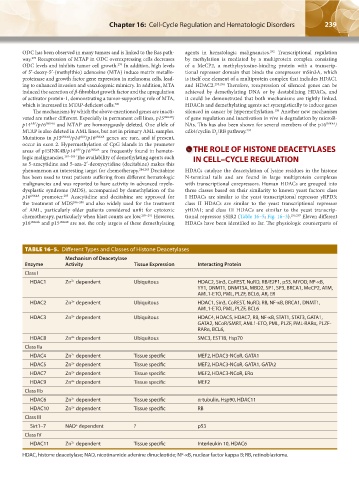
                  chemotherapy, particularly when blast counts are low. 289–291  However,   tional repressor ySIR2 (Table 16–5; Fig. 16–3). 296,297  Eleven different
                  p16 INK4A  and p15 INK4B  are not the only targets of these demethylating   HDACs have been identified so far. The physiologic counterparts of


                   TABLE 16–5.  Different Types and Classes of Histone Deacetylases
                                Mechanism of Deacetylase
                   Enzyme       Activity               Tissue Expression     Interacting Protein
                   Class I
                     HDAC1      Zn  dependent          Ubiquitous            HDAC2, Sin3, CoREST, NuRD, RB/E2F1, p53, MYOD, NF-κB,
                                  2+
                                                                             YY1, DNMT1, DNMT3A, MBD2, SP1, SP3, BRCA1, MeCP2, ATM,
                                                                             AML1-ETO, PML, PLZF, BCL6, AR, ER
                     HDAC2      Zn  dependent          Ubiquitous            HDAC1, Sin3, CoREST, NuRD, RB, NF-κB, BRCA1, DNMT1,
                                  2+
                                                                             AML1-ETO, PML, PLZF, BCL6
                     HDAC3      Zn  dependent          Ubiquitous            HDAC4, HDAC5, HDAC7, RB, NF-κB, STAT1, STAT3, GATA1,
                                  2+
                                                                             GATA2, NCoR/SMRT, AML1-ETO, PML, PLZF, PML-RARα, PLZF-
                                                                             RARα, BCL6,
                     HDAC8      Zn  dependent          Ubiquitous            SMC3, EST1B, Hsp70
                                  2+
                   Class IIa
                     HDAC4      Zn  dependent          Tissue specific       MEF2, HDAC3-NCoR, GATA1
                                  2+
                     HDAC5      Zn  dependent          Tissue specific       MEF2, HDAC3-NCoR, GATA1, GATA2
                                  2+
                     HDAC7      Zn  dependent          Tissue specific       MEF2, HDAC3-NCoR, ERα
                                  2+
                     HDAC9      Zn  dependent          Tissue specific       MEF2
                                  2+
                   Class IIb
                     HDAC6      Zn  dependent          Tissue specific       α-tubulin, Hsp90, HDAC11
                                  2+
                     HDAC10     Zn  dependent          Tissue specific       RB
                                  2+
                   Class III
                     Sirt1–7    NAD  dependent         ?                     p53
                                    +
                   Class IV
                     HDAC11     Zn  dependent          Tissue specific       Interleukin 10, HDAC6
                                  2+
                  HDAC, histone deacetylase; NAD, nicotinamide adenine dinucleotide; NF-κB, nuclear factor kappa B; RB, retinoblastoma.


          Kaushansky_chapter 16_p0213-0246.indd   239                                                                   9/18/15   11:58 PM

