


Page 265 - Williams Hematology ( PDFDrive )
P. 265
240            Part IV:  Molecular and Cellular Hematology                                                                                                Chapter 16:  Cell-Cycle Regulation and Hematologic Disorders             241


                 Class I : Yeast RPD 3  HDAC1  HD domain  373 429 483  mechanism in the development of AML, most notably APL. The
                                                                      PML-RARα fusion protein is an oncoprotein that represses retinoic
                                           483
                   HDAC2
                                                                      acid-dependent transcription by recruitment of HDAC to RAR-reg-
                   HDAC3
                                                                      ulated genes (Fig. 16–4B), halting myeloid maturation because of
                                                                      cell-cycle arrest. In the PML-RARα fusion protein, the RARα is not
                   HDAC8
                                                                      responsive to physiologic concentrations of retinoic acid and supra-
                                     347
                   HDAC11
                                                                      physiologic doses of all-trans-retinoic acid are necessary to overcome
                                                                      the tight HDAC-recruitment and the consequent cell-cycle block.
                                                                                                                       296
                   HDAC4
                 Class II: Yeast HDA 1  HDAC5          808  879/1011 ∗∗  which directly interacts with the NCoR–mSin3a–HDAC complex to
                                                           1003
                                                                      The rare translocation t(11;17) fuses the RARα gene to the PLZF gene,
                                                             1123
                                                               1215
                   HDAC6
                                                                      suppress gene transcription. This block can only be overcome by the
                   HDAC7
                                                                      addition of a HDACI. Another well-known example of transcriptional
                   HDAC9
                                                                      silencing by the recruitment of an HDAC repressor is the AML1-ETO
                                                         ∗∗
                   HDAC10
                                                   662/673
                                                                      fusion protein which results from the t(8;21) translocation. As already
                                                                      described, the addition of an HDACI can relieve ETO-mediated tran-
                                                                                       299
                   Sirt1                       Class III: Yeast Sir 2  scriptional repression.  Although 11 HDACs have been described,
                                                                      only limited information is available about their redundant biologic
                  ∗ HD domain, histone deacetylase;  two-splice variants  and physiologic functions. As shown in Figure  16–4B, inhibitors of
                                        ∗∗
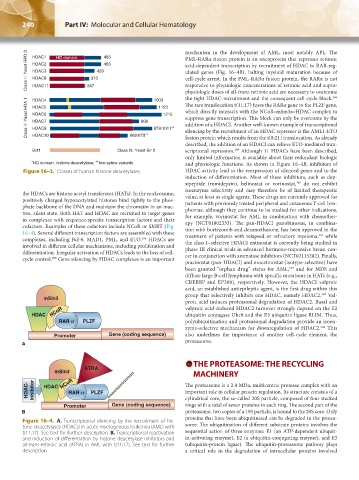
                Figure 16–3.  Classes of human histone deacetylases.  HDAC activity lead to the reexpression of silenced genes and to the
                                                                      induction  of  differentiation. Most  of these inhibitors,  such  as dep-
                                                                                                           300
                                                                      sipeptide (romidepsin), belinostat or vorinostat,  do not exhibit
                                                                      isoenzyme selectivity and may therefore be of limited therapeutic
               the HDACs are histone acetyl transferases (HATs). In the nucleosome,
               positively charged hypoacetylated histones bind tightly to the phos-  value, at least as single agents. These drugs are currently approved for
               phate backbone of the DNA and maintain the chromatin in an inac-  patients with previously treated peripheral and cutaneous T-cell lym-
               tive, silent state. Both HAT and HDAC are recruited to target genes   phomas, although they continue to be studied for other indications,
               in complexes with  sequence-specific transcription  factors and  their   for example, vorinostat for AML in combination with chemother-
               cofactors. Examples of these cofactors include NCoR or SMRT (Fig.   apy (NCT01802333). The pan-HDACI panobinostat, in combina-
               16–4). Several different transcription factors are assembled with these   tion with bortezomib and dexamethasone, has been approved in the
                                                                                                                   301
               complexes, including Bcl-6, MAD1, PML, and ETO.  HDACs are   treatment of patients with relapsed or refractory myeloma,  while
                                                       296
               involved in different cellular mechanisms, including proliferation and   the class I–selective HDACI entinostat is currently being studied in
               differentiation. Irregular activation of HDACs leads to the loss of cell-  phase III clinical trials in advanced hormone-responsive breast can-
               cycle control.  Gene silencing by HDAC complexes is an important   cer in conjunction with aromatase inhibitors (NCT02115282). Finally,
                         298
                                                                      pracinostat (pan-HDACI) and mocetinostat (isotype-selective) have
                                                                                                         147
                                                                      been granted “orphan drug” status for AML,  and for MDS and
                                                                      diffuse large B-cell lymphoma with specific mutations in HATs (e.g.,
                                                                      CREBBP and EP300), respectively. However, the HDACI valproic
                                                                      acid, an established antiepileptic agent, is the first drug within this
                                                                      group that selectively inhibits one HDAC, namely HDAC2.  Val-
                                                                                                                    302
                                                                      proic acid induces proteasomal degradation of HDAC2. Basal and
                                                                      valproic acid-induced HDAC2 turnover strongly depend on the E2
                                                                      ubiquitin conjugase Ubc8 and the E3 ubiquitin ligase RLIM. Thus,
                                                                      polyubiquitination and proteasomal degradation provide an isoen-
                                                                                                                   302
                                                                      zyme-selective mechanism for downregulation of HDAC2.  This
                                                                      also underlines the importance of another cell-cycle element, the
                                                                      proteasome.
               A
                                                                           THE PROTEASOME: THE RECYCLING
                                                                         MACHINERY
                                                                      The proteasome is a 2.4 MDa, multicentric protease complex with an
                                                                      important role in cellular protein regulation. Its structure consists of a
                                                                      cylindrical core, the so-called 20S particle, composed of four stacked
                                                                      rings with a total of seven proteins in each ring. The second part of the
               B                                                      proteasome, two copies of a 19S particle, is bound to the 20S core. Only
                                                                      proteins that have been ubiquitinated can be degraded in the protea-
               Figure 16–4.  A. Transcriptional silencing by the recruitment of his-
               tone deacetylases (HDACs) in acute myelogenous leukemia (AML) with   some. The ubiquitination of different substrate proteins involves the
               t(11;17). See text for further description. B. Transcriptional reactivation   sequential action of three enzymes: E1 (an ATP-dependent ubiquit-
               and induction of differentiation by histone deacetylase inhibitors and   in-activating enzyme), E2 (a ubiquitin-conjugating enzyme), and E3
               all-trans-retinoic acid (ATRA) in AML with t(11;17). See text for further   (ubiquitin-protein ligase). The ubiquitin-proteasome pathway plays
               description.                                           a  critical  role  in  the  degradation  of  intracellular  proteins  involved


          Kaushansky_chapter 16_p0213-0246.indd   240                                                                   9/18/15   11:58 PM

