


Page 490 - Williams Hematology ( PDFDrive )
P. 490
464  Part VI:  The Erythrocyte                   Chapter 31:  Structure and Composition of the Erythrocyte            465


                                                               C


                                                                                  pnc


                                        P


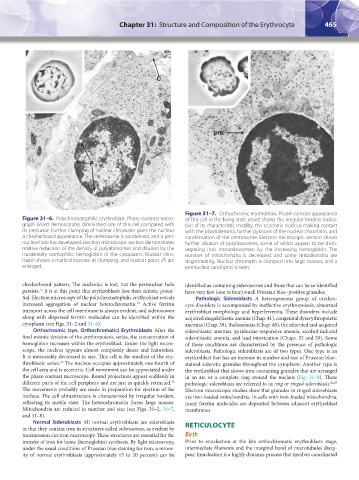
                                                                        Figure 31–7.  Orthochromic erythroblast. Phase-contrast appearance
                  Figure 31–6.  Polychromatophilic erythroblast. Phase-contrast micro-  of this cell in the living state (inset) shows the irregular borders indica-
                  graph (inset) demonstrates diminished size of this cell compared with   tive of its characteristic motility, the eccentric nucleus making contact
                  its precursor. Further clumping of nuclear chromatin gives the nucleus   with the plasmalemma, further pyknosis of the nuclear chromatin, and
                  a checkerboard appearance. The centrosome is condensed, and a peri-  condensation of the centrosome. Electron microscopic section shows
                  nuclear halo has developed. Electron microscopic section demonstrates   further dilution of polyribosomes, some of which appear to be disin-
                  relative reduction of the density of polyribosomes and dilution by the   tegrating into monoribosomes, by the increasing hemoglobin.  The
                  moderately osmiophilic hemoglobin in the cytoplasm. Nuclear chro-  number of mitochondria is decreased, and some mitochondria are
                  matin shows a marked increase in clumping, and nuclear pores (P) are   degenerating. Nuclear chromatin is clumped into large masses, and a
                  enlarged.                                             perinuclear canal (pnc) is seen.


                  checkerboard pattern. The nucleolus is lost, but the perinuclear halo   identified as containing siderosomes and those that can be so identified
                  persists.  It is at this point that erythroblasts lose their mitotic poten-  have very few (one to four) small Prussian blue–positive granules.
                        13
                  tial. Electron microscopy of the polychromatophilic erythroblast reveals   Pathologic Sideroblasts A heterogeneous group of erythro-
                                                        13
                  increased aggregation  of  nuclear  heterochromatin.   Active  ferritin   cyte disorders is accompanied by ineffective erythropoiesis, abnormal
                  transport across the cell membrane is always evident, and siderosomes   erythroblast morphology and hyperferremia. These disorders include
                  along with dispersed ferritin molecules can be identified within the   acquired megaloblastic anemia (Chap. 41), congenital dyserythropoietic
                  cytoplasm (see Figs. 31–2 and 31–6).                  anemias (Chap. 39), thalassemias (Chap. 48), the inherited and acquired
                     Orthochromic (syn. Orthochromatic) Erythroblasts After the   sideroblastic anemias, pyridoxine-responsive anemia, alcohol-induced
                  final mitotic division of the erythropoietic series, the concentration of   sideroblastic anemia, and lead intoxication (Chaps. 52 and 59). Some
                  hemoglobin increases within the erythroblast. Under the light micro-  of these conditions are characterized by the presence of pathologic
                  scope, the nucleus appears almost completely dense and featureless.   sideroblasts. Pathologic sideroblasts are of two types. One type is an
                  It is measurably decreased in size. This cell is the smallest of the ery-  erythroblast that has an increase in number and size of Prussian blue–
                              13
                  throblastic series.  The nucleus occupies approximately one-fourth of   stained siderotic granules throughout the cytoplasm. Another type is
                  the cell area and is eccentric. Cell movement can be appreciated under   the erythroblast that shows iron-containing granules that are arranged
                  the phase-contrast microscope. Round projections appear suddenly in   in an arc or a complete ring around the nucleus (Fig. 31–8). These
                  different parts of the cell periphery and are just as quickly retracted.    pathologic sideroblasts are referred to as ring or ringed sideroblasts. 26,27
                                                                    13
                  The movements probably are made in preparation for ejection of the   Electron microscopic studies show that granules in ringed sideroblasts
                  nucleus. The cell ultrastructure is characterized by irregular borders,   are iron-loaded mitochondria. In cells with iron-loaded mitochondria,
                  reflecting  its  motile  state.  The  heterochromatin  forms  large  masses.   many ferritin molecules are deposited between adjacent erythroblast
                  Mitochondria are reduced in number and size (see Figs. 31–2, 31–7,   membranes.
                  and 31–8).
                     Normal Sideroblasts All normal erythroblasts are sideroblasts
                  in that they contain iron in structures called siderosomes, as evident by   RETICULOCYTE
                  transmission electron microscopy. These structures are essential for the   Birth
                  transfer of iron for heme (hemoglobin) synthesis. By light microscopy,   Prior to enucleation at the late orthochromatic erythroblasts stage,
                  under the usual conditions of Prussian blue staining for iron, a minor-  intermediate filaments and the marginal band of microtubules disap-
                  ity of  normal  erythroblasts  (approximately  15 to 20  percent) can  be   pear. Enucleation is a highly dynamic process that involves coordinated


          Kaushansky_chapter 31_p0459-0478.indd   465                                                                   9/18/15   10:58 PM

