


Page 492 - Williams Hematology ( PDFDrive )
P. 492
466  Part VI:  The Erythrocyte                   Chapter 31:  Structure and Composition of the Erythrocyte            467


                                                                        may be twice the normal volume, with a corresponding increase in mean
                                                                        cell hemoglobin (MCH) content. Whether the increase results from one
                                                                        less mitotic division during maturation or from some other process such
                                                                        as changes in cell cycle is not clear. It is interesting to note that mice
                                                                        do not have the ability to produce stress reticulocytes with increased
                                                                        mean cell volume (MCV) and MCH. In contrast, even under moderate
                                                                        erythropoietic stress, some reticulocytes in the marrow pool shift to the
                                                                        circulating pool. These “shift” reticulocytes with normal MCH contain
                                                                        a higher-than-normal RNA content and now can be quantified. Quan-
                                                                        tification is commonly performed by applying a fluorescent stain to tag
                                                                        RNA and then dividing reticulocytes into high-, medium-, and low-fluo-
                                                                        rescence categories using a fluorescence-sensitive flow cytometer. The
                                                                        “stress” reticulocytes of the older literature likely fall in the high- and
                                                                        medium-fluorescence categories. Unfortunately, at present little atten-
                                                                        tion is being paid to discriminate stress and shift reticulocytes.
                                                                        Pathology of the Reticulocyte
                                                                        The reticulocyte may show pathologic alterations in size or staining
                                                                        properties. The reticulocyte may contain inclusions visible by light
                                                                        microscopy or identifiable only on ultrastructural analysis. Most patho-
                                                                        logic inclusions usually attributed to erythrocytes are actually found
                  Figure 31–10.  Orthochromic erythroblast ejecting its nucleus. A thin   within reticulocytes and are nuclear or cytoplasmic remnants derived
                  rim of cytoplasm surrounds the nucleus. In the cytoplasm, a single cen-  from late-stage erythroblasts. In splenectomized patients, they may also
                  triole (c) is partially encircled by some Golgi saccules.  be found in mature erythrocytes.

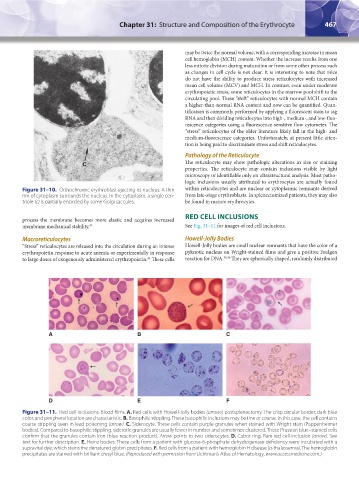
                                                                        RED CELL INCLUSIONS
                  process the membrane becomes more elastic and acquires increased
                  membrane mechanical stability. 32                     See Fig. 31–11 for images of red cell inclusions.

                  Macroreticulocytes                                    Howell-Jolly Bodies
                  “Stress” reticulocytes are released into the circulation during an intense   Howell-Jolly bodies are small nuclear remnants that have the color of a
                  erythropoietin response to acute anemia or experimentally in response   pyknotic nucleus on Wright-stained films and give a positive Feulgen
                  to large doses of exogenously administered erythropoietin.  These cells   reaction for DNA. 35,36  They are spherically shaped, randomly distributed
                                                            34


                           A                            B                             C


                           D                            E                             F
                  Figure 31–11.  Red cell inclusions. Blood films. A. Red cells with Howell-Jolly bodies (arrows) postsplenectomy. The crisp circular border, dark blue
                  color, and peripheral location are characteristic. B. Basophilic stippling. These basophilic inclusions may be fine or coarse. In this case, the cell contains
                  coarse stippling seen in lead poisoning (arrow). C. Siderocyte. These cells contain purple granules when stained with Wright stain (Pappenheimer
                  bodies). Compared to basophilic stippling, siderotic granules are usually fewer in number and sometimes clustered. These Prussian blue–stained cells
                  confirm that the granules contain iron (blue reaction product). Arrow points to two siderocytes. D. Cabot ring. Rare red cell inclusion (arrow). See
                  text for further description. E. Heinz bodies. These cells from a patient with glucose-6-phosphate dehydrogenase deficiency were incubated with a
                  supravital dye, which stains the denatured globin precipitates. F. Red cells from a patient with hemoglobin H disease (α-thalassemia). The hemoglobin
                  precipitates are stained with brilliant cresyl blue. (Reproduced with permission from Lichtman’s Atlas of Hematology, www.accessmedicine.com.)


          Kaushansky_chapter 31_p0459-0478.indd   467                                                                   9/18/15   10:59 PM

