


Page 491 - Williams Hematology ( PDFDrive )
P. 491
466            Part VI:  The Erythrocyte                                                                                                                      Chapter 31:  Structure and Composition of the Erythrocyte            467


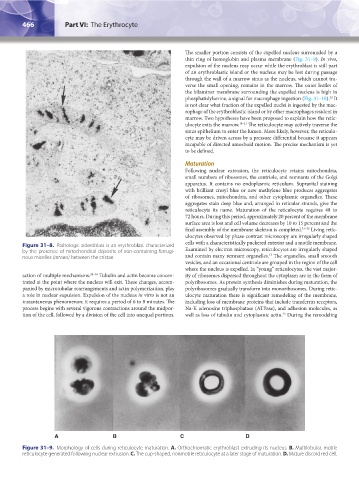
                                                                      The smaller portion consists of the expelled nucleus surrounded by a
                                                                      thin ring of hemoglobin and plasma membrane (Fig. 31–9). In vivo,
                                                                      expulsion of the nucleus may occur while the erythroblast is still part
                                                                      of an erythroblastic island or the nucleus may be lost during passage
                                                                      through the wall of a marrow sinus as the nucleus, which cannot tra-
                                                                      verse the small opening, remains in the marrow. The outer leaflet of
                                                                      the bilaminar membrane surrounding the expelled nucleus is high in
                                                                                                                      22
                                                                      phosphatidylserine, a signal for macrophage ingestion (Fig. 31–10).  It
                                                                      is not clear what fraction of the expelled nuclei is ingested by the mac-
                                                                      rophage of the erythroblastic island or by other macrophages resident in
                                                                      marrow. Two hypotheses have been proposed to explain how the retic-
                                                                      ulocyte exits the marrow. 19–21  The reticulocyte may actively traverse the
                                                                      sinus epithelium to enter the lumen. More likely, however, the reticulo-
                                                                      cyte may be driven across by a pressure differential because it appears
                                                                      incapable of directed amoeboid motion. The precise mechanism is yet
                                                                      to be defined.

                                                                      Maturation
                                                                      Following nuclear extrusion, the reticulocyte retains mitochondria,
                                                                      small numbers of ribosomes, the centriole, and remnants of the Golgi
                                                                      apparatus. It contains no endoplasmic reticulum. Supravital staining
                                                                      with brilliant cresyl blue or new methylene blue produces aggregates
                                                                      of ribosomes, mitochondria, and other cytoplasmic organelles. These
                                                                      aggregates stain deep blue and, arranged in reticular strands, give the
                                                                      reticulocyte its  name. Maturation of  the reticulocyte requires 48  to
                                                                      72 hours. During this period, approximately 20 percent of the membrane
                                                                      surface area is lost and cell volume decreases by 10 to 15 percent and the
                                                                      final assembly of the membrane skeleton is completed. 31–33  Living retic-
                                                                      ulocytes observed by phase-contrast microscopy are irregularly shaped
                                                                      cells with a characteristically puckered exterior and a motile membrane.
               Figure 31–8.  Pathologic sideroblast is an erythroblast characterized
               by the presence of mitochondrial deposits of iron-containing ferrugi-  Examined by electron microscopy, reticulocytes are irregularly shaped
                                                                                                  13
               nous micelles (arrows) between the cristae.            and contain many remnant organelles.  The organelles, small smooth
                                                                      vesicles, and an occasional centriole are grouped in the region of the cell
                                                                      where the nucleus is expelled. In “young” reticulocytes, the vast major-
               action of multiple mechanisms. 28–30  Tubulin and actin become concen-  ity of ribosomes dispersed throughout the cytoplasm are in the form of
               trated at the point where the nucleus will exit. These changes, accom-  polyribosomes. As protein synthesis diminishes during maturation, the
               panied by microtubular rearrangements and actin polymerization, play   polyribosomes gradually transform into monoribosomes. During retic-
               a role in nuclear expulsion. Expulsion of the nucleus in vitro is not an   ulocyte maturation there is significant remodeling of the membrane,
               instantaneous phenomenon; it requires a period of 6 to 8 minutes. The   including loss of membrane proteins that include transferrin receptors,
               process begins with several vigorous contractions around the midpor-  Na-K adenosine triphosphatase (ATPase), and adhesion molecules, as
               tion of the cell, followed by a division of the cell into unequal portions.   well as loss of tubulin and cytoplasmic actin.  During the remodeling
                                                                                                       33


                          A                   B                     C                     D
               Figure 31–9.  Morphology of cells during reticulocyte maturation. A. Orthochromatic erythroblast extruding its nucleus. B. Multilobular, motile
               reticulocyte generated following nuclear extrusion. C. The cup-shaped, nonmotile reticulocyte at a later stage of maturation. D. Mature discoid red cell.


          Kaushansky_chapter 31_p0459-0478.indd   466                                                                   9/18/15   10:58 PM

