


Page 1004 - Clinical Immunology_ Principles and Practice ( PDFDrive )
P. 1004
968          Part Seven  Organ-Specific Inflammatory Disease


                       Steady state              Initiation of injury and repair    Dysregulated repair
                       Alveolus
                       Type I epithelial cell
                                                  Monocytes
              Dendritic cell  Alveolar
                         macrophages
                                                      Lymphocytes                                          Fibrosis
                       Type II epithelial cell
                                                              PMNs


                                                               ECM                            ECM
                                         Resolution

                                                             Fibroblasts                     Fibroblasts
                                                   1. Denudation of barrier
                                                   2. Cytokine/chemokine expression
                                                   3. Recruitment of inflammatory cells
                                                   4. Proliferation of type II epithelial cells
                                                   5. DC maturation
                                                   6. Fibroblasts express ECM
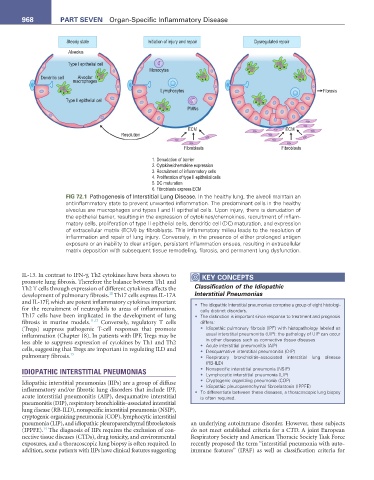
                       FIG 72.1  Pathogenesis of Interstitial Lung Disease. In the healthy lung, the alveoli maintain an
                       antiinflammatory state to prevent unwanted inflammation. The predominant cells in the healthy
                       alveolus are macrophages and types I and II epithelial cells. Upon injury, there is denudation of
                       the epithelial barrier, resulting in the expression of cytokines/chemokines, recruitment of inflam-
                       matory cells, proliferation of type II epithelial cells, dendritic cell (DC) maturation, and expression
                       of extracellular matrix (ECM) by fibroblasts. This inflammatory milieu leads to the resolution of
                       inflammation and repair of lung injury. Conversely, in the presence of either prolonged antigen
                       exposure or an inability to clear antigen, persistent inflammation ensues, resulting in extracellular
                       matrix deposition with subsequent tissue remodeling, fibrosis, and permanent lung dysfunction.


        IL-13. In contrast to IFN-γ, Th2 cytokines have been shown to    KeY COnCePtS
        promote lung fibrosis. Therefore the balance between Th1 and
        Th2 T cells through expression of different cytokines affects the   Classification of the Idiopathic
                                     10
        development of pulmonary fibrosis.  Th17 cells express IL-17A   Interstitial Pneumonias
        and IL-17F, which are potent inflammatory cytokines important   •  The idiopathic interstitial pneumonias comprise a group of eight histologi-
        for  the  recruitment  of  neutrophils  to areas of  inflammation.   cally distinct disorders.
        Th17  cells  have  been  implicated  in  the  development  of  lung   •  The distinction is important since response to treatment and prognosis
        fibrosis in murine models. 11,12  Conversely, regulatory T cells   differs:
        (Tregs) suppress pathogenic T-cell responses that promote   •  Idiopathic pulmonary fibrosis (IPF) with histopathology labeled as
        inflammation (Chapter 18). In patients with IPF, Tregs may be   usual interstitial pneumonitis (UIP): the pathology of UIP can occur
                                                                    in other diseases such as connective tissue diseases
        less able to suppress expression of cytokines by Th1 and Th2   •  Acute interstitial pneumonitis (AIP)
        cells, suggesting that Tregs are important in regulating ILD and   •  Desquamative interstitial pneumonitis (DIP)
        pulmonary fibrosis. 13                                     •  Respiratory bronchiolitis–associated interstitial lung disease
                                                                    (RB-ILD)
        IDIOPATHIC INTERSTITIAL PNEUMONIAS                         •  Nonspecific interstitial pneumonia (NSIP)
                                                                   •  Lymphocytic interstitial pneumonia (LIP)
                                                                   •  Cryptogenic organizing pneumonia (COP)
        Idiopathic interstitial pneumonias (IIPs) are a group of diffuse
                                                                   •  Idiopathic pleuroparenchymal fibroelastosis (IPPFE)
        inflammatory and/or fibrotic lung disorders that include IPF,   •  To differentiate between these diseases, a thoracoscopic lung biopsy
        acute interstitial pneumonitis (AIP), desquamative interstitial   is often required.
        pneumonitis (DIP), respiratory bronchiolitis–associated interstitial
        lung disease (RB-ILD), nonspecific interstitial pneumonia (NSIP),
        cryptogenic organizing pneumonia (COP), lymphocytic interstitial
        pneumonia (LIP), and idiopathic pleuroparenchymal fibroelastosis   an underlying autoimmune disorder. However, these subjects
               14
        (IPPFE).  The diagnosis of IIPs requires the exclusion of con-  do not meet established criteria for a CTD. A joint European
        nective tissue diseases (CTDs), drug toxicity, and environmental   Respiratory Society and American Thoracic Society Task Force
        exposures, and a thoracoscopic lung biopsy is often required. In   recently proposed the term “interstitial pneumonia with auto-
        addition, some patients with IIPs have clinical features suggesting   immune features” (IPAF) as well as classification criteria for

