


Page 1300 - Clinical Immunology_ Principles and Practice ( PDFDrive )
P. 1300
1262         Part eleven  Diagnostic Immunology


                                Unstimulated                          Stimulated
                   10 3                                  10 3
                                                                                           HLA B8 tetramer with
                   10 2                                  10 2                              CD107 a expression after
                                                                                           CMV IE-1 peptide stimulation
                  Relevant tetramer  10 1              Relevant tetramer  10 1


                   10 0                                  10 0

                    0                                     0

                        0     10 0  10 1  10 2   10 3         0    10 0   10 1  10 2  10 3
                                CD107a/b                               CD107a/b

                   10 3                                  10 3

                   10 2                                  10 2
                  Relevant tetramer  10 1               Relevant tetramer  10 1            HLA B8 tetramer with
                                                                                           CD107 a expression after
                                                                                           CMV peptide stimulation

                   10 0                                  10 0


                    0                                     0

                        0    10 0   10 1  10 2  10 3          0    10 0   10 1  10 2  10 3
                                  IFN-g                                 IFN-g
                B
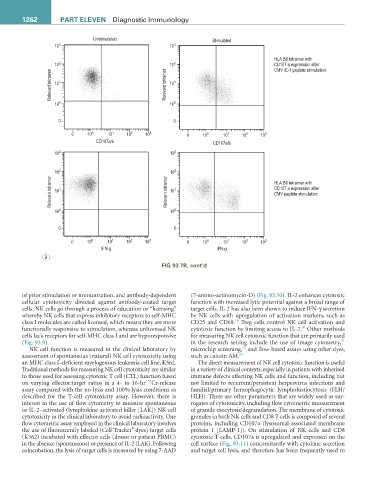
                                                      FIG 93.7B, cont’d


        of prior stimulation or immunization, and antibody-dependent   (7-amino-actinomycin-D) (Fig. 93.10). IL-2 enhances cytotoxic
        cellular cytotoxicity directed against antibody-coated target   function with increased lytic potential against a broad range of
        cells. NK cells go through a process of education or “licensing”   target cells. IL-2 has also been shown to induce IFN-γ secretion
        whereby NK cells that express inhibitory receptors to self-MHC   by NK cells with upregulation of activation markers, such as
                                                                              19
        class I molecules are called licensed, which means they are more   CD25 and  CD69.  Treg cells control NK cell  activation and
                                                                                                    20
        functionally responsive to stimulation, whereas unlicensed NK   cytotoxic function by limiting access to IL-2.  Other methods
        cells lack receptors for self-MHC class I and are hyporesponsive   for measuring NK cell cytotoxic function that are primarily used
                                                                                                                 21
        (Fig. 93.9).                                           in  the  research  setting  include  the  use  of  image  cytometry,
                                                                                22
           NK cell function is measured in the clinical laboratory by   microchip screening,  and flow-based assays using other dyes,
        assessment of spontaneous (natural) NK cell cytotoxicity using   such as calcein AM. 23
        an MHC class I–deficient myelogenous leukemia cell line, K562.   The direct measurement of NK cell cytotoxic function is useful
        Traditional methods for measuring NK cell cytotoxicity are similar   in a variety of clinical contexts, especially in patients with inherited
        to those used for assessing cytotoxic T cell (CTL) function based   immune defects affecting NK cells and function, including but
                                                 51
        on varying effector:target ratios in a 4- to 16-hr  Cr-release   not limited to recurrent/persistent herpesvirus infections and
        assay compared with the no-lysis and 100% lysis conditions as   familial/primary  hemophagocytic  lymphohistiocytosis  (FLH/
        described for the T-cell cytotoxicity assay. However, there is   HLH). There are other parameters that are widely used as sur-
        interest in the use of flow cytometry to measure spontaneous   rogates of cytotoxicity, including flow cytometric measurement
        or IL-2–activated (lymphokine-activated killer [LAK]) NK cell   of granule exocytosis/degranulation. The membrane of cytotoxic
        cytotoxicity in the clinical laboratory to avoid radioactivity. One   granules in both NK cells and CD8 T cells is composed of several
        flow cytometric assay employed in the clinical laboratory involves   proteins, including CD107a (lysosomal-associated membrane
                                            ®
        the use of fluorescently labeled (Cell Tracker  dyes) target cells   protein 1 [LAMP-1]). On stimulation of NK cells and CD8
        (K562) incubated with effector cells (donor or patient PBMC)   cytotoxic T cells, CD107a is upregulated and expressed on the
        in the absence (spontaneous) or presence of IL-2 (LAK). Following   cell surface (Fig. 93.11) concomitantly with cytokine secretion
        coincubation, the lysis of target cells is measured by using 7-AAD   and target cell lysis, and therefore has been frequently used to

