


Page 1304 - Clinical Immunology_ Principles and Practice ( PDFDrive )
P. 1304
1266         Part eleven  Diagnostic Immunology


                                                                  Mutations in BTK impair B-cell maturation and function,
        ASSESSMENT OF SIGNALING AND DNA REPAIR                 and patients with XLA can have either no peripheral B cells (null
        PATHWAYS IN LYMPHOCYTES VIA                            mutations) or reduced B cells (hypomorphic/leaky mutations),
        PHOSPHOFLOW CYTOMETRY                                  depending  on  the  specific  genetic  defect  (Chapter  34).  Two
                                                               regulatory tyrosine residues in BTK undergo rapid phosphoryla-
        A key aspect of studying lymphocyte responses is to assess   tion upon B-cell receptor (BCR) cross-linking (Y551 within the
                                                                                                  43
        signaling in appropriate lymphocyte subsets and its alteration   SH1 domain and Y223 in the SH3 domain).  Y551 is transphos-
        in pathological conditions. A versatile tool called phosphoflow is   phorylated by Src family kinases whereas Y223 is autophosphory-
        unique in its ability to allow the study of multiple intracellular   lated. Phospho-BTK accounts for a small fraction (<5%) of the
        signaling molecules in specific lymphocyte populations at a   total  BTK  pool  in  BCR-activated  B  cells.  BTK  molecules  are
                     40
        single-cell level.  Phosphoflow assays for the signal transducer   singly or doubly tyrosine-phosphorylated, and Y551 phosphoryla-
        and activator of transcription (STAT) molecules 41,42  (Fig. 93.12)   tion increases BTK activity, whereas Y223 phosphorylation is
        have been well described and are discussed in Chapter 92. The use   likely more relevant for protein-protein interactions due to its
        of phosphoflow assays to assess Bruton’s tyrosine kinase (BTK)   presence in the SH3 domain. Since the phosphorylation events
        phosphorylation in X-linked agammaglobulinemia (XLA) with   are sequential (Y551 before Y223), the dephosphorylation event
        leaky (hypomorphic) defects as well as to assess radiosensitivity   is also successive in the same order. In the flow assay,  Y223
        and the DNA repair pathway will be covered briefly.    phosphorylation is measured after an anti-IgM antibody is used


          1  Stimulation of cells to induce phosphorylation  Stimulus 1   Stimulus 2           Stimulus 1+2


                                                                               P                     P
                                                    P                                           P


          2  Process sample and stain with phospho-specific
            antibody


                                                     P P P P P P P P P P P P P P P P P  P       P P P P P P P P P P P P P P P P P  P P P P P P P P P P P P P P P P


          3  Flow cytometric analysis
                Unstimulated cells
                     Stimulus 1
                     Stimulus 2           Red Florescence
                    Stimulus 1+2


                                                                        Green Florescence
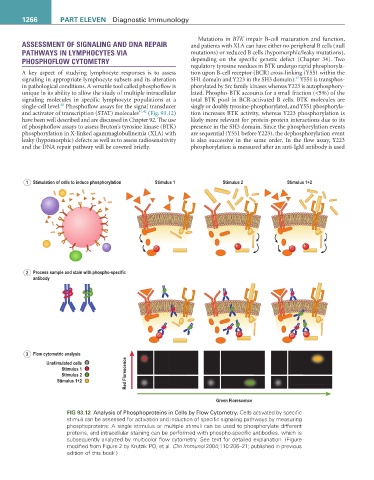
                       FIG 93.12  Analysis of Phosphoproteins in Cells by Flow Cytometry. Cells activated by specific
                       stimuli can be assessed for activation and induction of specific signaling pathways by measuring
                       phosphoproteins: A single stimulus or multiple stimuli can be used to phosphorylate different
                       proteins, and intracellular staining can be performed with phospho-specific antibodies, which is
                       subsequently analyzed by multicolor flow cytometry. See text for detailed explanation. (Figure
                       modified from Figure 2 by Krutzik PO, et al. Clin Immunol 2004;110:206–21; published in previous
                       edition of this book.)

