


Page 1378 - Hall et al (2015) Principles of Critical Care-McGraw-Hill
P. 1378
CHAPTER 99: Electrolyte Disorders in Critical Care   951


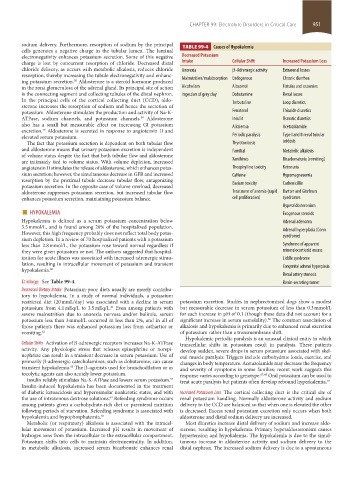
                    sodium delivery. Furthermore, resorption of sodium by the principal     TABLE 99-4    Causes of Hypokalemia
                    cells generates a negative charge in the tubular lumen. The luminal
                    electronegativity enhances potassium secretion. Some of this negative   Decreased Potassium
                    charge is lost by concurrent resorption of chloride. Decreased distal   Intake  Cellular Shift  Increased Potassium Loss
                    chloride delivery, as occurs with metabolic alkalosis, reduces chloride   Anorexia  β-Adrenergic activity  Extrarenal losses
                    resorption, thereby increasing the tubule electronegativity and enhanc-  Malnutrition/malabsorption Endogenous  Chronic diarrhea
                    ing potassium secretion.  Aldosterone is a steroid hormone produced
                                     58
                    in the zona glomerulosa of the adrenal gland. Its principal site of action   Alcoholism  Albuterol  Fistulas and ostomies
                    is the connecting segment and collecting tubules of the distal nephron.   Ingestion of grey clay  Dobutamine  Renal losses
                    In  the  principal cells  of  the  cortical  collecting  duct  (CCD),  aldo-  Terbutaline  Loop diuretics
                    sterone increases the resorption of sodium and hence the secretion of
                    potassium. Aldosterone stimulates the production and activity of Na-K-  Fenoterol        Thiazide diuretics
                    ATPase, sodium channels, and potassium channels.  Aldosterone          Insulin           Osmotic diuretics
                                                            59
                    also has a small but measurable effect on increasing GI potassium      Alkalemia         Acetazolamide
                    excretion.  Aldosterone is secreted in response to angiotensin II and
                           49
                    elevated serum potassium.                                              Periodic paralysis  Type I and II renal tubular
                     The fact that potassium secretion is dependent on both tubular flow   Thyrotoxicosis    acidosis
                    and aldosterone means that urinary potassium excretion is independent   Familial         Metabolic alkalosis
                    of volume status despite the fact that both tubular flow and aldosterone
                    are  intimately tied to volume status. With volume depletion,  increased   Xanthines     Bicarbonaturia (vomiting)
                    angiotensin II stimulates the release of aldosterone, which enhances potas-  Theophylline toxicity  Ketonuria
                    sium secretion; however, the simultaneous decrease in GFR and increased   Caffeine       Hypomagnesemia
                    resorption by the proximal tubule decrease tubular flow, antagonizing
                    potassium secretion. In the opposite case of volume overload, decreased   Barium toxicity  Carbenicillin
                    aldosterone suppresses potassium secretion, but increased tubular flow   Treatment of anemia (rapid   Bartter and Gitelman
                    enhances potassium secretion, maintaining potassium balance.           cell proliferation)  syndromes
                        ■  HYPOKALEMIA                                                                       Hyperaldosteronism
                                                                                                             Exogenous steroids
                    Hypokalemia is defined as a serum potassium concentration below                          Adrenal adenoma
                    3.5 mmol/L, and is found among 20% of the hospitalized population.                       Adrenal hyperplasia (Conn
                    However, this high frequency probably does not reflect total body potas-
                    sium depletion. In a review of 70 hospitalized patients with a potassium                 syndrome)
                    less than 2.8 mmol/L, the potassium rose toward normal regardless if                     Syndrome of apparent
                    they were given potassium or not. The authors suggested that hospital-                   mineralocorticoid excess
                    ization for acute illness was associated with increased adrenergic stimu-                Liddle syndrome
                    lation, resulting in intracellular movement of potassium and transient                   Congenital adrenal hyperplasia
                    hypokalemia. 60
                                                                                                             Renal artery stenosis
                    Etiology:  See Table 99-4.                                                               Renin-secreting tumor
                    Decreased Dietary Intake  Potassium-poor diets usually are merely contribu-
                    tory to hypokalemia. In a study of normal individuals, a potassium
                    restricted diet (20 mmL/day) was associated with a decline in serum   potassium excretion. Studies in nephrectomized dogs show a modest
                    potassium from 4.1 mEq/L to 3.5 mEq/L.  Even among patients with   but measurable decrease in serum potassium of less than 0.3 mmol/L
                                                  61
                    severe malnutrition due to anorexia nervosa and/or bulimia, serum   for each increase in pH of 0.1 (though these data did not account for a
                                                                                                        66
                    potassium less than 3 mmol/L occurred in less than 2%, and in all of   significant increase in serum osmolality).  The common association of
                    those patients there was enhanced potassium loss from cathartics or   alkalosis and hypokalemia is primarily due to enhanced renal excretion
                    vomiting. 62                                          of potassium rather than a transmembrane shift.
                                                                           Hypokalemic periodic paralysis is an unusual clinical entity in which
                    Cellular Shifts  Activation of β-adrenergic receptors increases Na-K-ATPase   transcellular shifts in potassium result in paralysis. These patients
                    activity. Any physiologic stress that releases epinephrine or norepi-  develop sudden, severe drops in serum potassium associated with skel-
                    nephrine can result in a transient decrease in serum potassium. Use of   etal muscle paralysis. Triggers include carbohydrate loads, exercise, and
                    primarily β-adrenergic catecholamines, such as dobutamine, can cause   changes in body temperature. Acetazolamide may decrease the frequency
                    transient hypokalemia.  The β-agonists used for bronchodilation or as   and  severity  of  symptoms  in  some  families;  recent  work  suggests  this
                                    63
                    tocolytic agents can also acutely lower potassium.    response varies according to genotype. 67,68  Oral potassium can be used to
                     Insulin reliably stimulates Na-K-ATPase and lowers serum potassium.     treat acute paralysis but patients often develop rebound hyperkalemia. 69
                                                                      54
                    Insulin-induced hypokalemia has been documented in the treatment
                    of diabetic ketoacidosis and hyperosmolar nonketotic states, and with   Increased Potassium Loss  The cortical collecting duct is the critical site of
                    the use of intravenous dextrose solutions.  Refeeding syndrome occurs   renal potassium handling. Normally aldosterone activity and sodium
                                                  64
                    among patients given a carbohydrate-rich diet or parenteral nutrition   delivery to the CCD are balanced so that when one is elevated the other
                    following periods of starvation. Refeeding syndrome is associated with   is decreased. Excess renal potassium excretion only occurs when both
                    hypokalemia and hypophosphatemia. 65                  aldosterone and distal sodium delivery are increased.
                     Metabolic (or respiratory) alkalosis is associated with the intracel-  Most diuretics increase distal delivery of sodium and increase aldo-
                    lular movement of potassium. Increased pH results in movement of   sterone, resulting in hypokalemia. Primary hyperaldosteronism causes
                    hydrogen ions from the intracellular to the extracellular compartment.   hypertension and hypokalemia. The hypokalemia is due to the simul-
                    Potassium  shifts  into  cells  to  maintain  electroneutrality.  In  addition,   taneous increase in aldosterone activity and sodium delivery to the
                    in metabolic alkalosis, increased serum bicarbonate enhances renal   distal nephron. The increased sodium delivery is due to a spontaneous


            section08.indd   951                                                                                       1/14/2015   8:28:13 AM

