


Page 1379 - Hall et al (2015) Principles of Critical Care-McGraw-Hill
P. 1379
952     PART 8: Renal and Metabolic Disorders


                 diuresis in response to the hypertension known as aldosterone escape. A   inappropriately wastes potassium. Three studies may be used to differ-
                 full discussion of the causes of increased aldosterone activity is beyond   entiate these states: spot urine potassium concentration, 24-hour urine
                 the scope of this text; however, a list of causes is included in Table 99-4.  potassium, and the transtubular potassium gradient (TTKG).
                   Normally, the primary anion in the tubular fluid is chloride. Various   The spot urine is the simplest test to use. The urine potassium should
                 conditions can result in chloride being replaced by an unresorb-  be less than 20 mmol/L in the face of hypokalemia. If the spot potas-
                 able anion. Anions that are not resorbed prevent sodium from being   sium is greater than 40, renal potassium wasting should be suspected.
                 resorbed and increase sodium and tubular fluid delivery to the distal   Urine potassium of 20 to 40 mmol/L is considered nondiagnostic.
                                                                                                                          81
                 nephron. In addition, unresorbable anions increase tubule electronega-  There are two primary problems with this test; the first is it fails to
                 tivity, which enhances potassium secretion by the principal cells. The   control for changes in the water content of urine. Since hypokalemia
                 most common example of an unresorbable anion resulting in hypokale-  is associated with decreased ADH sensitivity, increased water content
                 mia is bicarbonate. In metabolic alkalosis, increased serum bicarbonate   will lower the urinary potassium concentration. The second problem
                 is delivered to the distal nephron, resulting in increased renal potassium   is that spot samples provide information for only a single moment
                 loss. Diabetic ketoacidosis increases delivery of the unresorbable anion   in time. Patients with diuretic-induced hypokalemia become potas-
                 β-hydroxybutyrate to the distal nephron.              sium avid after the diuretic has cleared. One study on the diagnosis
                   Hypomagnesemia is associated with hypokalemia that is resistant to   of hypokalemia (mean K = 2.0 mmol/L) found spot urine potassium
                 therapy. Decreased magnesium increases renal potassium losses and   to have a sensitivity of 40% and specificity of 100% for excess renal
                 needs to be corrected prior to successful treatment of hypokalemia. 70  potassium loss. 82
                   Despite  a  high  concentration  of  potassium  in  lower  GI  secretions,   The 24-hour urine potassium test avoids both of the above prob-
                 85 to 95 mmol/L, GI potassium losses are typically modest, about   lems at the expense of increased complexity and a 24-hour delay.
                 10 mEq/d.  Chronic diarrhea can cause hypokalemia, but the mecha-  Patients with hypokalemia should reduce urinary potassium losses
                         51
                 nism appears to be more complex than simple GI loss of potassium. In   to less than 15 mEq/d. Potassium losses greater than that indicate
                 cases of experimental diarrhea, daily GI potassium loss was never higher   inappropriate renal losses. The 24-hour urine provides no informa-
                 than 24 mEq/d, a level well below average daily potassium intake.  In   tion on the renal potassium handling prior to the urine collection
                                                                  71
                 addition, studies on diarrhea show that as stool volume increases, stool   (eg, diuretic use that is stopped prior to collection will show an
                 potassium concentration falls, ultimately reaching a level similar to that   appropriately potassium-avid kidney).
                 of plasma in cases of severe cholera.  Explanations for the commonly   The transtubular potassium gradient calculates the ratio of tubular
                                            49
                 seen association of diarrhea and hypokalemia include secondary hyper-  potassium to venous potassium at the end of the CCD. The CCD is
                 aldosteronism, diminished intake of potassium, or transcellular shifts of   responsible for potassium excretion, so increases in the TTKG indicate
                 extracellular potassium.                              renal wasting of potassium, while decreases indicate renal potassium
                   Gastric secretions have potassium content similar to that of plasma, 5   conservation (Fig. 99-10 and Eq. 99-5). When serum and renal potas-
                 to 8 mmol/L. Gastric losses result in severe metabolic alkalosis and sec-  sium handling are normal, the TTKG runs from 5 to 8. 81,83  In the face
                 ondary hyperaldosteronism, both of which enhance renal potassium loss.  of hypokalemia, the CCD should minimize  the potassium excretion,
                                                                       resulting in a reduced TTKG. The TTKG has been validated in patients
                 Clinical Sequelae:  Hypokalemia is a well-known risk factor for a variety   with decreased dietary potassium, periodic paralysis, diuretic-induced
                 of cardiac arrhythmias. Increased ectopy with hypokalemia has been   hypokalemia, primary hyperaldosteronism, and vomiting. 83,84
                 documented in ambulatory hypertensive patients, in patients under-
                 going coronary artery bypass grafting, and during acute myocardial                  UrineOsm
                 infarction (AMI). 72,73  Following AMI, hypokalemia increases the risk    UrineK ÷
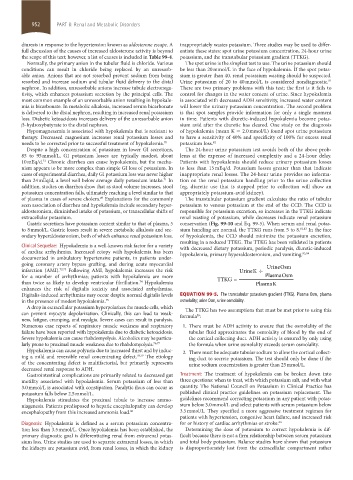
                 for a number of arrhythmias; patients with hypokalemia are more    TTKG=           PlasmaOsm
                 than twice as likely to develop ventricular fibrillation.  Hypokalemia          PlasmaK
                                                         74
                 enhances the risk of digitalis toxicity and associated arrhythmias.
                 Digitalis-induced arrhythmias may occur despite normal digitalis levels   Equation 99-5.  The transtubular potassium gradient (TTKG). Plasma Osm, plasma
                 in the presence of modest hypokalemia. 75             osmolality; urine Osm, urine osmolality.
                   A drop in extracellular potassium hyperpolarizes the muscle cells, which   The TTKG has two assumptions that must be met prior to using this
                 can prevent myocyte depolarization. Clinically, this can lead to weak-  formula :
                                                                             85
                 ness, fatigue, cramping, and myalgia. Severe cases can result in paralysis.
                 Numerous case reports of respiratory muscle weakness and respiratory     1.  There must be ADH activity to ensure that the osmolality of the
                 failure have been reported with hypokalemia due to diabetic ketoacidosis.   tubular fluid approximates the osmolality of blood by the end of
                 Severe hypokalemia can cause rhabdomyolysis. Alcoholics may be particu-  the cortical collecting duct. ADH activity is ensured by only using
                 larly prone to proximal muscle weakness due to rhabdomyolysis. 76,77  the formula when urine osmolality exceeds serum osmolality.
                   Hypokalemia can cause polyuria due to increased thirst and by induc-    2.  There must be adequate tubular sodium to allow the cortical collect-
                 ing  a mild and  reversible  renal  concentrating  defect. 78,79   The etiology   ing duct to secrete potassium. The test should only be done if the
                 of the concentrating defect is multifactorial, but primarily represents   urine sodium concentration is greater than 25 mmol/L.
                 decreased renal response to ADH.
                   Gastrointestinal complications are primarily related to decreased gut   Treatment:  The treatment of hypokalemia can be broken down into
                 motility associated with hypokalemia. Serum potassium of less than   three questions: when to treat, with which potassium salt, and with what
                 3.0 mmol/L is associated with constipation. Paralytic ileus can occur as   quantity. The National Council on Potassium in Clinical Practice has
                 potassium falls below 2.5 mmol/L.                     published clinical practice guidelines on potassium replacement. The
                   Hypokalemia stimulates the proximal tubule to increase ammo-  guidelines recommend correcting potassium in any patient with potas-
                 niagenesis. Patients predisposed to hepatic encephalopathy can develop   sium below 3.0 mmol/L and select patients with serum potassium below
                 encephalopathy from this increased ammonia load. 80   3.5 mmol/L. They specified a more aggressive treatment regimen for
                                                                       patients with hypertension, congestive heart failure, and increased risk
                 Diagnosis:  Hypokalemia  is  defined  as  a  serum  potassium  concentra-  for or history of cardiac arrhythmias or stroke. 86
                 tion less than 3.5 mmol/L. Once hypokalemia has been established, the   Determining the dose of potassium to correct hypokalemia is dif-
                 primary diagnostic goal is differentiating renal from extrarenal potas-  ficult because there is not a firm relationship between serum potassium
                 sium loss. Urine studies are used to separate extrarenal losses, in which   and total body potassium. Balance studies have shown that potassium
                 the kidneys are potassium avid, from renal losses, in which the kidney   is  disproportionately  lost  from  the  extracellular  compartment  rather


            section08.indd   952                                                                                       1/19/2015   11:35:07 PM

