


Page 1393 - Hall et al (2015) Principles of Critical Care-McGraw-Hill
P. 1393
966     PART 8: Renal and Metabolic Disorders


                 nearly zero in the presence of hypermagnesemia or reduced GFR (ie, all     TABLE 99-16    Etiologies of Hyper- and Hypomagnesemia (Continued)
                 of the filtered magnesium is excreted). In response to magnesium deple-
                 tion or decreased intake, the fractional resorption of Mg  can rise to   Hypomagnesemia
                                                           2+
                 99.5% in order to minimize urinary losses.               Increased tubular flow
                     ■  HYPOMAGNESEMIA                                     Osmotic diuresis

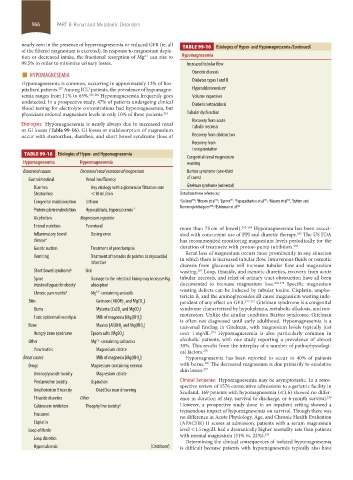
                 Hypomagnesemia is common, occurring in approximately 12% of hos-      Diabetes types I and II
                 pitalized patients.  Among ICU patients, the prevalence of hypomagne-     Hyperaldosteronism e
                              257
                 semia ranges from 11% to 65%. 258-260  Hypomagnesemia frequently goes      Volume expansion
                 undetected. In a prospective study, 47% of patients undergoing clinical      Diabetic ketoacidosis
                 blood testing for electrolyte concentrations had hypomagnesemia, but
                 physicians ordered magnesium levels in only 10% of these patients. 261    Tubular dysfunction
                                                                             Recovery from acute
                 Etiologies:  Hypomagnesemia is nearly always due to increased renal
                 or GI losses (Table 99-16). GI losses or malabsorption of magnesium   tubular necrosis
                 occur with steatorrhea, diarrhea, and short bowel syndrome (loss of       Recovery from obstruction
                                                                           Recovery from
                                                                             transplantation
                   TABLE 99-16    Etiologies of Hyper- and Hypomagnesemia
                                                                           Congenital renal magnesium
                  Hypomagnesemia     Hypermagnesemia                      wasting
                  Extrarenal causes  Decreased renal excretion of magnesium     Bartter syndrome (one-third
                    Gastrointestinal    Renal insufficiency               of cases)
                     Diarrhea             Any etiology with a glomerular filtration rate     Gitelman syndrome (universal)
                     Steatorrhea         <10 mL/min                    Data from these references:
                                                                                   264 c
                                                                           340 b
                                                                                        341 d
                                                                                                            267 f
                                                                                                    342 e
                     Congenital malabsorption   Lithium                a Galland ;  Hessov et al ;  Lipner ;  Papazachariou et al ;  Massry et al ; Sutton and
                                                                                 268 g
                                                                       Domrongkitchaiporn ;  Eshleman et al 343
                      Protein calorie malnutrition   Hypocalciuria, hypercalcemia  f
                     Alcoholism      Magnesium ingestion
                     Enteral nutrition    Parenteral                   more than 75 cm of bowel). 262-264  Hypomagnesemia has been associ-
                     Inflammatory bowel      Dosing error              ated with concurrent use of PPI and diuretic therapy.  The US FDA
                                                                                                               265
                     disease a                                         has recommended monitoring magnesium levels periodically for the
                     Gastric suction      Treatment of preeclampsia    duration of treatment with proton-pump inhibitors. 266
                                                                         Renal loss of magnesium occurs most prominently in any situation
                     Vomiting             Treatment of torsades de pointes or myocardial   in which there is increased tubular flow. Intravenous fluids or osmotic
                                         infarction
                                                                       diuresis from glucosuria will increase tubular flow and magnesium
                      Short bowel syndrome b    Oral                   wasting.  Loop, thiazide, and osmotic diuretics, recovery from acute
                                                                             267
                     Sprue                Damage to the intestinal lining may increase Mg   tubular necrosis, and relief of urinary tract obstruction have all been
                      Intestinal bypass for obesity c  absorption      documented to increase magnesium loss. 268-270  Specific magnesium
                                                                       wasting defects can be induced by tubular toxins. Cisplatin, ampho-
                                           2+
                     Chronic pancreatitis d     Mg -containing antacids
                                                                       tericin B, and the aminoglycosides all cause magnesium wasting inde-
                    Skin                 Gaviscon [Al(OH)  and MgCO ]  pendent of any effect on GFR. 271-273  Gitelman syndrome is a congenital
                                                    3     3
                     Burns               Mylanta (CaCO  and MgCO )     syndrome characterized by hypokalemia, metabolic alkalosis, and nor-
                                                   3     3             motension. Unlike the similar condition Bartter syndrome, Gitelman
                      Toxic epidermal necrolysis       Milk of magnesia [Mg(OH) ]
                                                         2             is often not diagnosed until early adulthood. Hypomagnesemia is a
                    Bone                 Maalox [Al(OH)  and Mg(OH) ]  universal finding in Gitelman, with magnesium levels typically just
                                                   3       2
                                                                                  274
                      Hungry bone syndrome      Epsom salts (MgSO )    over  1 mg/dL.  Hypomagnesemia is also particularly common in
                                                   4
                                           2+
                    Other               Mg -containing cathartics      alcoholic patients, with one study reporting a prevalence of almost
                                                                       30%. This results from the interplay of a number of pathophysiologi-
                     Pancreatitis        Magnesium citrate             cal factors. 275
                  Renal causes             Milk of magnesia [Mg(OH) ]    Hypomagnesemia has been reported to occur in 40% of patients
                                                         2
                                                                                276
                    Drugs               Magnesium-containing enemas    with burns.  The decreased magnesium is due primarily to exudative
                                                                       skin losses. 277
                     Aminoglycoside toxicity      Magnesium citrate
                     Pentamidine toxicity     Aspiration               Clinical Sequelae:  Hypomagnesemia may be asymptomatic. In a retro-
                                                                       spective review of 1576 consecutive admissions to a geriatric facility in
                      Amphotericin B toxicity        Dead Sea near drowning  Scotland, 169 patients with hypomagnesemia (≤1.6) showed no differ-
                                                                                                                         278
                     Thiazide diuretics  Other                         ence in duration of stay, survival to discharge, or 6-month survival.
                     Calcineurin inhibitors    Theophylline toxicity g  However,  a  prospective  study  done  in  an  inpatient  setting  showed  a
                                                                       tremendous impact of hypomagnesemia on survival. Though there was
                     Foscarnet
                                                                       no difference in Acute Physiology, Age, and Chronic Health Evaluation
                     Cisplatin                                         (APACHE) II scores at admission, patients with a serum magnesium
                    Loop of Henle                                      level <1.5 mg/dL had a dramatically higher mortality rate than patients
                                                                       with normal magnesium (31% vs. 22%). 279
                     Loop diuretics
                                                                         Determining the clinical consequences of isolated hypomagnesemia
                     Hypercalcemia                           (Continued)  is difficult because patients with hypomagnesemia typically also have
            section08.indd   966                                                                                       1/14/2015   8:28:23 AM

