


Page 1390 - Hall et al (2015) Principles of Critical Care-McGraw-Hill
P. 1390
CHAPTER 99: Electrolyte Disorders in Critical Care   963


                    indicator of total body phosphorus. Isolated hypophosphatemia without   Etiologies:  There are three principal mechanisms by which hypophos-
                    intracellular depletion is of little consequence and is usually a transient   phatemia can arise: transcellular redistribution, decreased intestinal
                    phenomenon.  Severe  symptoms  from hypophosphatemia  are due  to   absorption, and increased urinary excretion.
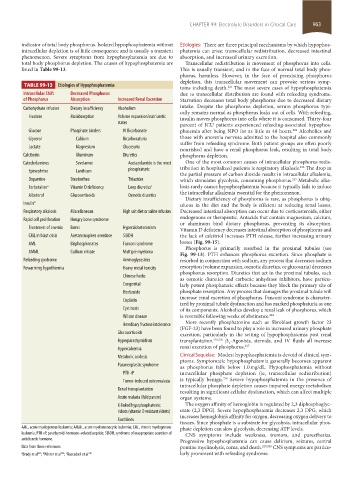
                    total body phosphorus depletion. The causes of hypophosphatemia are   Transcellular redistribution is movement of phosphorus into cells.
                    listed in Table 99-13.                                This is usually transient, and in the face of normal total body phos-
                                                                          phorus, harmless. However, in the face of preexisting phosphorus
                                                                          depletion, this transcellular movement can provoke serious symp-
                      TABLE 99-13    Etiologies of Hypophosphatemia
                                                                          toms including death.  The most severe cases of hypophosphatemia
                                                                                          221
                    Intracellular Shift    Decreased Phosphorus           due  to  transcellular  distribution  are  found  with  refeeding  syndrome.
                    of Phosphorus   Absorption      Increased Renal Excretion  Starvation decreases total body phosphorus due to decreased dietary
                    Carbohydrate infusion  Dietary insufficiency  Alcoholism  intake.  Despite  the  phosphorus  depletion,  serum  phosphorus  typi-
                                                                          cally remains normal as phosphorus leaks out of cells. With refeeding,
                      Fructose      Malabsorption   Volume expansion/natriuretic   insulin moves phosphorus into cells where it is consumed. Thirty-four
                                                    states                percent of ICU patients experienced refeeding-associated hypophos-
                                                                                                                222
                      Glucose       Phosphate binders    IV Bicarbonate   phatemia after being NPO for as little as 48 hours.  Alcoholics and
                      Glycerol        Calcium         Bicarbonaturia      those with anorexia nervosa admitted to the hospital also commonly
                                                                          suffer from refeeding syndrome. Both patient groups are often poorly
                      Lactate         Magnesium       Glucosuria
                                                                          nourished and have a renal phosphorus leak, resulting in total body
                    Calcitonin        Aluminum        Diuretics           phosphorus depletion.
                    Catecholamines    Sevelamer          Acetazolamide is the most   One of the most common causes of intracellular phosphorus redis-
                                                                                                                  216
                      Epinephrine     Lanthium          phosphaturic      tribution in hospitalized patients is respiratory alkalosis.  The drop in
                                                                          the partial pressure of carbon dioxide results in intracellular alkalemia,
                      Dopamine      Steatorrhea        Thiazides          which stimulates glycolysis, consuming phosphorus.  Metabolic alka-
                                                                                                                223
                      Terbutaline a  Vitamin D deficiency     Loop diuretics c  losis rarely causes hypophosphatemia because it typically fails to induce
                                                                          the intracellular alkalemia essential for the phenomenon.
                      Albuterol     Glucocorticoids     Osmotic diuretics
                                                                           Dietary insufficiency of phosphorus is rare, as phosphorus is ubiq-
                    Insulin b                                             uitous in the diet and the body is efficient at reducing renal losses.
                    Respiratory alkalosis  Miscellaneous     High salt diet or saline infusion  Decreased intestinal absorption can occur due to corticosteroids, either
                    Rapid cell proliferation  Hungry bone syndrome        endogenous or therapeutic. Antacids that contain magnesium, calcium,
                                                                          or aluminum bind dietary phosphorus, preventing its absorption.
                      Treatment of anemia  Burns      Hyperaldosteronism  Vitamin D deficiency decreases intestinal absorption of phosphorus and
                      CML in blast crisis  Acetaminophen overdose    SIADH  the lack of calcitriol increases PTH release, further increasing urinary
                      AML           Bisphosphonates    Fanconi syndrome   losses (Fig. 99-15).
                                                                           Phosphorus is primarily resorbed in the proximal tubules (see
                      AMML          Gallium nitrate    Multiple myeloma   Fig.  99-13). PTH enhances phosphorus excretion. Since phosphate is
                    Refeeding syndrome                Aminoglycosides     resorbed in conjunction with sodium, any process that decreases sodium
                    Rewarming hypothermia             Heavy metal toxicity  resorption (volume expansion, osmotic diuretics, or glucosuria) decreases
                                                                          phosphorus resorption. Diuretics that act in the proximal tubules, such
                                                      Chinese herbs
                                                                          as  osmotic  diuretics  and  carbonic  anhydrase  inhibitors,  have  particu-
                                                      Congenital          larly potent phosphaturic effects because they block the primary site of
                                                      Ifosfamide          phosphate resorption. Any process that damages the proximal tubule will
                                                                          increase renal excretion of phosphorus. Fanconi syndrome is character-
                                                      Cisplatin
                                                                          ized by proximal tubule dysfunction and has marked phosphaturia as one
                                                      Cystinosis          of its components. Alcoholics develop a renal leak of phosphorus, which
                                                      Wilson disease      is reversible following weeks of abstinence. 224
                                                                           More  recently  phosphatonins  such  as  fibroblast  growth  factor  23
                                                       Hereditary fructose  intolerance
                                                                          (FGF-23) have been found to play a role in increased urinary phosphate
                                                    Glucocorticoids       excretion,  particularly  in  the  setting  of  hypophosphatemia  post  renal
                                                    Hyperparathyroidism   transplantation. 225,226   β -Agonists, steroids, and IV fluids all increase
                                                                                          2
                                                    Hypercalcemia         renal excretion of phosphorus. 227
                                                                          Clinical Sequelae:  Modest hypophosphatemia is devoid of clinical sym-
                                                    Metabolic acidosis    ptoms. Symptomatic hypophosphatemia generally becomes apparent
                                                    Paraneoplastic syndrome  as phosphorus falls below 1.0 mg/dL. Hypophosphatemia without
                                                      PTH-rP              intracellular phosphate depletion (ie, transcellular redistribution)
                                                                                        228
                                                       Tumor-induced  osteomalacia  is typically benign.  Severe hypophosphatemia in the presence of
                                                                          intracellular phosphate depletion causes impaired energy metabolism
                                                    Renal transplantation  resulting in significant cellular dysfunction, which can affect multiple
                                                    Acute malaria (falciparum)  organ systems.
                                                    X-linked hypophosphatemic   The oxygen affinity of hemoglobin is regulated by 2,3 diphosphoglyc-
                                                      rickets (vitamin D resistant rickets)  erate (2,3 DPG). Severe hypophosphatemia decreases 2,3 DPG, which
                                                    Xanthines             increases hemoglobin’s affinity for oxygen, decreasing oxygen delivery to
                                                                          tissues. Since phosphate is a substrate for glycolysis, intracellular phos-
                    AML, acute myelogenous leukemia; AMML, acute myelomonocytic leukemia; CML, chronic myelogenous   phate depletion can slow glycolysis, decreasing ATP levels.
                    leukemia; PTH-rP, parathyroid-hormone–related peptide; SIADH, syndrome of inappropriate secretion of   CNS symptoms include weakness, tremors, and paresthesias.
                    antidiuretic hormone.                                 Progressive hypophosphatemia can cause delirium, seizures, central
                    Data from these references:                           pontine myelinolysis, coma, and death. 229,230  CNS symptoms are particu-
                                 243 c
                         227 b
                    a Brady et al ;  Winter et al ;  Fiaccadori et al 218  larly prominent with refeeding syndrome.


            section08.indd   963                                                                                       1/14/2015   8:28:20 AM

