


Page 1391 - Hall et al (2015) Principles of Critical Care-McGraw-Hill
P. 1391
964 PART 8: Renal and Metabolic Disorders
Ca reabsorption Serum
–
Ca – Ca
PO 4 Calcitriol PTH
PO 4 PO 4
PO 4 reabsorption
1-
hydroxylase
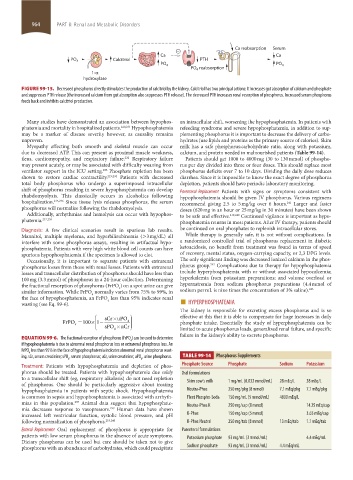
FIGURE 99-15. Decreased phosphorus directly stimulates the production of calcitriol by the kidney. Calcitriol has two principal actions: It increases gut absorption of calcium and phosphate
and suppresses PTH release (the increased calcium from gut absorption also suppresses PTH release). The decreased PTH increases renal resorption of phosphorus. Increased serum phosphorus
feeds back and inhibits calcitriol production.
Many studies have demonstrated an association between hypophos- an intracellular shift, worsening the hypophosphatemia. In patients with
phatemia and mortality in hospitalized patients. 220,231 Hypophosphatemia refeeding syndrome and severe hypophosphatemia, in addition to sup-
may be a marker of disease severity however, as causality remains plementing phosphorus it is important to decrease the delivery of carbo-
unproven. hydrates (use lipids and proteins as the primary source of calories). Skim
Myopathy affecting both smooth and skeletal muscle can occur milk has a safe phosphorus:carbohydrate ratio, along with potassium,
due to decreased ATP. This can present as proximal muscle weakness, calcium, and protein needed in malnourished patients (Table 99-14).
232
ileus, cardiomyopathy, and respiratory failure. Respiratory failure Patients should get 1000 to 4000 mg (30 to 130 mmol) of phospho-
may present acutely, or may be associated with difficulty weaning from rus per day divided into three or four doses. This should replace most
ventilator support in the ICU setting. Phosphate repletion has been phosphorus deficits over 7 to 10 days. Dividing the daily dose reduces
233
shown to restore cardiac contractility. 219,234 Patients with decreased diarrhea. Since it is impossible to know the exact degree of phosphorus
total body phosphorus who undergo a superimposed intracellular depletion, patients should have periodic laboratory monitoring.
shift of phosphorus resulting in severe hypophosphatemia can develop Parenteral Replacement Patients with signs or symptoms consistent with
rhabdomyolysis. This classically occurs in alcoholics following hypophosphatemia should be given IV phosphorus. Various regimens
hospitalization. 235,236 Since tissue lysis releases phosphorus, the serum recommend giving 2.5 to 5 mg/kg over 6 hours. Larger and faster
241
phosphorus will normalize following the rhabdomyolysis. doses (620 mg in an hour or 25 mg/kg in 30 minutes) have been shown
Additionally, arrhythmias and hemolysis can occur with hypophos- to be safe and effective. 219,240 Continued vigilance is important as hypo-
phatemia. 237,238 phosphatemia returns in most patients. After IV therapy, patients should
Diagnosis: A few clinical scenarios result in spurious lab results. be continued on oral phosphates to replenish intracellular stores.
Mannitol, multiple myeloma, and hyperbilirubinemia (>3 mg/dL) all While therapy is generally safe, it is not without complications. In
interfere with some phosphorus assays, resulting in artifactual hypo- a randomized controlled trial of phosphorus replacement in diabetic
phosphatemia. Patients with very high white blood cell counts can have ketoacidosis, no benefit from treatment was found in terms of speed
spurious hypophosphatemia if the specimen is allowed to clot. of recovery, mental status, oxygen-carrying capacity, or 2,3 DPG levels.
Occasionally, it is important to separate patients with extrarenal The only significant finding was decreased ionized calcium in the phos-
242
phosphorus losses from those with renal losses. Patients with extrarenal phorus group. Complications due to therapy for hypophosphatemia
losses and transcellular distribution of phosphorus should have less than include hyperphosphatemia with or without associated hypocalcemia;
100 mg (3.3 mmol) of phosphorus in a 24-hour collection. Determining hyperkalemia from potassium preparations; and volume overload or
the fractional resorption of phosphorus (FrPO ) on a spot urine can give hypernatremia from sodium phosphorus preparations (4.4 mmol of
4
similar information. While FrPO normally varies from 75% to 99%, in sodium per mL is nine times the concentration of 3% saline). 243
4
the face of hypophosphatemia, an FrPO less than 95% indicates renal ■
4
wasting (see Eq. 99-6). HYPERPHOSPHATEMIA
The kidney is responsible for excreting excess phosphorus and is so
sCruPO effective at this that it is able to compensate for huge increases in daily
×
FrPO =100 × − sPO × uCr phosphate intake. Essentially the study of hyperphosphatemia can be
1
4
4
limited to acute phosphorus loads, generalized renal failure, and specific
4
failure in the kidney’s ability to excrete phosphorus.
EqUATIon 99-6. The fractional resorption of phosphorus (FrPO ) can be used to determine
4
if hypophosphatemia is due to abnormal renal phosphorus loss or extrarenal phosphorus loss. An
FrPO less than 95% in the face of hypophosphatemia indicates abnormal renal phosphorus wast-
4
ing. sCr, serum creatinine; sPO , serum phosphorus; uCr, urine creatinine; uPO , urine phosphorus. TABLE 99-14 Phosphorus Supplements
4 4
Treatment: Patients with hypophosphatemia and depletion of phos- Phosphate Source Phosphate Sodium Potassium
phorus should be treated. Patients with hypophosphatemia due solely Oral formulations
to a transcellular shift (eg, respiratory alkalosis) do not need repletion
of phosphorus. One should be particularly aggressive about treating Skim cow’s milk 1 mg/mL (0.032 mmol/mL) 28 mEq/L 38 mEq/L
hypophosphatemia in patients with septic shock. Hypophosphatemia Neutra-Phos 250 mg/pkg (8 mmol) 7.1 mEq/pkg 7.1 mEq/pkg
is common in sepsis and hypophosphatemia is associated with arrhyth- Fleet Phospho-Soda 150 mg/mL (5 mmol/mL) 4800 mEq/L
mias in this population. Animal data suggest that hypophosphate- Neutra-Phos K 250 mg/cap (8 mmol) 14.25 mEq/cap
237
mia decreases response to vasopressors. Human data have shown
239
increased left ventricular function, systolic blood pressure, and pH K-Phos 150 mg/cap (5 mmol) 3.65 mEq/cap
following normalization of phosphorus. 219,240 K-Phos Neutral 250 mg/tab (8 mmol) 13 mEq/tab 1.1 mEq/tab
Enteral Replacement Oral replacement of phosphorus is appropriate for Parenteral formulations
patients with low serum phosphorus in the absence of acute symptoms. Potassium phosphate 93 mg/mL (3 mmol/mL) 4.4 mEq/mL
Dietary phosphorus can be used but care should be taken not to give
phosphorus with an abundance of carbohydrates, which could precipitate Sodium phosphate 93 mg/mL (3 mmol/mL) 4.4 mEq/mL
section08.indd 964 1/14/2015 8:28:22 AM

