


Page 1392 - Hall et al (2015) Principles of Critical Care-McGraw-Hill
P. 1392
CHAPTER 99: Electrolyte Disorders in Critical Care   965


                                                                                        246
                    Etiologies                                            cardiac arrhythmias.  The risk of calcification increases as the calcium-
                                                                                                                            2
                                                                                                                         2
                    Increased Intake of Phosphorus  The  ability  to  maintain phosphorus balance   phosphorus product (calcium times phosphorus) rises above 70 mg /dL .
                    in the face of massive phosphorus loads (4000 mg/d) depends on the   In patients with end-stage renal disease, empiric data have shown
                    phosphorus load being spread over time. Sudden loads can overwhelm   decreased mortality in patients with a calcium-phosphorus product less
                    renal phosphate clearance, resulting in hyperphosphatemia. Phosphorus   than 52. In the same study, isolated hyperphosphatemia also predicted
                    loads can be exogenous or endogenous (Table 99-15). Exogenous intake   increased mortality. 247
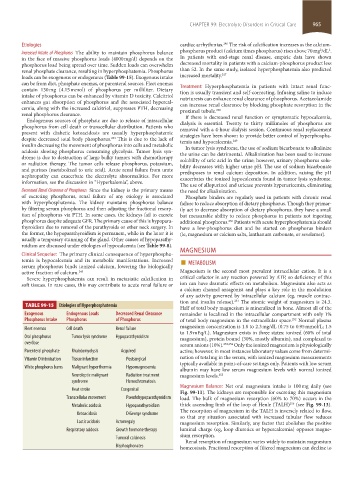
                    can be from diet, phosphate enemas, or parenteral sources. Fleet enemas   Treatment:  Hyperphosphatemia in patients with intact renal func-
                    contain 130 mg (4.15 mmol) of phosphorus per milliliter. Dietary   tion is usually transient and self-correcting. Infusing saline to induce
                    intake of phosphorus can be enhanced by vitamin D toxicity. Calcitriol   natriuresis can enhance renal clearance of phosphorus. Acetazolamide
                    enhances gut absorption of phosphorus and the associated hypercal-  can increase renal clearance by blocking phosphate resorption in the
                    cemia, along with the increased calcitriol, suppresses PTH, decreasing   proximal tubule. 248
                    renal phosphorus clearance.                            If there is decreased renal function or symptomatic hypocalcemia,
                     Endogenous sources of phosphate are due to release of intracellular   dialysis is essential. Twenty to thirty millimoles of phosphorus are
                    phosphorus from cell death or transcellular distribution. Patients who   removed with a 4-hour dialysis session. Continuous renal replacement
                    present  with  diabetic  ketoacidosis  are  usually  hyperphosphatemic   strategies have been shown to provide better control of hyperphospha-
                    despite decreased total body phosphorus.  This is due to the lack of   temia and hypocalcemia. 249
                                                  244
                    insulin decreasing the movement of phosphorus into cells and metabolic   In tumor lysis syndrome, the use of sodium bicarbonate to alkalinize
                    acidosis slowing phosphorus consuming glycolysis. Tumor lysis syn-  the urine can be detrimental. Alkalinization has been used to increase
                    drome is due to destruction of large bulky tumors with chemotherapy   solubility of uric acid in the urine; however, urinary phosphorus solu-
                    or radiation therapy. The tumor cells release phosphorus, potassium,   bility decreases with higher urine pH. The use of sodium bicarbonate
                    and purines (metabolized to uric acid). Acute renal failure from urate   predisposes to renal calcium deposition. In addition, raising the pH
                    nephropathy can exacerbate the electrolyte abnormalities. For more   exacerbates the ionized hypocalcemia found in tumor lysis syndrome.
                    information, see the discussion in “Hyperkalemia”, above.  The use of allopurinol and uricase prevents hyperuricemia, eliminating
                    Decreased Renal Clearance of Phosphorus  Since the kidney is  the primary means   the need for alkalinization.
                    of excreting phosphorus, renal failure of any etiology is associated   Phosphate binders are regularly used in patients with chronic renal
                    with hyperphosphatemia. The kidney maintains phosphorus balance   failure to reduce absorption of dietary phosphorus. Though they primar-
                    by filtering serum phosphorus and then adjusting the fractional resorp-  ily act to decrease absorption of dietary phosphorus, they have a small
                    tion of phosphorus via PTH. In some cases, the kidneys fail to excrete     but  measurable  ability  to  reduce  phosphorus  in  patients  not  ingesting
                    phosphorus despite adequate GFR. The primary cause of this is hypopara-  additional phosphorus.  Patients with acute hyperphosphatemia should
                                                                                          250
                    thyroidism due to removal of the parathyroids or other neck surgery. In   have a low-phosphorus diet and be started on phosphorus binders
                    the former, the hypoparathyroidism is permanent, while in the latter it is   (ie, magnesium or calcium salts, lanthanum carbonate, or sevelamer).
                    usually a temporary stunning of the gland. Other causes of hypoparathy-
                    roidism are discussed under etiologies of hypocalcemia (see Table 99-8).
                    Clinical Sequelae:  The primary clinical consequence of hyperphospha-  MAGNESIUM
                    temia is hypocalcemia and its metabolic manifestations. Increased     ■  METABOLISM
                    serum phosphorus binds ionized calcium, lowering the biologically
                    active fraction of calcium. 245                       Magnesium is the second most prevalent intracellular cation. It is a
                     Severe  hyperphosphatemia  can  result  in  metastatic  calcification  in   critical cofactor in any reaction powered by ATP, so deficiency of this
                    soft tissues. In rare cases, this may contribute to acute renal failure or   ion can have dramatic effects on metabolism. Magnesium also acts as
                                                                          a calcium channel antagonist and plays a key role in the modulation
                                                                          of any activity governed by intracellular calcium (eg, muscle contrac-
                                                                          tion and insulin release).  The atomic weight of magnesium is 24.3.
                                                                                            251
                      TABLE 99-15    Etiologies of Hyperphosphatemia
                                                                          Half of total body magnesium is mineralized in bone. Almost all of the
                     Exogenous     Endogenous Loads   Decreased Renal Clearance    remainder is localized in the intracellular compartment with only 1%
                     Phosphorus Intake  Phosphorus  of Phosphorus         of total body magnesium in the extracellular space.  Normal plasma
                                                                                                                252
                                                                          magnesium concentration is 1.8 to 2.3 mg/dL (0.75 to 0.95 mmol/L; 1.5
                     Fleet enemas  Cell death       Renal failure
                                                                          to 1.9 mEq/L). Magnesium exists in three states: ionized (60% of total
                     Oral phosphorus     Tumor lysis syndrome  Hypoparathyroidism  magnesium), protein bound (30%, mostly albumin), and complexed to
                     overdose                                             serum anions (10%). 253,254  Only the ionized magnesium is physiologically
                     Parenteral phosphate    Rhabdomyolysis    Acquired   active; however, in most instances laboratory values come from determi-
                     Vitamin D intoxication    Tissue infarction     Postsurgical  nation of total mg in the serum, with ionized magnesium measurements
                                                                          typically available in point-of-care settings only. Patients with low serum
                     White phosphorus burns   Malignant hyperthermia    Hypomagnesemia
                                                                          albumin may have low serum magnesium levels with normal ionized
                                      Neuroleptic malignant      Radiation treatment  magnesium levels. 255
                                     syndrome          Hemochromatosis
                                                                          Magnesium Balance:  Net oral magnesium intake is 100 mg daily (see
                                     Heat stroke      Congenital
                                                                          Fig. 99-11). The kidneys are responsible for excreting this magnesium
                                   Transcellular movement     Pseudohypoparathyroidism  load. The bulk of magnesium resorption (60% to 70%) occurs in the
                                                                                                               256
                                     Metabolic acidosis     Hypoparathyroidism  thick ascending limb of the loop of Henle (TALH)  (see Fig. 99-13).
                                                                          The resorption of magnesium in the TALH is inversely related to flow,
                                      Ketoacidosis     DiGeorge syndrome
                                                                          so that any situation associated with increased tubular flow reduces
                                      Lactic acidosis  Acromegaly         magnesium resorption. Similarly, any factor that abolishes the positive
                                   Respiratory acidosis  Growth hormone therapy  luminal charge (eg, loop diuretics or hypercalcemia) opposes magne-
                                                                          sium resorption.
                                                    Tumoral calcinosis
                                                                           Renal resorption of magnesium varies widely to maintain magnesium
                                                    Bisphosphonates       homeostasis. Fractional resorption of filtered magnesium can decline to


            section08.indd   965                                                                                       1/14/2015   8:28:23 AM

